


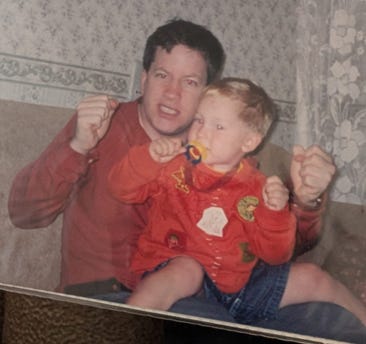
I first met my future son in late 2003. I won’t call him my stepson. I have never liked the word. Stepson seems to arrive carrying centuries of rather dreadful public relations.
Grimm’s fairy tales did it no favours: wicked stepmothers, unwanted children, families divided into the authentic and the inferior. Even now the word can suggest a relationship one degree removed from the real thing. Not quite your child. Not quite his father. I don’t believe that.
Perhaps I feel particularly strongly because I was adopted. I am my father’s son. I am my mother’s son. There is no asterisk after either sentence. The absence of a blood connection did not make them partial parents or me some lesser category of child. They were my parents because they raised me. They worried about me. They disciplined me. They loved me.
Blood is one way families begin. It is not the only way they become families. And so it was with Vanya.
When I came into his life, his biological father was already absent from it. Since I came on the scene, Vanya has had no relationship with him. Once he left Russia, there was no contact at all. No visits. No phone calls. No second father somewhere sharing the work or occupying some parallel place in his life. And make no mistake, I was happy for this.
There was me. I adopted him when he was very young. I raised him. I worried about him. I took him to school and hockey and rugby. I celebrated him. I fought with him. I lost sleep over him. I loved him.
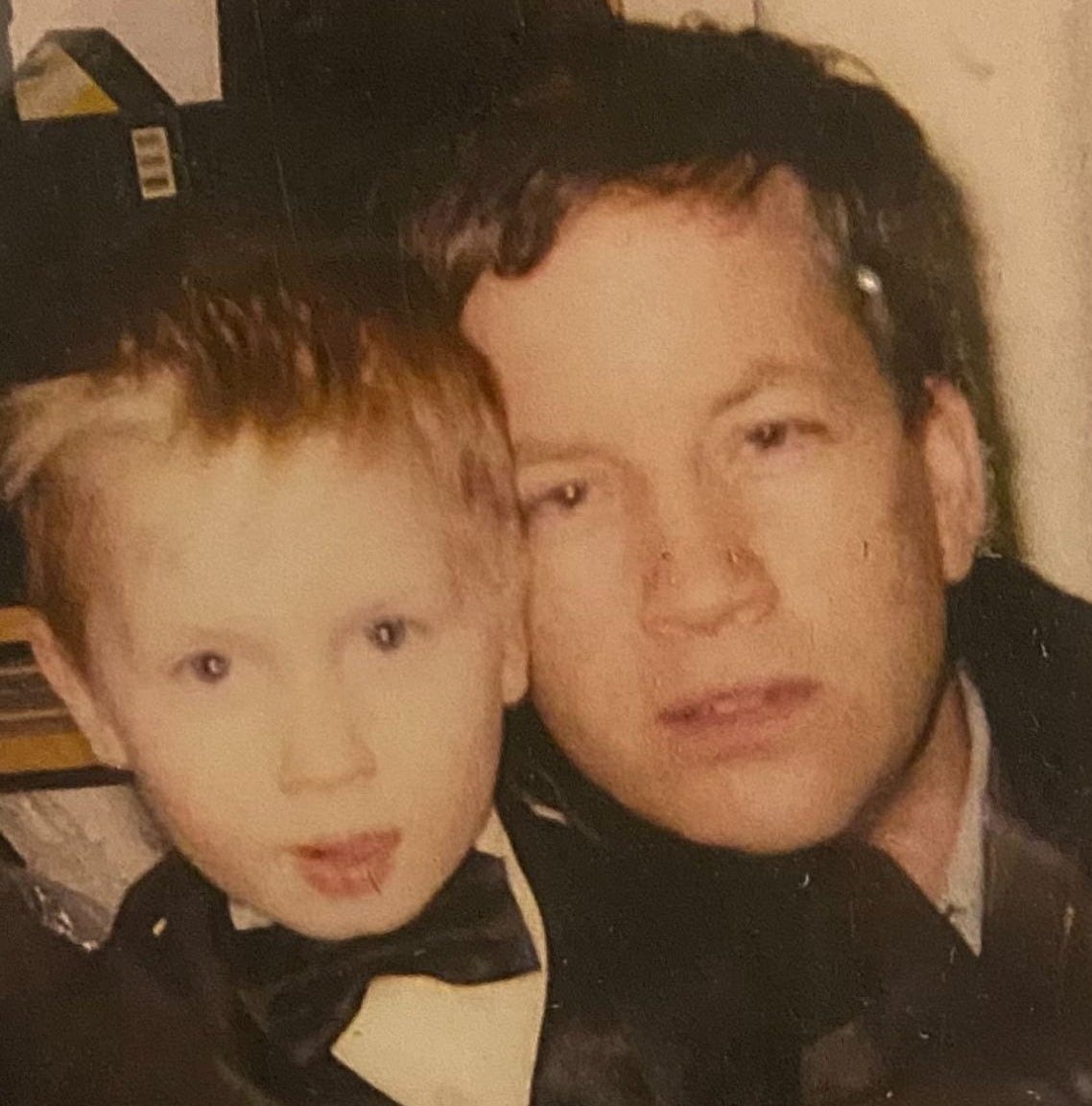
He is not my stepson.
He is my son.
And I first met my future son in the city of Veliky Novgorod in late 2003. I was courting his mother and had travelled to this ancient Russian city north of St. Petersburg, a place of churches, stone, snow and history far older than anything I had grown up around in Canada.
Vanya’s mum and I walked toward one of those long Soviet-era apartment blocks, designed less by an architect than by a committee charged with proving that personal charm was bourgeois. Four floors, if I remember correctly. No elevator. The entrance was protected by one of those solid Soviet metal doors, as if designed with suspicion toward outsiders. There was a mechanical combination lock. Every entrance seemed identical to every other.
Inside was the apartment where Vanya lived with his mother and grandmother, Rionalda, who would later become my mother-in-law and move to join us in Canada. The apartment had a peculiar layout to me but was perfectly natural to everyone who lived there. There was the kitchen, separate from the living room, and then the bedrooms followed one another in sequence, almost like railway compartments arranged along a rectangle, one room giving way to another rather than opening independently onto some generous North American hallway.
Hot water came through the kolonka, the gas water heater mounted in the apartment, a piece of machinery I regarded with the respectful suspicion Canadians reserve for household appliances involving open flame.
And there, inside this entirely ordinary Russian apartment, Rionalda had dressed up her grandson to meet me. Vanya was on the cusp of three. He was small, serious, curious and completely incapable of speaking English to me.
I spoke almost no Russian. It didn’t matter very much.
His mother and grandmother had to work, so during my visits Vanya and I spent enormous amounts of time together during the days. We played on the floor with toys I had brought for him from Canada. We communicated by pointing, demonstrating, laughing, and occasionally looking at one another with the mutual resignation of two people who understood perfectly well that the other was speaking nonsense.
Then we went walking. The Russian winter was bitter. Vanya would be bundled up, and I would take him through the parks and streets of Novgorod, right next to the river Volkov and the ancient kremlin that ran by the park.
Every so often, an elderly babushka would stop us. She would inspect Vanya. Then she would inspect me. Somehow she knew. Perhaps foreigners walked differently. Perhaps Canadians carried small Russian children with insufficient winter vigilance. Whatever betrayed me, these women seemed instantly to grasp that the child was Russian and the adult accompanying him was not. Without ceremony, one would reach over and tighten Vanya’s scarf. Perhaps pull his hat down farther. Then send us on our way. It was never hostile. It was grandmotherly concern exercised across international borders.
Later, when his mother and grandmother were with us, I would carry Vanya around Novgorod on my shoulders. And somewhere during those visits something happened that I had not really planned. While falling in love with his mother, I fell in love with Vanya too. I wanted to be a father. More particularly, I wanted to be Vanya’s father.
His mother and I married in 2005. Vanya attended the wedding dressed in an outfit that deserves permanent preservation in a museum of international childhood diplomacy. He wore a proper white shirt. A small black bow tie. A black jacket. And then, below the waist, Manchester United shorts and soccer socks that I had brought him from Canada. The top half announced a solemn matrimonial occasion. The bottom half announced Saturday afternoon at Old Trafford. He looked magnificent.
Then life began accelerating. We moved to Canada. We lived for a time in Fort McMurray, AB, where I was teaching at the college. Vanya started school. On his first day, I somehow managed to leave without giving him a proper goodbye. I had already begun walking away when his teacher came running down the sidewalk after me. Vanya was crying. He wanted his father to come back. Not because something terrible had happened. He simply wanted the goodbye done properly. So I went back. And did it properly.
Years fell off. Eventually we moved to Ontario. Vanya did well at school. In Grade 9, he won a mathematics and science award. I remember the pride of that moment because there was nothing ambiguous about it. He was doing well. He was capable. Teachers saw it. We saw it. He was not some great prodigy being groomed for MIT. He was simply a bright kid doing well. And I was enormously proud of him.
He played soccer and rugby. He played hockey too, although hockey had not originally fascinated him. He was an ordinary house-league player, much as I had been. No scouts appeared. No NHL franchise was ever endangered by his decision to pursue academics. But I remember one game particularly well. I sat in one of those Canadian arenas whose principal architectural objective seems to be ensuring that parents suffer alongside their children. I was freezing. Vanya played. And that night he was named man of the match.
It was a small thing. Almost nothing, against the backdrop of a whole life. But parenthood is made largely from these almost-nothings. A school award. A good hockey game. A teacher running after you because your son needs another goodbye. A little boy in a bow tie and Manchester United shorts. For a while, life felt wonderfully ordinary.
Then circumstances shifted. Because of regulations governing his mother’s medical practice at the time, she couldn't initially establish her practice in Toronto, so we were forced to move outside the large urban areas and ended up in Peterborough.
Five years later, when we could move back toward Toronto, Vanya had to leave behind the friends he had made there. Adults often underestimate what moving means to children. For us it means houses. For them it can mean a vanished civilization. His Peterborough friends were now far away. The friendships faded. New ones did not replace them easily. Vanya had never been the social butterfly his younger sister would become. He withdrew. And increasingly, he withdrew into gaming.
