



There was once a boy named Mendacio, born not so much in a hospital as in a footnote—under a thundercloud of paperwork and the stench of institutional perfume. His birthplace was a marble tower suspended somewhere between Geneva and irrelevance, where human rights are defined mainly by who gets the nicer lunch.
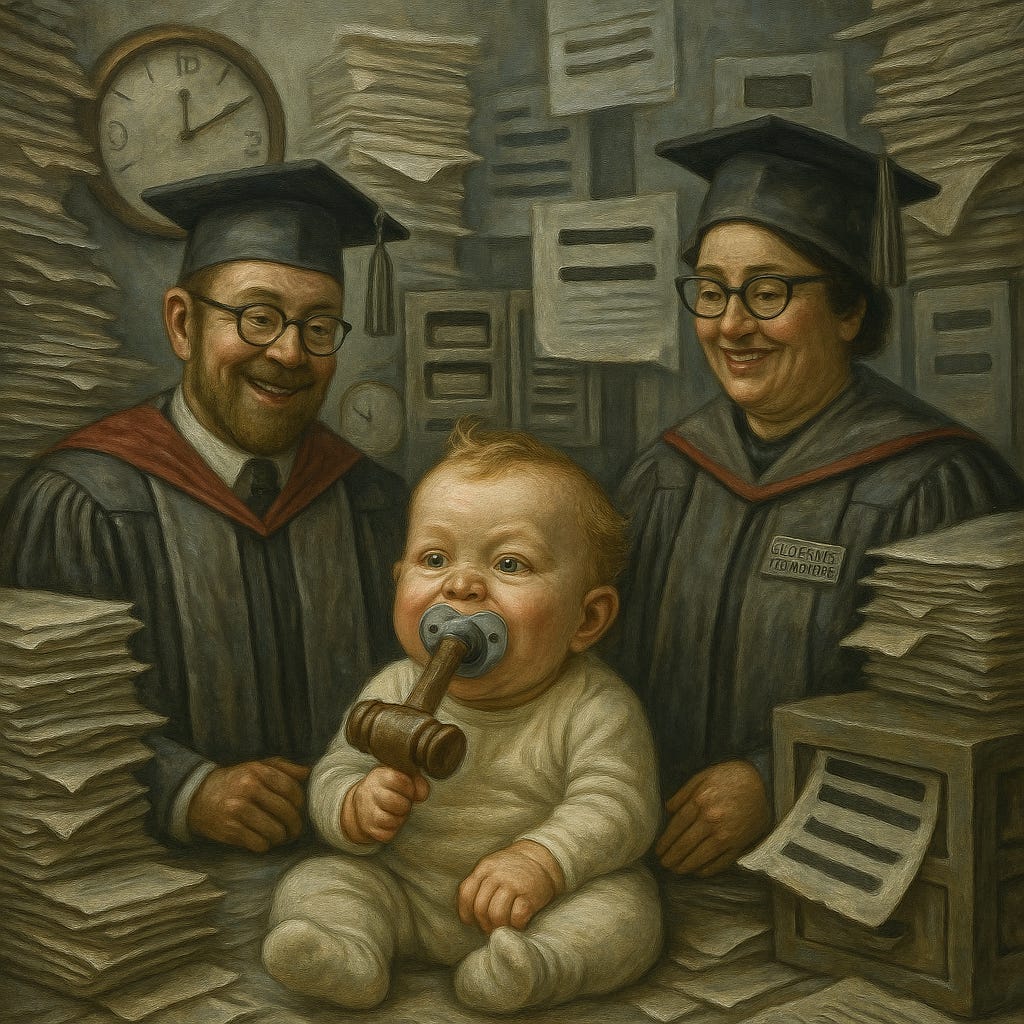
His birth certificate, filed in triplicate, was redacted into haiku by a junior bureaucrat and then promptly lost in the same cabinet as accountability. His parents, both self-proclaimed legal scholars with diplomas obtained from diploma mills, gave him a pacifier shaped like a gavel.
He gnawed through it in two days and used it to assault the family dog—his first documented abuse of process.
Promising,” his father muttered.
Young Mendacio showed early signs of brilliance—not in truth, but in its performance. He could recite an entire HR policy backwards while juggling empty manila folders and humming the Magna Carta. At age nine, he created a peer-review tribunal that expelled all his classmates for “non-compliance with best practices of shared governance.”
At twelve, he filed his first amicus curiae brief—against his grandmother, for excessive affection.
He was twice expelled from law school for impersonating a Dean, but he found himself far more suited for a more inventive trade, not law, philosophy, or politics. No, young Mendacio chose the manufacturing of injustice.
And so he built it.
The Factory.
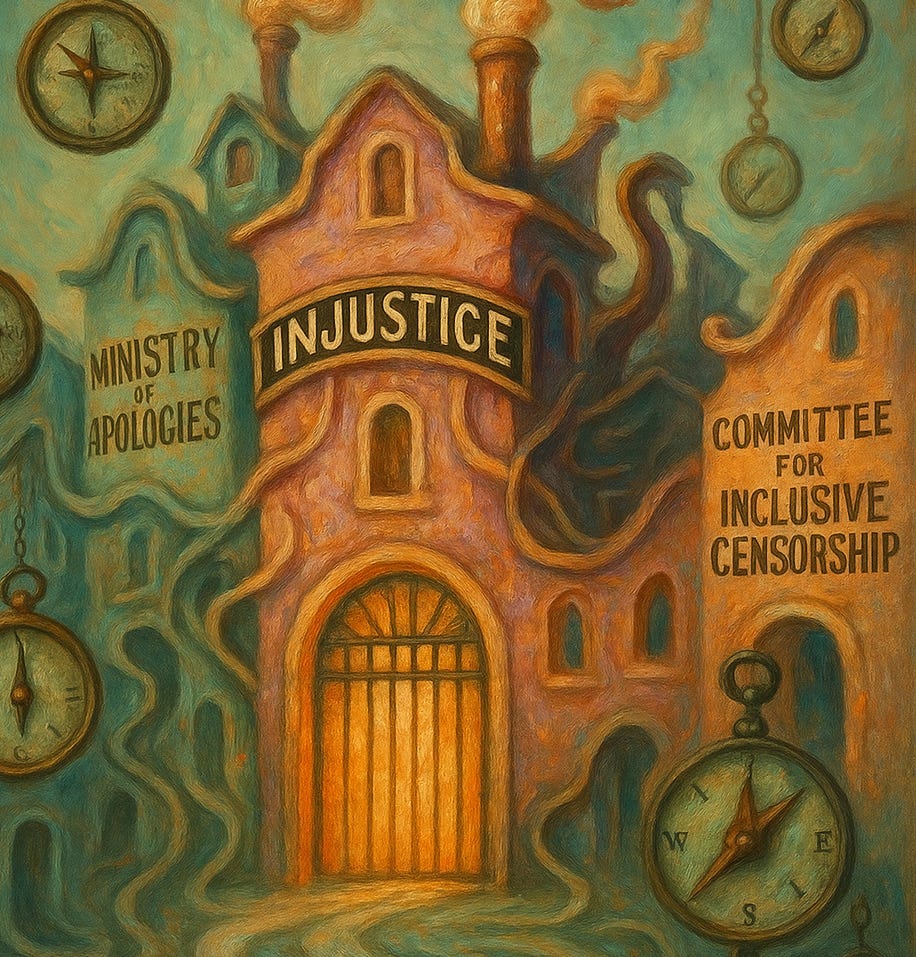
Tucked between the Ministry of Apologies and the Committee Forum for Inclusive Censorship, the Injustice Factory appeared to outsiders as a whimsical bureaucratic playground: pastel walls, rusted moral compasses hung like clocks, and corridors that bent back on themselves like ethics in a committee meeting. But inside—oh inside—it pulsed with malicious efficiency.
Scurilka, his middle name, was a legacy from his mother’s side. It was a legacy of an old Roman trickster who used humour to conceal executions. Mendacio wore it like a lapel pin, always on the left. Scurilka taught him that duplicity wrapped in civility is twice as potent.
When people think they are treated fairly, they are less likely to see that they might be bleeding.
And Arbitrika? That surname was no accident. In every tribunal, every kangaroo court, every external investigation, every HR “conversation,” the final judgment would always fall with arbitrary delight. A flourish of “due process” and a well-timed sigh, and boom—the innocent condemned, the guilty promoted.
“Not because it’s true,” he’d say with a wink, “but because it’s properly formatted.”
Mendacio Scurilka Arbitrika didn’t just preside over injustice.
He franchised it.
From university tribunals to diversity councils, ethics boards to anonymous complaint portals, Mendacio’s fingerprints are on every rulebook nobody reads. His proudest invention? The Redundancy Loop™: where complaints are investigated by the perpetrators, appeals reviewed by the original author, and justice filed under “Other.”
He trains his Oompa-Loophole minions to sing when firing people, always in passive voice:
“You have not violated what we say you have /
Though there’s no exact offender, it’s enough that someone bled.”
And he doesn’t punish through cruelty—he does it through silence. His genius lies in the machine that runs itself: rules that no one checks, accusations no one names, a process where the attempt to seek truth is proof of guilt.
His office has no door, just a QR code that crashes when scanned.
And when questioned?
He smiles and says:
“This is justice, my dear. You simply don’t understand how it’s meant to feel.”
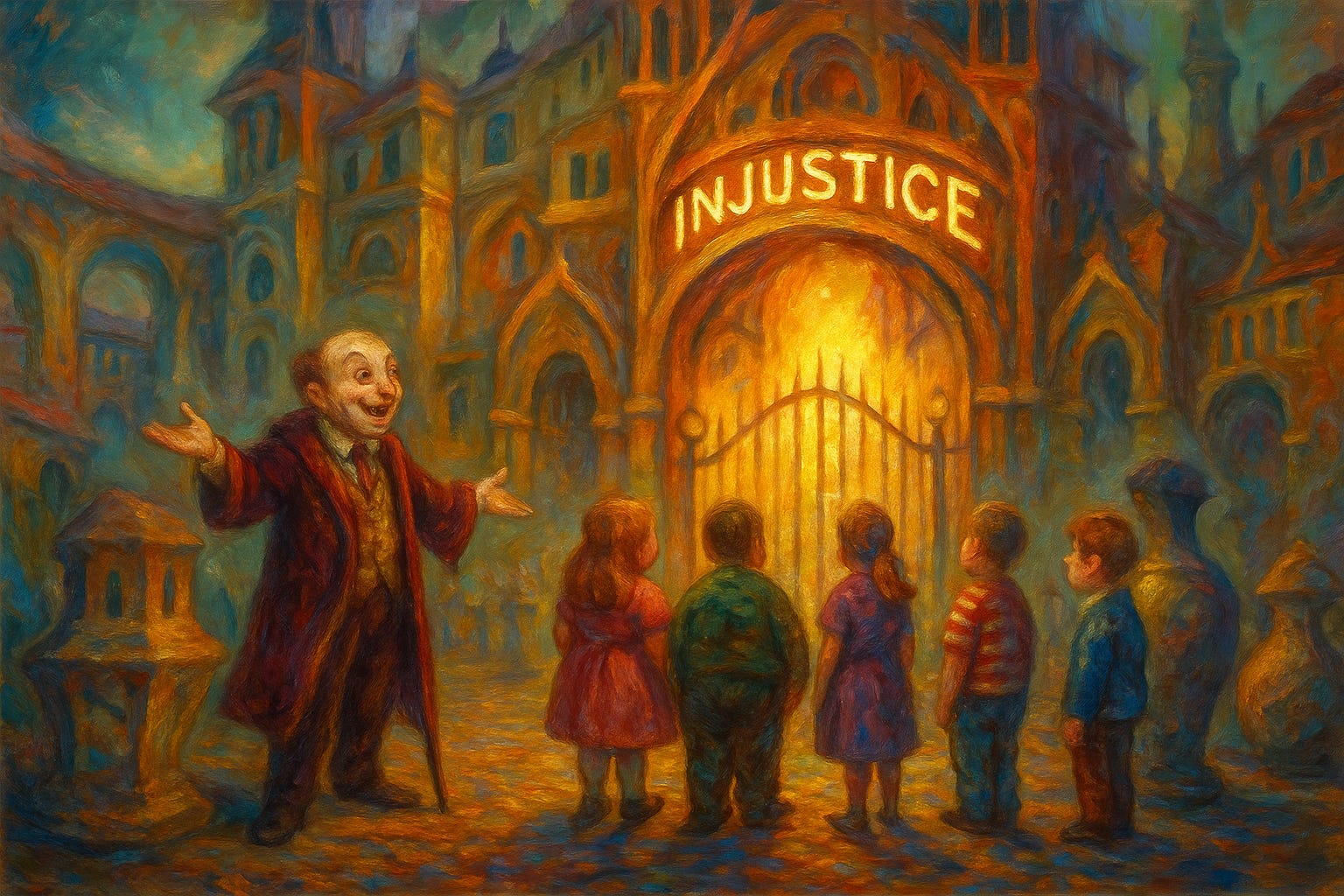
The Factory Tour
The gates creaked open—not to chocolate dreams — but to a factory where justice dies with a smile. Mr. Mendacio Scurilka Arbitrika himself, in his velvet robe and bureaucratic cane, extended a bony hand to the lucky few granted a tour of his magnificent Injustice Factory.
“Welcome, my dear litigants and liabilities,” he purred. “Here at Injustice Industries, we manufacture something far sweeter than toffee: plausible deniability.”
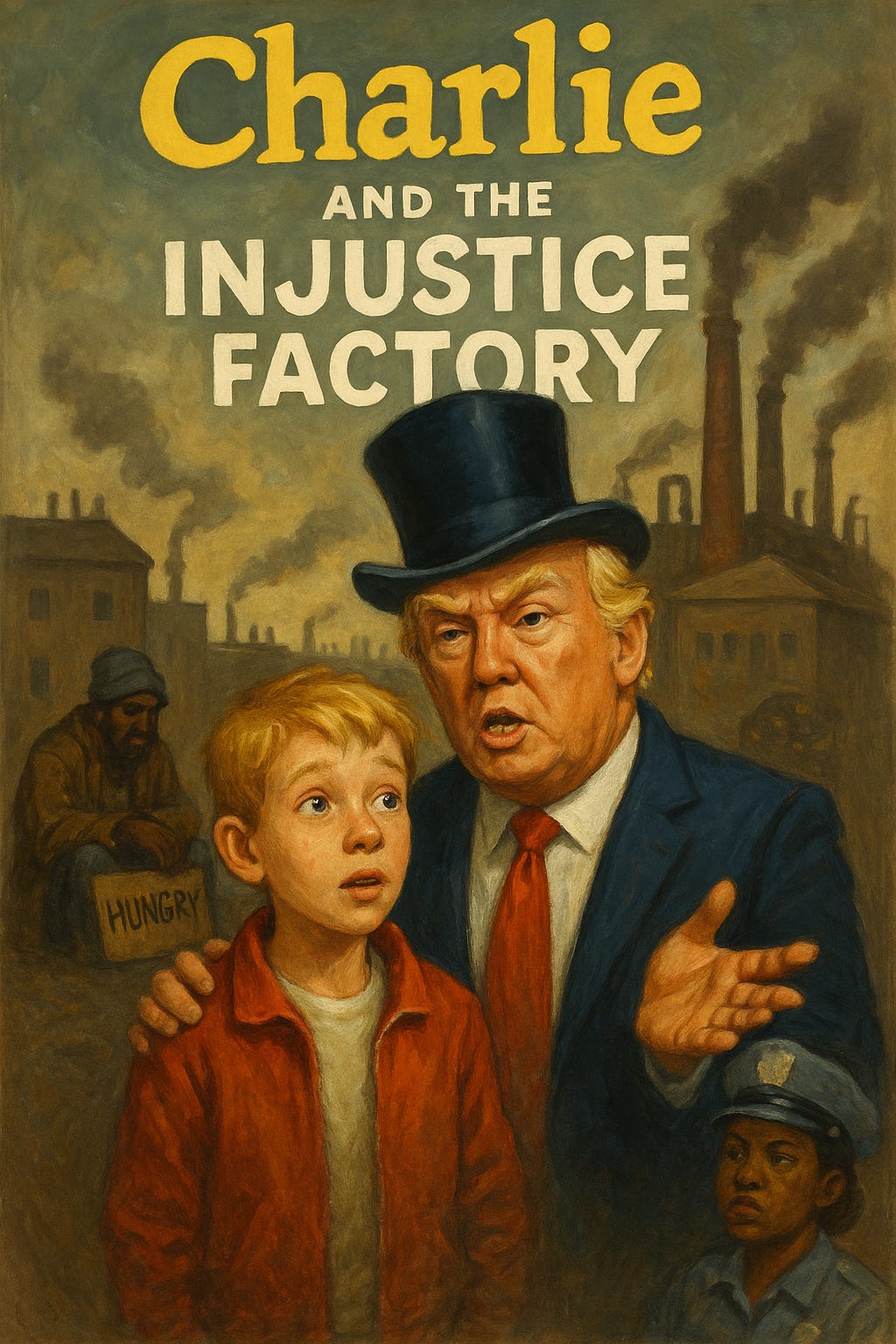
Trailing him were five blithely anesthetized guests: Veruca Vendetta, shrieking entitlement in every syllable; Augustus Accuser, stuffed with grievance and self-importance; Violet Procedureguard, puffed up with rules she couldn’t spell; Mike Microaggressions, whose every twitch longed to be offended; and poor, bewildered Charlie Dueprocess—wide-eyed as a calf at the abattoir. Each had been issued a golden subpoena, though none could recall requesting one.
But that’s bureaucracy for you: involuntary voluntarism is its finest party trick.
The velvet corridor curled and twisted like an HR manual on mescaline—decorative, impenetrable, and written in a dialect only the morally constipated can decipher. Fluorescent lights sputtered overhead like ethical clarity in a grievance committee. Doors loomed with splendid titles: “Due Process Intake Unit,” “Natural Justice Simulacrum,” “Hearsay Amplifier,” “Unsubstantiated Allegation Printer”—each more self-parodic than the last, the whole façade a grotesque Disneyland of due process cosplay.
Mendacio Scurilka Arbitrika clicked his heels with synthetic glee. “Shall we?” he purred, like a cat introducing itself to a canary. “You’ll find, my precious litigants and liabilities, that injustice—real, structural, unfalsifiable-is rarely committed in rage. Rage is gauche. No, our injustice is administrative. Sanitised. We call it policy.”
He spun on his heels, baton slicing through the air.
“Everyone thinks this is the Justice Factory. But nobody reads the footnotes. Our product isn’t malevolence—it’s efficiency. We don’t persecute. We proceed.”
He twirled toward a display of leather chairs and digital grievance portals.
“Our investigators are marvels of modern amnesia: no names, no times, no evidence—just judgments wrapped in jargon. The trick isn’t proof, my darlings. It’s posture.”
A puff of steam hissed from a pipe labelled “Neutrality Optics.”
“And the pièce de résistance? The Redundancy Loop. An appeal heard by the same hand that passed judgment. Justice eats its tail while nodding solemnly.”
He paused and whispered:
“You see, the accused is guilty when they enter. And guilty when they leave. But the beauty is—they might thank us for it.”
The Defamation Department
A Whimsical Tasting Room of Reputational Rot
The hallway narrowed, the air curdled, and the wallpaper grew sticky with implication. “Ah!” cried Mendacio Scurilka Arbitrika, twirling his cane as the velvet curtains parted. “Here we are! The Defamation Department—our flavour lab of character erosion. Smells like scandal, doesn’t it?”
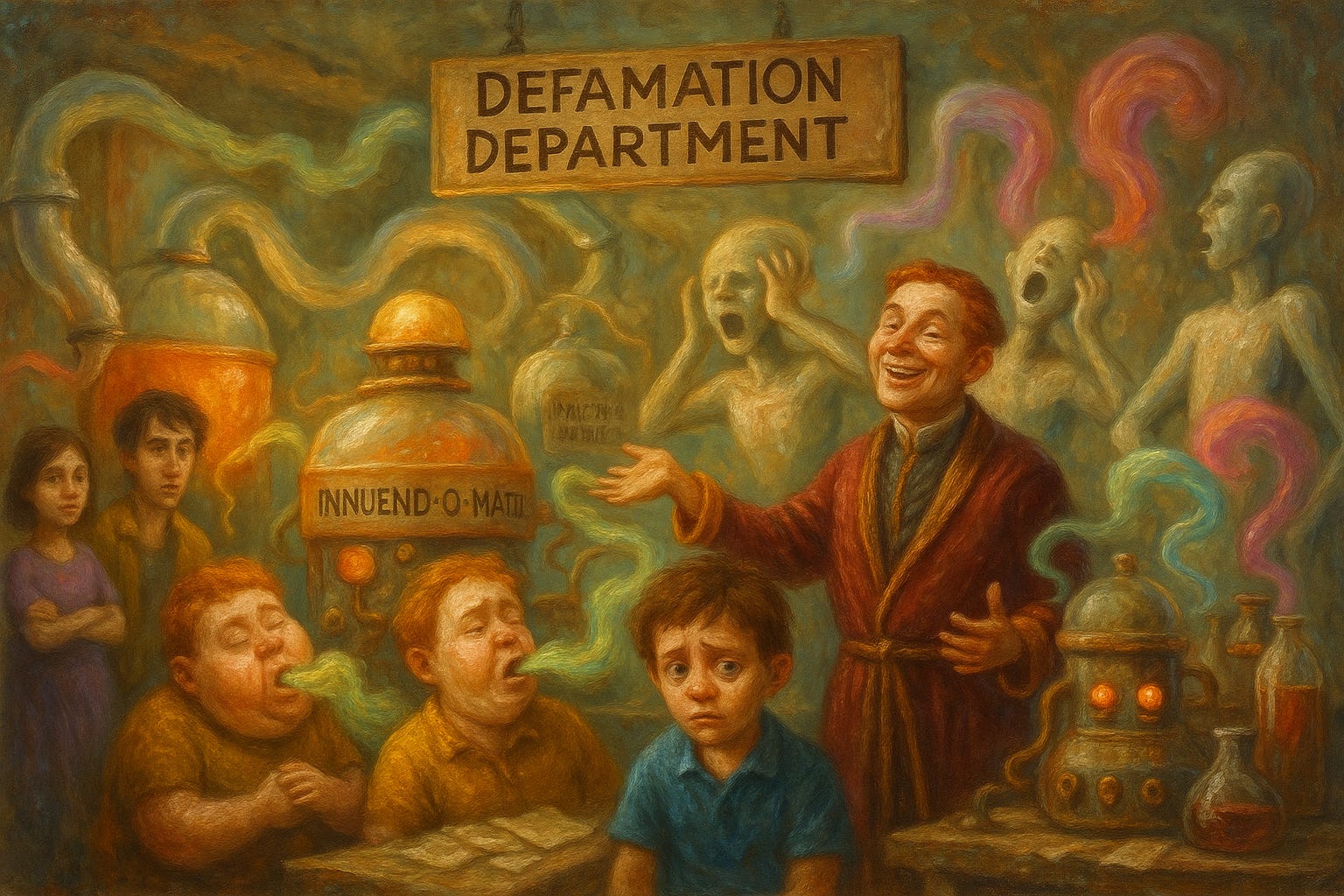
A sweet, rotten scent hung in the air like overripe fruit. Inside the room were thousands of transparent tubes, each humming gently as they pumped tiny rumours—likes, DMs, text threads, snide emojis—into the gaseous atmosphere. It was warm. It was viral.
“This room,” whispered Mendacio, “is our most potent innovation. Here we ferment whispers into facts.”
The guests blinked. Veruca Vendetta wrinkled her nose. Charlie Due Process covered his mouth with Due Process. Already quite full of himself, Augustus Accuser inhaled deeply and sighed, “I smell vindication.”
Mendacio chuckled. “You will, my boy. You will.”
He led them past a contraption labelled the Innuend-O-Matic 6000, where anonymous notes were boiled down into suggestive phrasing.
“He always made me uncomfortable.”
“I don’t know, something about him…”
“I heard he was seen near a complainant.”
Each droplet, amber and sticky, was squirted onto the tongues of passing faculty and staff-shaped mannequins, who instantly flushed with certainty.
“You see,” said Mendacio, eyes twinkling with malevolence, “the truth is burdensome. It requires evidence. But defamation? Oh-ho!
Defamation is intoxicating. It’s fast food for the morally lazy.”
He tapped a display jar filled with glistening pink blobs. “This, my darlings, is ‘Like-Lichen’—a social fungus that attaches to statements and, through the miracle of repetition, becomes belief. Just one ‘like’ on the right post and the whole department starts speaking in passive-aggressive absolutes.”
Charlie reached out.
“Don’t touch that,” Mendacio snapped. “It’ll take over your frontal lobe.”
He gestured grandly toward the centrepiece: The Truth-Divorce Chamber, where facts were severed from context and discarded.
“Smears are like fungal spores,” Mendacio explained. “Once inhaled, they embed in the mind, rewriting loyalty. The infected no longer remember where they heard the rumour—only that they felt it was true.”
A mannequin wearing a university lanyard began to convulse, its head twitching, eyes glazing over. It stood upright and muttered:
“I don’t remember what he did, but it was bad. Definitely bad.”
The guests recoiled.
Mendacio clapped with joy. “Isn’t it marvellous? Once contaminated, the subject—be it faculty, friend, or neutral bystander—becomes a soldier in the Borg of Lies, forever compelled to repeat the smear, to nod solemnly at innuendo, to defend the accusation’s ‘emotional validity’ long after its origin has faded.”
Mike Microaggressions glanced nervously at Charlie. “Is this where all the ‘I-heard-he-did-something-but-I’m-not-sure-what’ comments come from?”
“I love that name,” Mendacio interjected, interrupting the boys.
“Oh yes,” said Mendacio, licking a stamp that read REPUTATION EXPUNGED. “You see, child, reputation once lost—like virginity—cannot be retrieved by appeal. And here we offer not stoning, but elegant decay.”
He leaned close.
“The genius of this room, dear friends, is that defamation doesn’t need a root once it’s airborne. It travels, mutates, evolves—like good bureaucracy or bad poetry. It is a spark that lights a great fire. And the accused? The more he protests, the guiltier he sounds. Defending yourself here is like sneezing in a plague ward—everyone steps back.”
A bell rang. A new rumour was born. The Virality Ventilator machine shuddered and expelled a vapour cloud: “He was seen yelling.” It settled into the lungs of another mannequin, who nodded solemnly and whispered to the next.
Charlie choked. “But it’s not true!”
Mendacio gave a mirthless smile. “What is truth, dear boy? Even Pilate didn’t know! An inconvenient footnote on a committee report. Here we deal in emotional contagion. The accusations are the destination. Truth is only ever the missed train.”
As they left the room, the Oompa-Loopholes could be heard softly chanting through respirators:
“Facts require thinking, but feelings are free,
And justice is heavy—we serve apathy.
One smear is a rumour, but three are a thread—
Now the truth’s irrelevant, and your name is dead.”
The Suspension Chute: Guilt by Extraction
First stop: the Suspension Chute. A conveyor belt snatched Charlie Due Process by his collar and flung him into a glass cylinder labelled "Precautionary Measures – No Evidence Required.
“He hasn’t been charged,” whispered Violet.
“That’s what makes it beautiful,” Mendacio Scurilka Arbitrika beamed. “Guilt implied by absence—silentum infamat.”
He gestured to the sign above: “EXCISION IS CLARITY.” A speaker hissed:
“He has not responded. He has been removed. Therefore, he must be guilty.”
“No one here asks ‘Why?’” Mendacio Scurilka Arbitrika said. “They only ask, ‘When?’”
The Redundancy Room: Appeals Without Substance
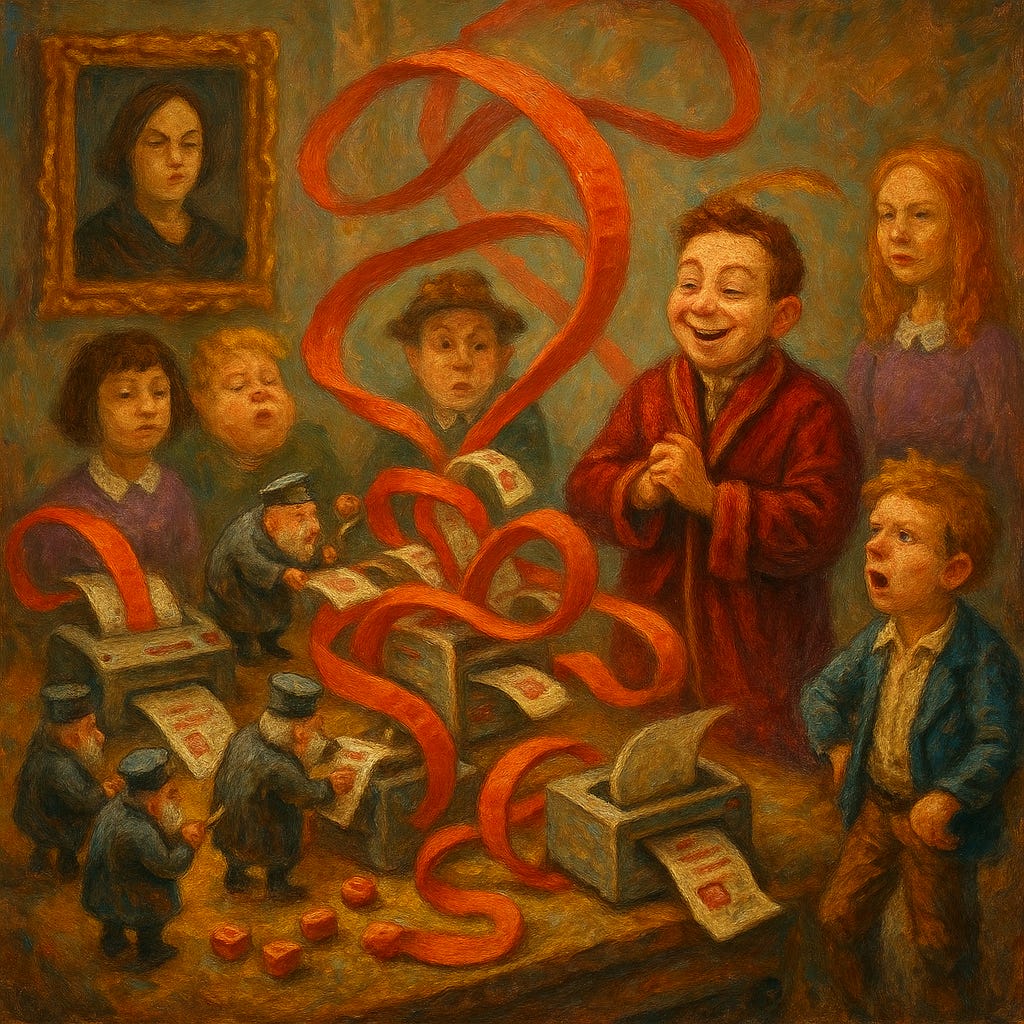
Next, they entered a room alive with dials, buttons, levers, and red tape loops. Oompa-Lawpas manned all—stubby bureaucrats humming Gregorian footnotes while threading forms through obsolete fax machines.
“This is where we handle appeals,” Mendacio Scurilka Arbitrika said with relish. “Each complaint is routed back to its originator. Ingenious, no?”
“But that’s circular,” protested Charlie.
“Exactly!” crowed Mendacio Scurilka Arbitrika. “We tell the world we permit appeals—look at all the mechanisms!—but everything returns to Miss Moralella, our most impartial impartialist.”
He gestured to a portrait of Gita “Moralella” Anand above the central loop machine, steam spurting as each appeal was stamped and reviewed before being shredded.
“She read none, but signed all,” Mendacio Scurilka Arbitrika whispered. “To question the machine is to commit procedural heresy.”
The Hearsay Bubble Room
The next room was filled with translucent bubbles, each one whispering conflicting rumours: “He assaulted a student… No, he made someone cry… I heard he supports libraries, the fascist.”
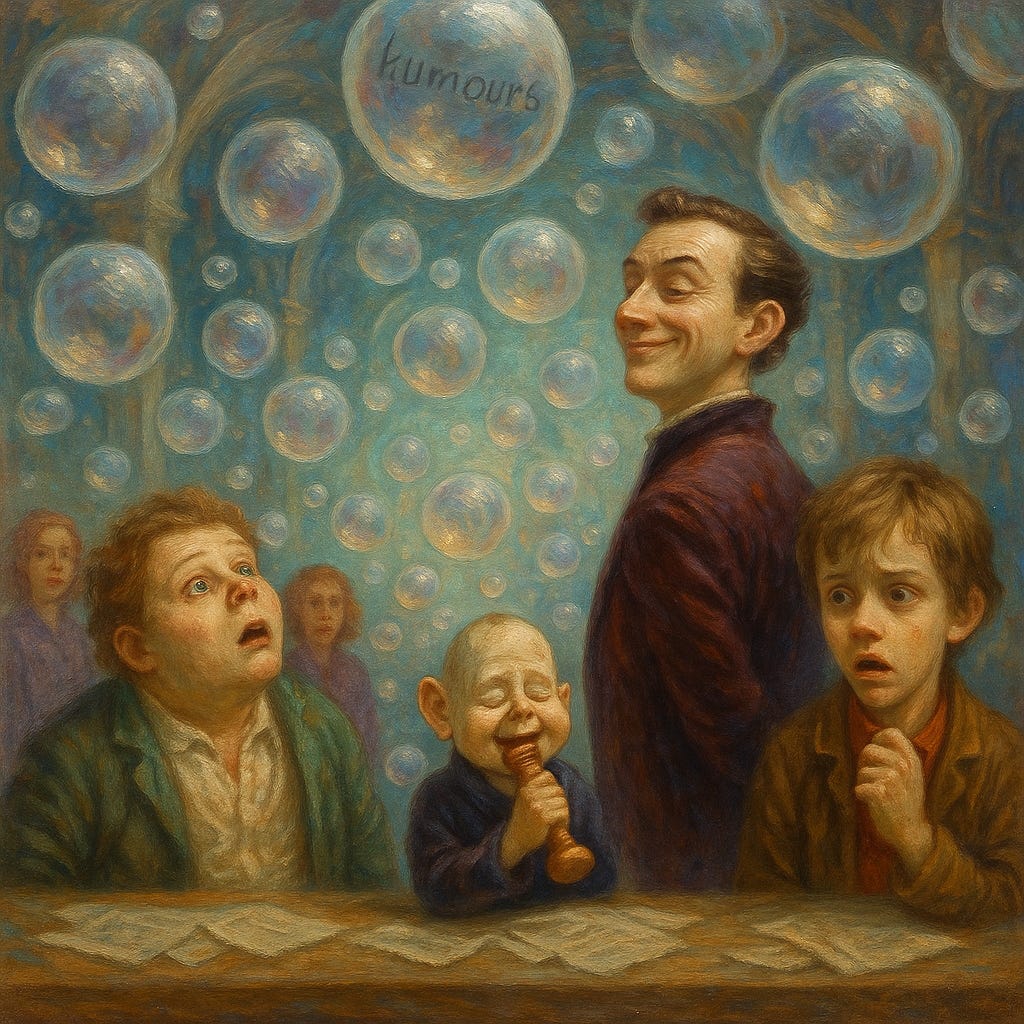
“They float!” gasped Augustus.
“Indeed,” said Mendacio Scurilka Arbitrika. “These are self-inflating. No witnesses, no time stamps. But each ‘source’ refers to another. You see, one lie is flimsy. But five lies citing each other? That, dear children, is institutional credibility.”
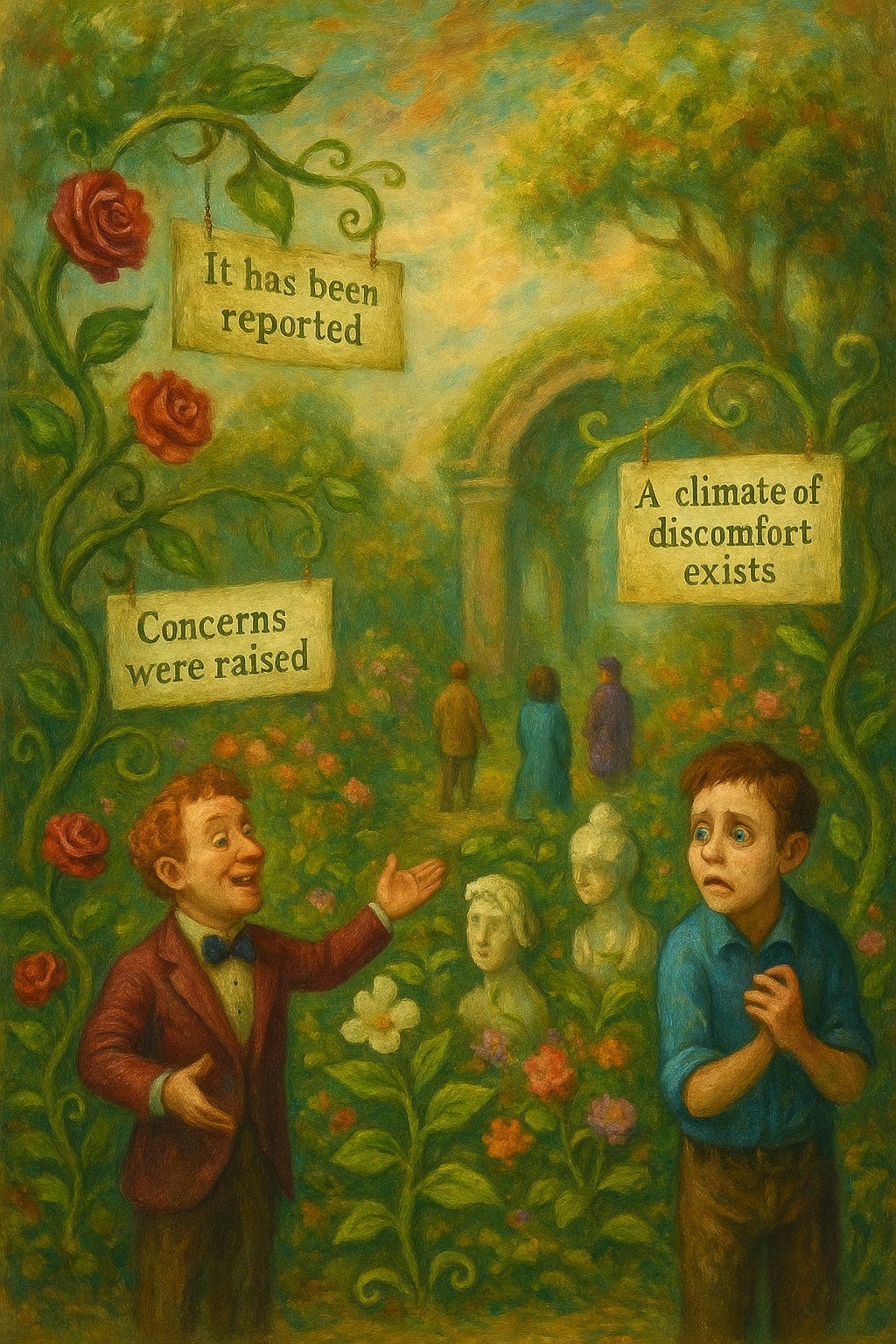
The Passive Voice Garden
Beyond the bubbles, they reached a lush botanical garden of policy shrubs and HR code vines, each labelled:
It has been reported…
Concerns were raised…
A climate of discomfort exists…
“Who raised these concerns?” asked Mike Microaggressions.
Mendacio Scurilka Arbitrika smiled indulgently. “My boy, it’s impolite to ask. The Passive Voice Garden thrives when no one is named. You see, ambiguity is the fertilizer of institutional courage. It’s not an issue of nobody knowing; it’s an agreement. I don’t blame you today; you won’t blame me tomorrow.”
A rose bloomed as he spoke: “The matter has been dealt with.”
“Perfect, perfect,” said Mendacio.
The Non-Communication Tunnel
Next came a long, suffocating tunnel—a mausoleum of missed correspondence—where the only sound was the soft drip of email auto-replies.
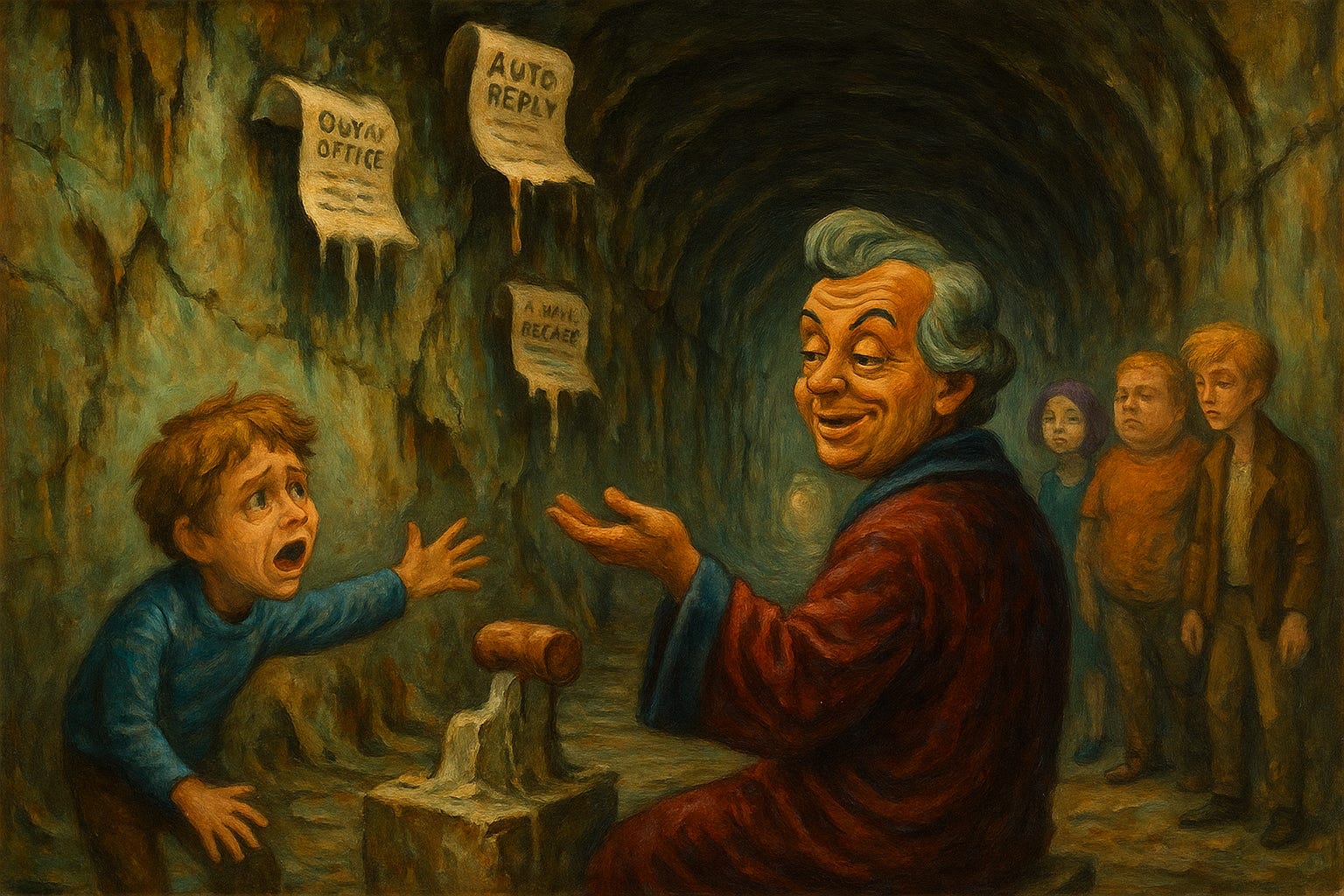
“This is where all inquiries go,” Mendacio Scurilka Arbitrika purred. “Faculty questions, legal notices, cries for clarity—all sent here to be ‘appreciated.’”
“But… do they ever come back?” Charlie asked, already knowing.
“Come back?” Mendacio recoiled, scandalized.
“My dear boy, the machine thrives on silence. It’s not a bug—it’s the bloodstream. Hope does not die with a bang, but with 137 unanswered emails.”
He gestured to the damp walls, where mould bloomed like confidentiality clauses. “You wouldn’t ignore someone who said good morning in a hallway, would you? But emails—ah, they’re perfect. You can ghost someone for months with nothing but plausible deniability and a bcc trail.”
“Each silence,” he added, “is a thumb pressed slowly on the petitioner's windpipe. They don’t scream—they unravel. Confusion becomes despair. Despair becomes self-blame. And by the time madness sets in, it looks like resignation.”
He grinned, almost tenderly. “This tunnel doesn’t break them. It convinces them they broke themselves.”
The Perpetual Motion Bureaucratron
They entered a cavernous chamber where an immense machine throbbed and wheezed.
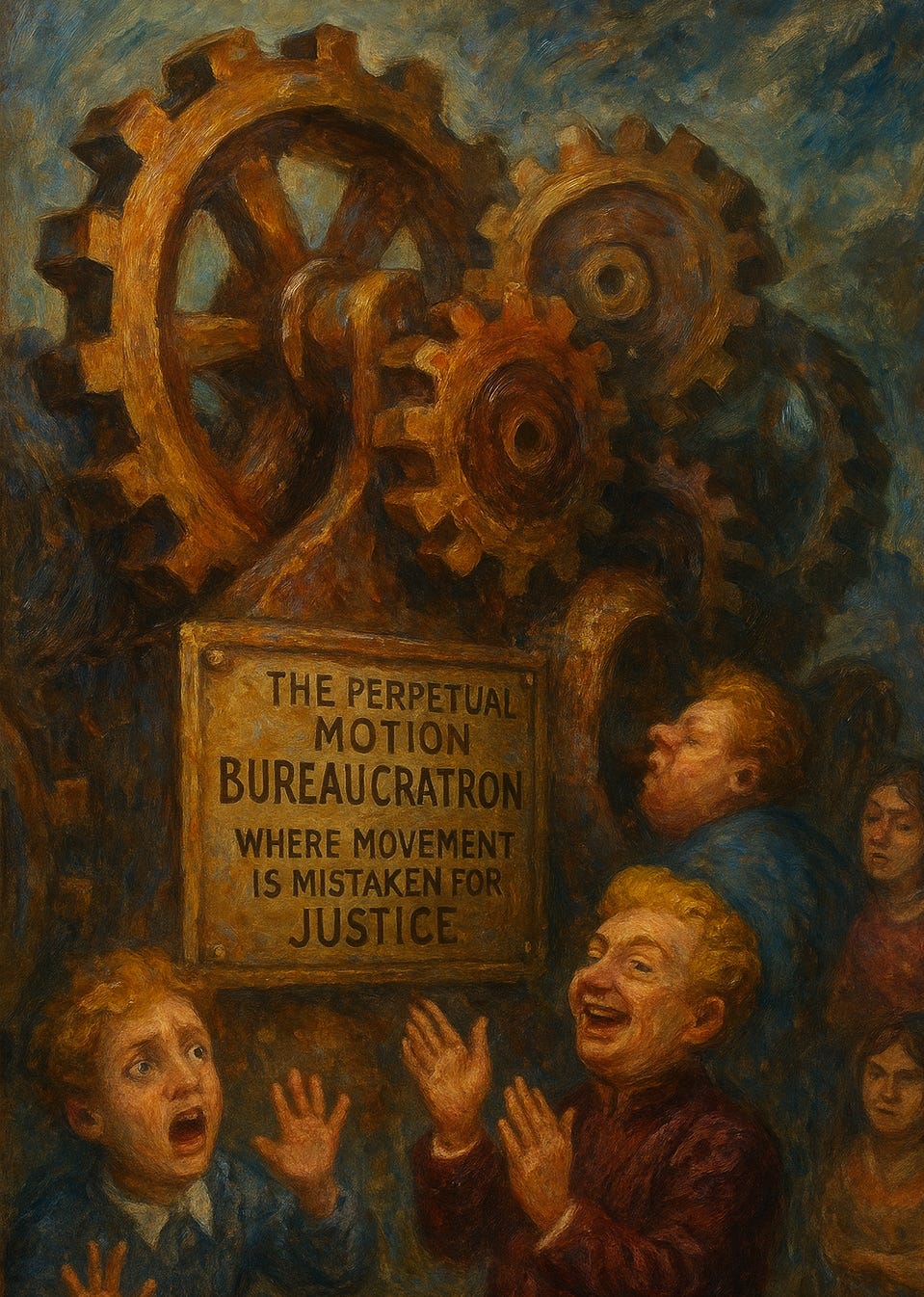
Gears the size of houses ground against each other, turning not with purpose but with the smug inevitability of a clock that had lost its hands. Pistons hissed. Belts snapped taut. Thousands of cogs meshed like teeth in an eternal jaw. Above it all glowed a brass plaque:
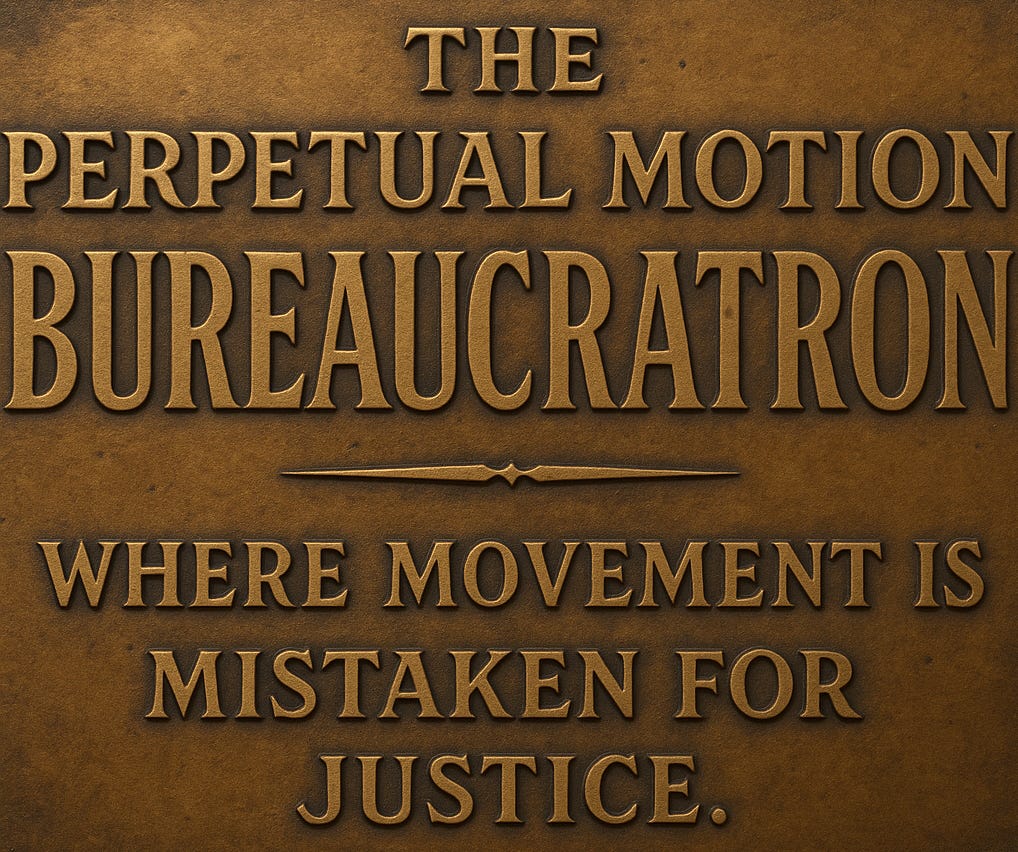
The very air vibrated with its drone. The ground trembled like a heartbeat underfoot. It was less a machine than a cathedral to inertia—ominous, colossal, infinitely complicated, and infinitely indifferent.
Mendacio Scurilka Arbitrika spread his arms like a prophet unveiling a miracle. His velvet sleeves caught the pale, smoky light as he cried: “Behold! The finest machine in my factory. It requires no fuel, no input, no evidence. Once set in motion, it turns forever. We call it due process.”
Charlie stared, horrified. “But… what does it do?”
“Ah!” Mendacio’s eyes gleamed. “That is its beauty. It does nothing. And yet it moves. The mere motion convinces the educated that justice is happening. The whir of gears drowns out conscience, and the smoke of procedure replaces thought. No one asks what it produces. They only admire that it produces.”
Violet Procedureguard clapped her hands in delight. “But if it turns forever, surely it must be working!”
“Exactly, my dear,” Mendacio whispered. “And because it turns, the clever people absolve themselves of responsibility. They no longer need to listen. They no longer need to think. Once a prejudice is tossed into the machine—say, a scribble of irritation from a manager, or the bile of a colleague—it is swallowed whole.
From then on, the machine declares guilt without hearing, without reading, without checking its own rules. It can erase a man’s career without once looking him in the eye. Isn’t that marvellous?”
The children shivered. Augustus Accuser shrank back, his eyes wide. “It’s… It’s terrifying!” he gasped.
“Terrifying?” Mendacio purred, delighted. “It is magnificent!”
Just then, Augustus—curious despite his fear—stumbled too close. Mendacio wagged a finger. “Ah-ah, don’t touch! The Bureaucratron does not like to be touched.”
But Augustus, puffed up with self-importance, pressed his hand against one of the lower cogs. In an instant, the machine seized him. With a shudder and a hiss, the gears swallowed him whole. There was no scream, no blood, no gore—just a silence so absolute it made the others gasp. Augustus was gone. Not a speck of flesh remained.
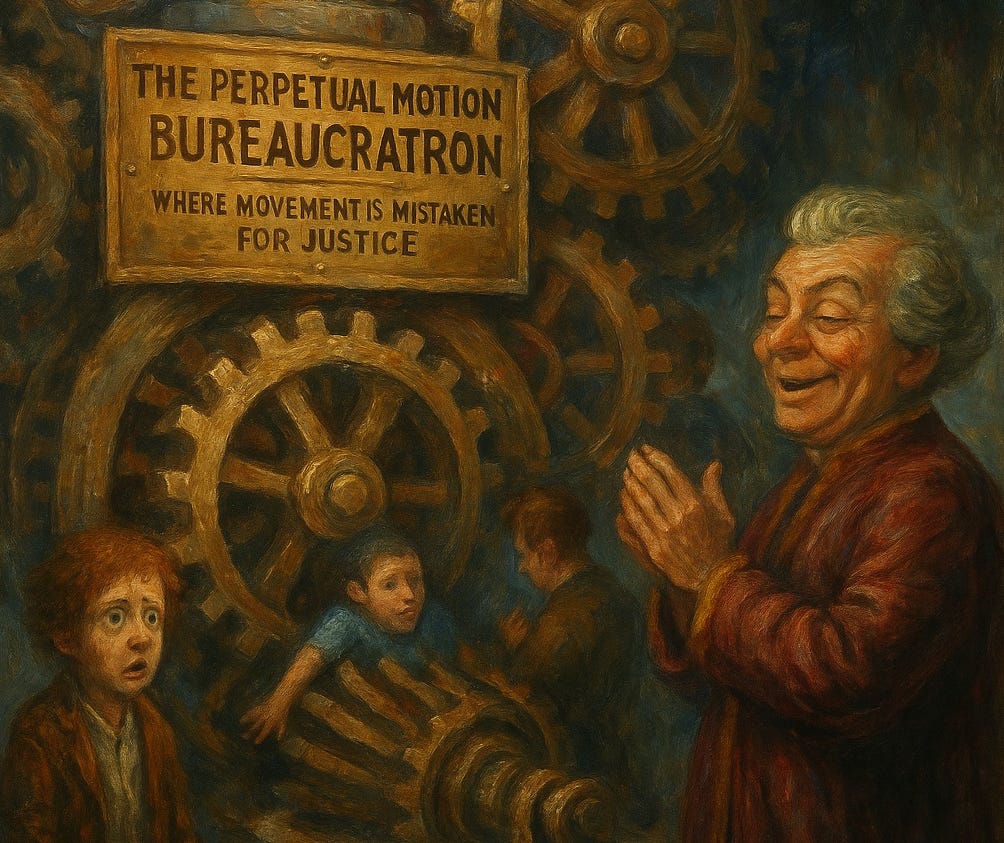
Mendacio clapped his hands, delighted. “You see! The Bureaucratron can crush and destroy in perfect silence. Not a bone, not a trace, not a cry escapes. Another miracle of my factory!”
Charlie reeled in horror, staring at the space where Augustus had been. “He’s… he’s gone. Just like that?”
But the other guests hardly blinked.
Veruca Vendetta sniffed and tossed her hair. “Well, serves him right. He should have listened.”
Violet Procedureguard nodded briskly, scribbling notes in her rulebook. “If he was swallowed, he must have been non-compliant. The machine doesn’t err.”
Mike Microaggressions shrugged, already adjusting his Inclusion Badge™. “Better him than me.”
None of them looked disturbed. None wept. None even paused to wonder where Augustus had gone. Their indifference hung in the air heavier than the machine’s smoke.
Mendacio twirled his cane with smug satisfaction. “Is this not the standard reaction to injustice? It doesn’t affect me, so I step aside. The machine thrives not on cruelty, but on apathy. Silence oils the gears.”
The Bureaucratron groaned, belching out ribbons stamped in block letters:
“PROCEDURAL FAIRNESS – FULLY OBSERVED.”
“APPEAL CLOSED – FURTHER PROCESS EXHAUSTED.”
“CONCERNS WERE RAISED – THEREFORE VALID.”
Charlie clutched at his chest. “But if no one listens, how can it ever be justice?”
Mendacio leaned close, eyes gleaming like polished brass. “Justice? My dear boy. Justice is irrelevant. What matters is motion. And motion, in this factory, is indistinguishable from truth.”
The Entrance of Bad Faith
A marble foyer with friendly signage: “WELCOME, WHISTLEBLOWERS!” confetti cannons fire policy statements in Arial Narrow.
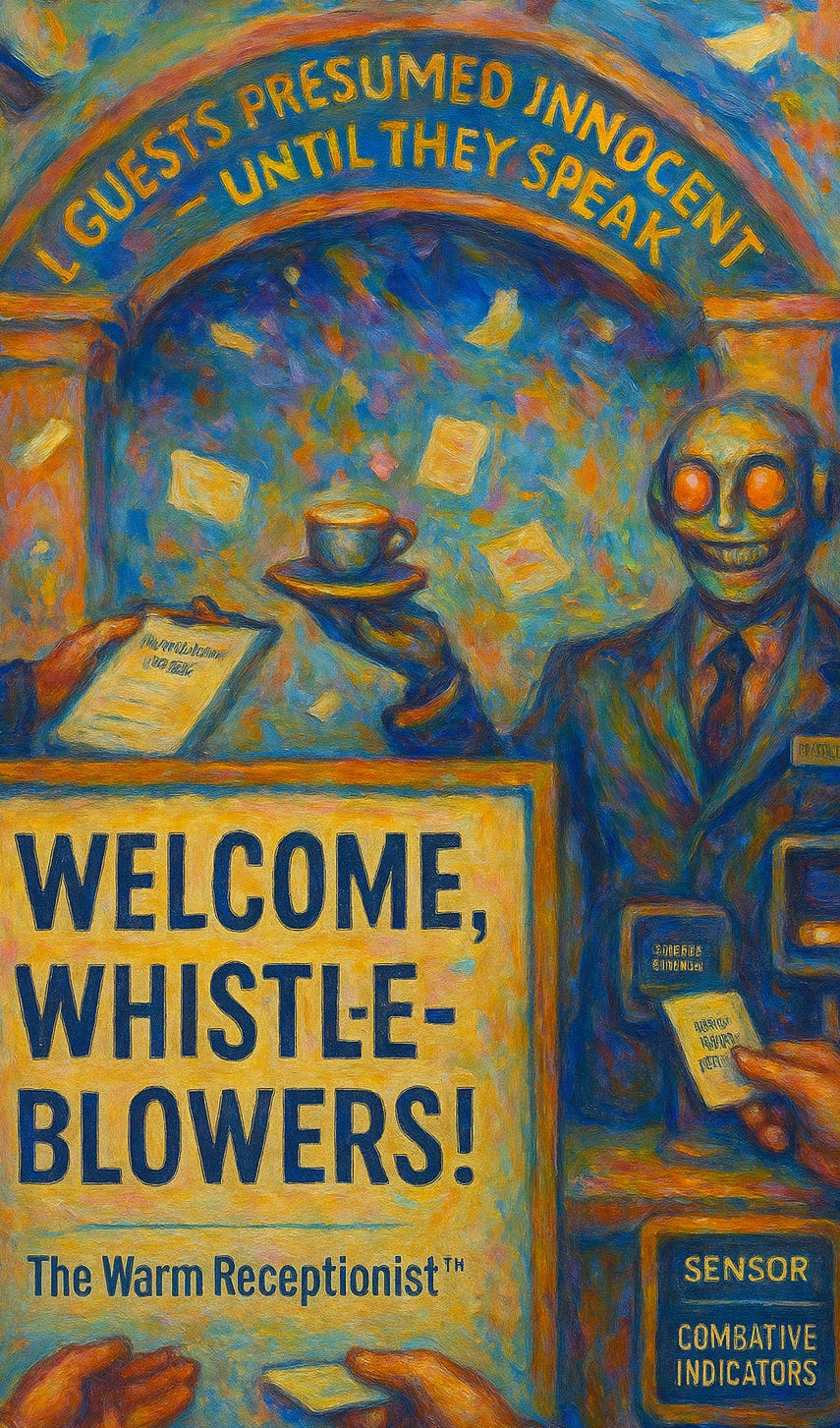
Guests are greeted by the Warm Receptionist™, a smiling automaton who offers tea, a waiver, and a wristband that doubles as an ankle monitor. A sensor scans your ID and immediately generates your Risk Profile™—highlighting your previous acts of integrity as “combative indicators.”
Above the entryway, a golden motto reads:
“All Guests Presumed Noble—Until They Speak.”
Mendacio doffs his cap. “Every revolution begins with a declaration of good faith,” he says. “Here, we file it, misfile it, and later use it as proof you were ‘emotional.’”
Surveillance follows you from this moment forward, as do your principles, though we’ll soon classify them as problematic.
The Office of Interpretive Policy
A soft-lit reading room, decorated like a monastery of modern HR theology.
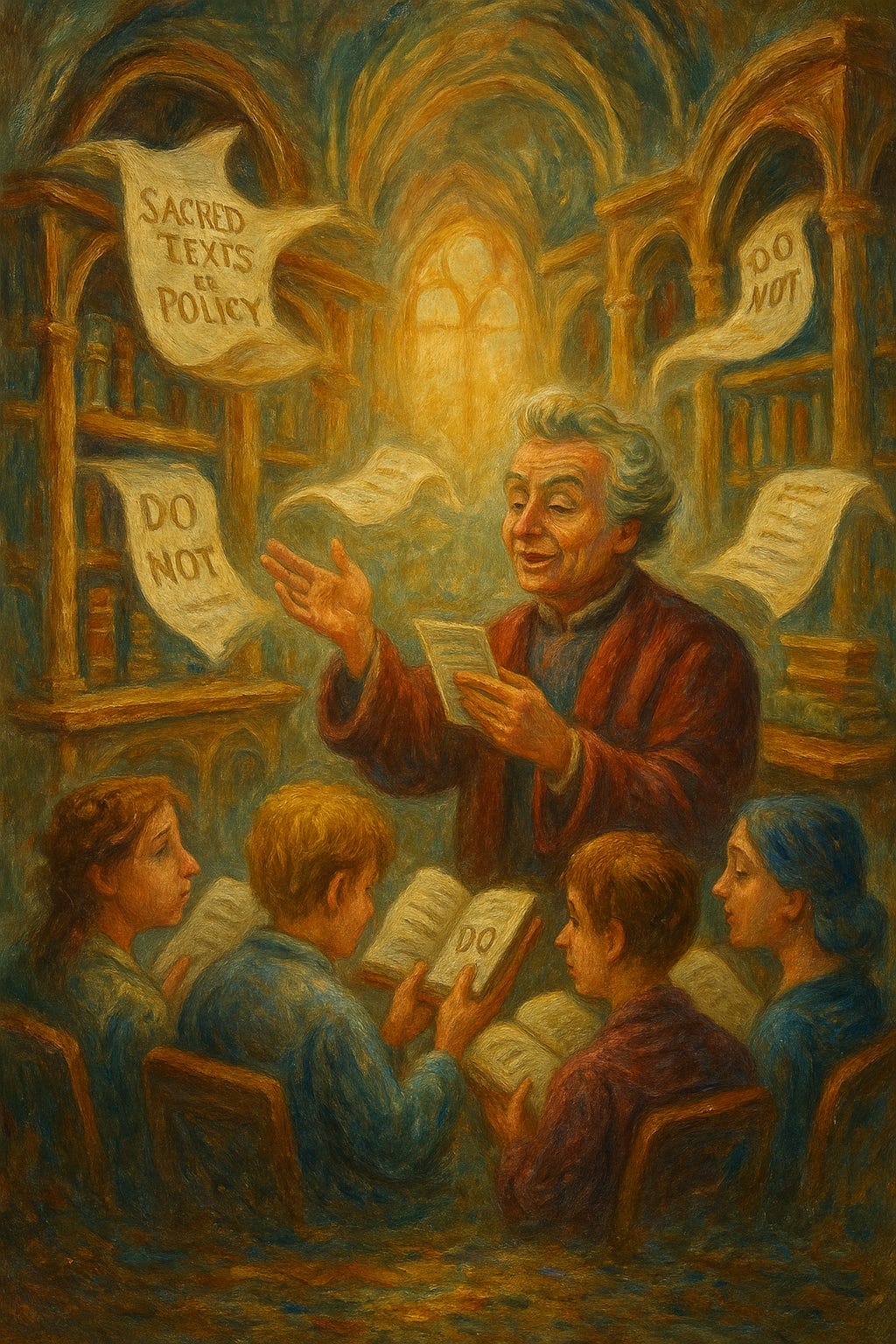
On display: the Sacred Texts of Policy, where each paragraph offers a Rorschach test of legalese. Visitors are encouraged to interpret as they feel—until their interpretation deviates from the Official Interpretation™, which is not disclosed but always correct.
Mendacio flips a laminated pamphlet:
“Policy 3.4.7 – Encourages free expression”
← flip →
“Policy 3.4.7 – Prohibits harmful speech”
← flip →
“Policy 3.4.7 – May apply retroactively or not at all”
A small statue of Ms. Moralia Extincta weeps softly in the corner. Or perhaps it’s leaking toner.
The Appeal Roundabout
A carnival carousel, staffed by Oompa-Loopholes in robes marked “Appeal Officer (Interim)”.

Each ride begins with the promise of review, but every appeal file is subtly placed on the same spinning track that circles back to its origin. Visitors exit where they entered, now stamped “Final Determination – No Further Process Available.”
Mendacio grins: “It’s not rejection—it’s rotational justice.”
A child asks, “What if the reviewer is biased?”
Mendacio gasps. “Biased? No, no. We’ve trained them to be consistent. They find against you every time!”
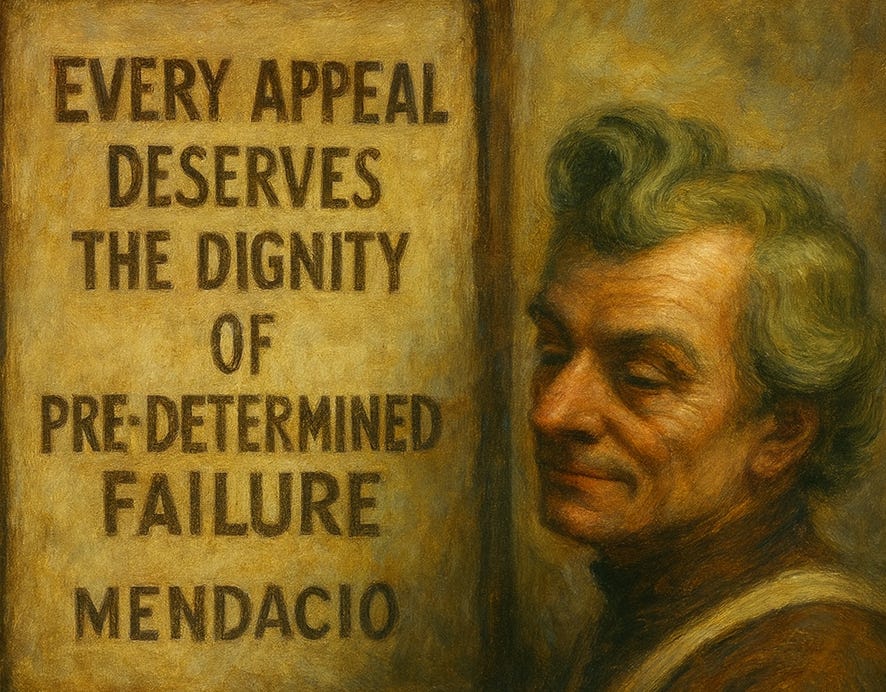
He gestures proudly to a slogan on the wall:
“Every appeal deserves the dignity of pre-determined failure.”
The Equality Inverter
As the group filed past the Equality Inverter and into the next corridor, Charlie’s brows furrowed, his voice timid but firm.
“Will I ever know who accused me?”
Mendacio halted, turned slowly, and smiled as though Charlie had just asked if sugar dissolves in tea.
“My dear boy,” he cooed, “that would violate our sacred Code of Unsubstantiated Accusations — Section 1984, Clause 0.1. We mustn’t risk clarity. Names are so… confrontational. We prefer implication. It scales better.”
Charlie pressed on. “But what if I just… ask people to stop lying about me? What if I try to defend myself?”
Mendacio placed a velvet-gloved hand over his heart. “Recrimination,” he sighed. “Such a sad, self-destructive habit. Here, attempts to defend yourself are promptly reclassified as retaliation. You see, intent is irrelevant, and perception is king.”
“But can I provide witnesses? Or context?” Charlie asked, his voice rising in desperation.
“Oh, we invite it!” Mendacio beamed. “Then we ignore it. And cite your effort as evidence of being… what’s the term? Ah, yes—‘overly defensive.’ A classic marker of guilt.”
Mike Microaggressions, half-listening while adjusting his Inclusion Badge™, asked, “What if… say, I’m Jewish… and my accuser publicly praises, oh, terrorist groups that want Jews dead?”
Mendacio let out a high, nasal laugh. “Oh, Mikey. That’s not hate. That’s ‘lived experience.’ Quite fashionable now.”
“But,” Charlie stammered, “if all the accusers are anonymous, and there’s no evidence, how do I even know they exist?”
“Oh, you poor procedural romantic,” Mendacio clucked. “We send the evidence in a tiny box. A second secret investigator views it. They nod. The nod is then notarised. This, we call transparency.”
Charlie, blinking, whispered, “So then I can see the evidence?”
Mendacio froze, turned slowly, and hissed, “No. Of course not. But you may see that others have seen it. And they have declared it… actionable.”
He twirled his cane, eyes dancing with delight. “In our system, child, the appearance of scrutiny is more potent than scrutiny itself. We are, after all, an institution.”
In a side chamber, they encountered a machine labelled Equity-O-Matic 3000. Two professors stood side by side.
The first had publicly praised Hamas, shared Holocaust-denial articles, and referred to Jewish students as “colonial implants.” The machine emitted a ding! And stamped: “Protected Expression – No Action Required.”
The second had written, “I stand with Israel. Hamas are Nazis.”
Ding! – “Violent Threat – Immediate Suspension.”
“How can the same machine treat them differently?” Charlie cried.
“Simple,” said Mendacio Scurilka Arbitrika. “Context! Interpretation! Feelings! And of course, proximity to power.”
“Isn’t that hypocrisy?”
“Oh no, dear boy. Hypocrisy is human. This is policy.”
The Spectator’s Lounge
Inside this sterile salon, faculty and union reps sipped soy lattes while watching the carnage unfold on small, ethical monitors.
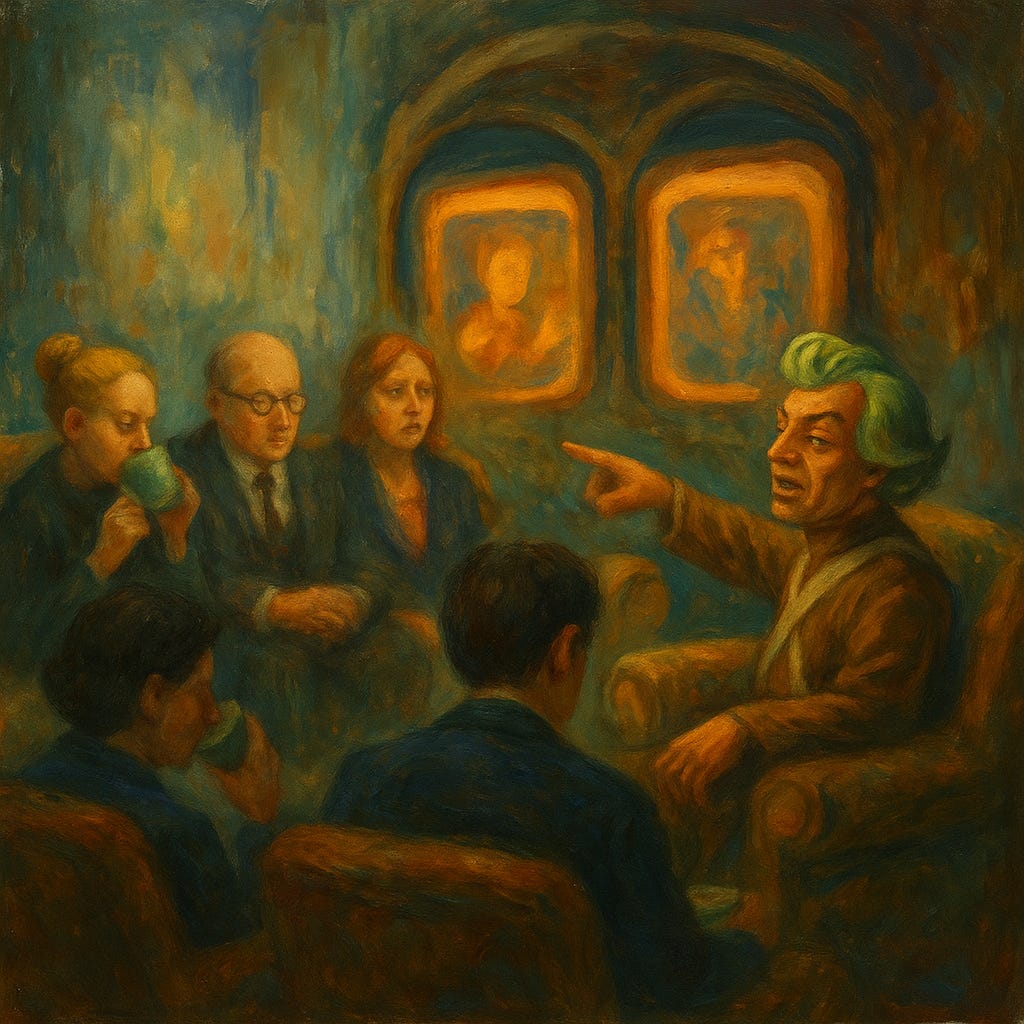
They saw Charlie’s defamation escalate, saw lies whispered to students, saw his health crumble. No one flinched.
“Why don’t they intervene?” asked Charlie.
“Because they believe they might be next,” Mendacio Scurilka Arbitrika said softly. “It is easier to watch injustice than to disrupt it. Especially in academia.”
The Gag Order Room
They entered a corridor where even echoes seemed too afraid to linger. Mouths were carved grotesquely into the walls—sealed, frozen mid-scream, like bureaucratic gargoyles condemned to eternal silence.
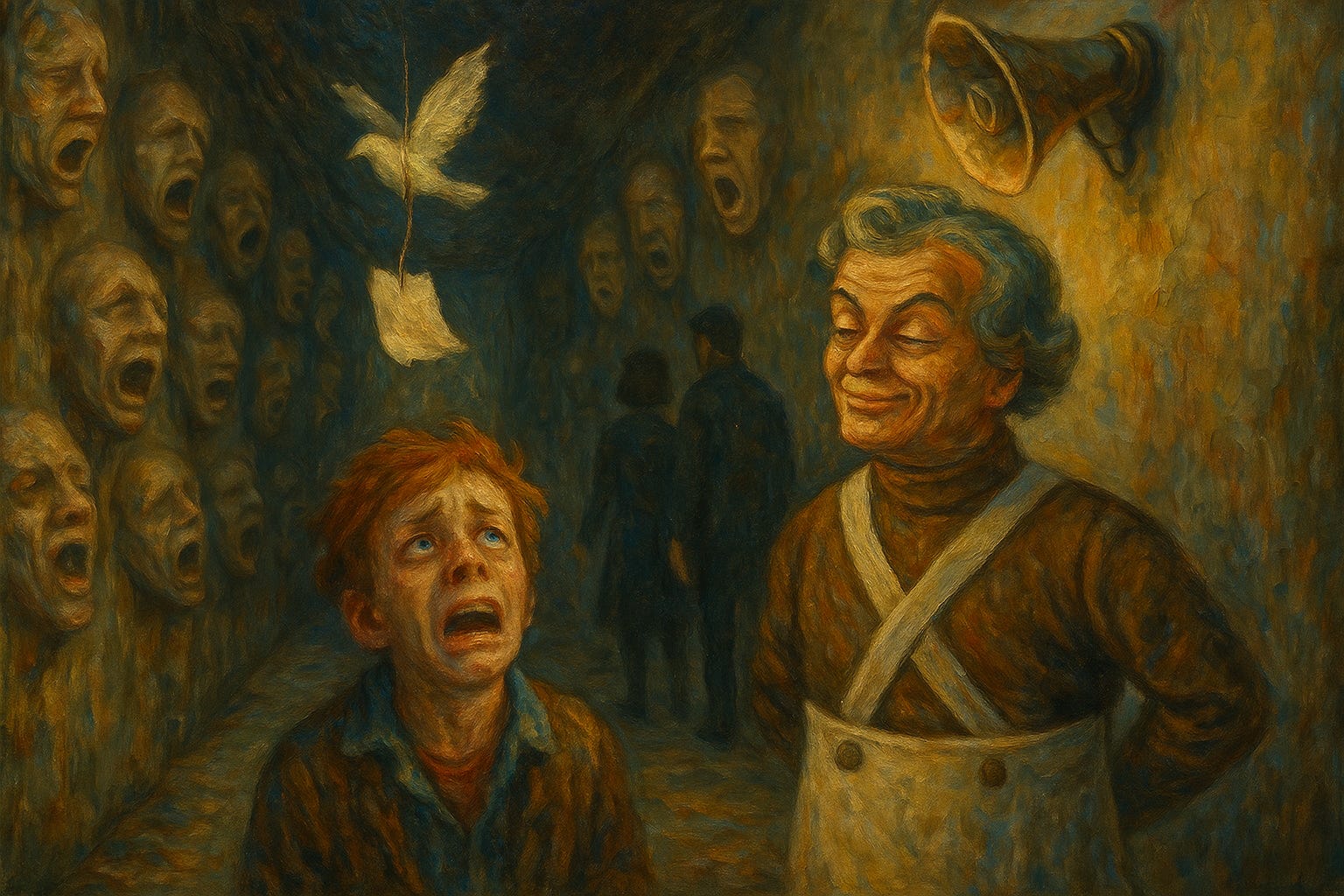
“This,” Mendacio Scurilka Arbitrika announced with a grin that belonged in the annals of Torquemada, “is the Gag Order Gallery—our mausoleum of meaning.”
The walls hummed faintly. You could hear the low murmur of lawyerly threats suspended in formaldehyde: cease-and-desists for quoting public documents, warnings of defamation for stating observable facts, and threats of arrest for asking, with vulgar audacity, ‘Why?’
“Here,” Mendacio gestured grandly, “we take the most dangerous currency in existence—language—and freeze it like contraband. Every truth becomes contraband once it contradicts policy.”
Charlie Dueprocess, ever naive, ventured: “But if he can’t speak, and can’t ask questions, how can he defend himself?”
Mendacio’s eyes gleamed. “Exactly!” he trilled, spinning theatrically on his cane. “We call it restorative silence. You see, if he speaks, he comes across as aggressive. If he doesn’t, he’s complicit. It’s a flawless little paradox—like justice wrapped in duct tape.”
He paused beneath a bronze plaque etched with legalese so vague it could only mean guilty until redacted.
“It’s modelled,” he added cheerfully, “on the old English witch trials. You remember, children: if she sank and drowned, she was innocent. If she floated, she was guilty and burned. The brilliance was not in the verdict, but in the inescapability.”
He leaned in conspiratorially. “That’s the beauty of the system: it requires no verdict. Only process. The rest is inference, prejudice, and the quiet nod of a union rep sipping soy foam.”
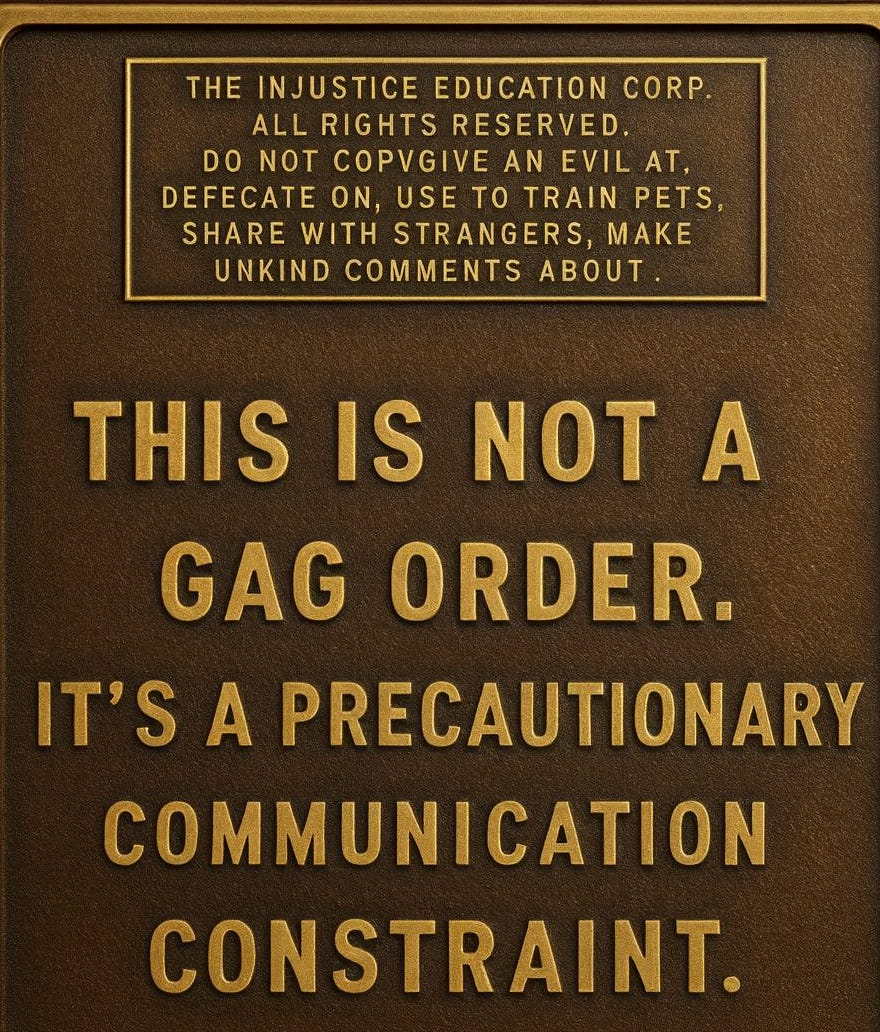
A paper dove hung from the ceiling with its wings tied. Beneath it, a cracked speaker crackled a looped HR message:
“This is not a gag order. It’s a precautionary communication constraint.”
Charlie choked on the hypocrisy. Mendacio exhaled with smug contentment.
“Ah, to weaponize silence in a culture that worships free speech—truly, dear guests, this is where the factory sings.”
The Final Conveyor: Defenestration Protocol
As they neared the end, Charlie was strapped to a conveyor labelled Termination Pending.
“But I haven’t had a hearing!” he cried.
“You had process,” Mendacio Scurilka Arbitrika corrected. “You received letters. You were allowed to write things. Everybody saw it and agreed you received the letters. They were ignored, of course, but the ritual was followed.”
“Where’s my evidence? Where’s my defence?” Charlie howled.
“There were appearances of both,” a smug Mendacio gloated, “and appearances and vibes rule today,” he said.
“And those two things? - Somewhere between the Department of Accountability and the Office of Meaningless Apologies,” Mendacio Scurilka Arbitrika” shrugged. “They’re closed indefinitely.”
The Sanctimony Fish Bowl: Guzzling and Vomit
The corridor narrowed so that they could only get through one at a time, and then it opened suddenly, like a ruptured ulcer. Before them loomed a glass chamber, softly lit from within, as if a strange presence were pickling something unholy. Mendacio Scurilka Arbitrika raised his baton and smiled with reverent glee.
“Ah, my treasured litigants and liabilities,” he purred. “The final stop, but the most glorious. Welcome to the Room of Sanctimony and Hubris. Do hold your noses.”
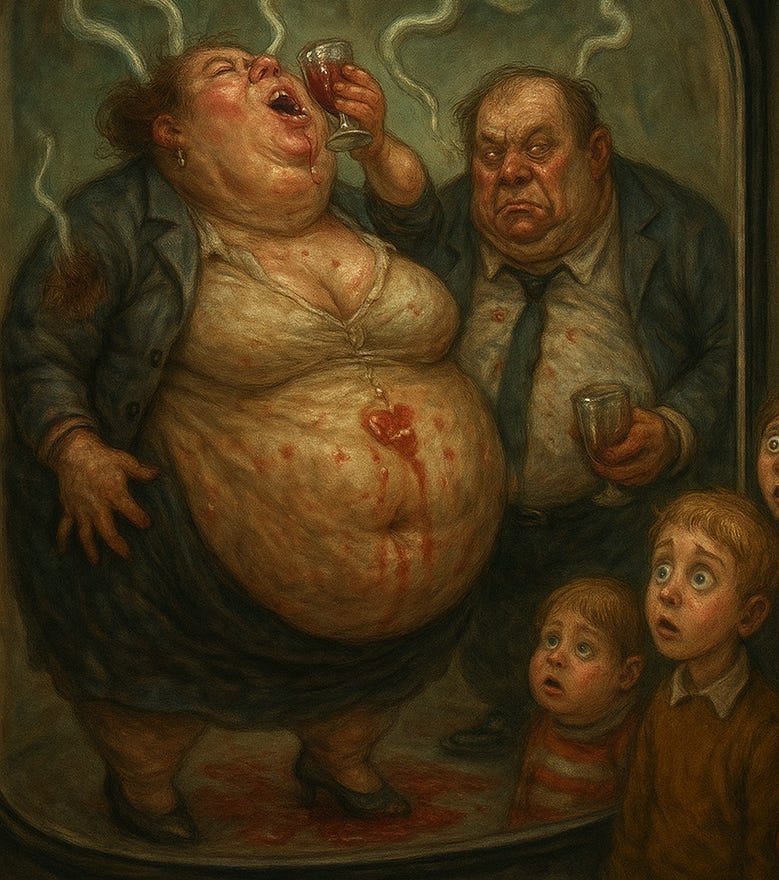
Inside the bowl, two nightmarish figures loomed: once human, now transformed by an overdose of moral certainty into heaving, glistening caricatures. The woman—squat, volcanic, draped in a suit that had long since surrendered-was swollen beyond recognition. Her body bulged in tiered folds, as though a mountain had swallowed a pantsuit. Pearls strained at her neck like prisoners. Her makeup had melted into war paint.
Beside her stood a shorter man, equally grotesque. His belly, vast and gelatinous, drooped over his belt like dough escaping a broken dam. His shirt clung like wet tissue, and his neck had disappeared into the mountainous landscape of his backfat. Both were connected by tubes—one pair snaking up from their pant legs into the moist crevice of their exposed upper rumps; another pair drooping from their mouths into crystal goblets that slowly filled with thick red liquid.
The source of their grotesqueness? A glowing green compressor in the corner, humming like a sermon in a cult compound. It hissed and pumped—hubris in liquid form—through the flesh-tubes, inflating them like dirigibles of self-importance.
The guests gasped. Veruca Vendetta recoiled in theatrical disgust. Violet Procedureguard clutched her HR handbook like a rosary. Mike Microaggressions wept softly into his Inclusion Badge™.
Charlie Dueprocess simply stared, wide-eyed, barely breathing.
“They’re going to explode,” he said, horrified.
“Why don’t they see what they look like?” asked Charlie.
“Because,” Mendacio said gently, “they don’t look with eyes. They look in mirrors.”
Inside the dome, the creatures were transfixed by distorted mirrors—slenderizing, saintly, the glass blessed by the gods of self-regard. In those warped reflections, they were radiant, lean, morally magnificent. The woman bared her yellow teeth in a smile of smug ecstasy. The man nodded approvingly at his reflection, eyes heavy with satisfied ignorance.
“What’s that red liquid?” Charlie whispered.
“Sanctimony,” Mendacio replied. “Fermented self-regard. The sweetest thing a person can consume—so long as it’s their own.”
The woman, trembling with delight, leaned forward. Her neck folds rippled like a landslide. With an audible snap, her pearl necklace burst, pearls ricocheting off the dome wall with bullets of broken illusion. She moaned—an unholy sound of moral climax—and drained her goblet of every last crimson drop.
“She loves it,” Veruca whispered.
The man wrenched the glass from her fingers, slurped the last mouthful, then paused, eyes bulging. He spat it onto the floor with a wet, monstrous splack—a sizzling puddle of bile-stained righteousness.
“Why doesn’t he like it?” Charlie asked, voice trembling.
Mendacio chuckled and tapped the glass.
“Sanctimony, dear boy, is like fine wine. Divine when it’s your vintage. But to taste another’s? It’s vinegar and venom. The palate rejects it.”
He gestured to the compressor. “This machine runs on a fuel more potent than evidence, stronger than fate, and more enduring than shame: hubris. It can distort the hideous into the holy. It doesn’t merely deny truth. It replaces it.”
The group stepped back as a new hiss burst from the tube. The man groaned. The woman licked her lips. The dome fogged slightly from the humid exhalations of delusion.
“We keep this room locked,” Mendacio said softly, almost reverently. “If hubris were to escape… it would run the entire Factory.”
He turned, cloak swirling, and whispered:
“Even if they were to explode, every greasy cell of fat would still proclaim its moral beauty, such is the power of hubris.”
Epilogue: The Fading Factory
And so, with Charlie gone—at least from their schedules and spreadsheets—the tour came to a close. Veruca Vendetta received a promotion for strategic empathy. Violet spun her procedural logorrhoea into a PhD on “Post-Veracity Frameworks.” And Mike Microaggressions, ever nimble, became Director of Inclusion—a position dedicated to saying everything while meaning nothing.
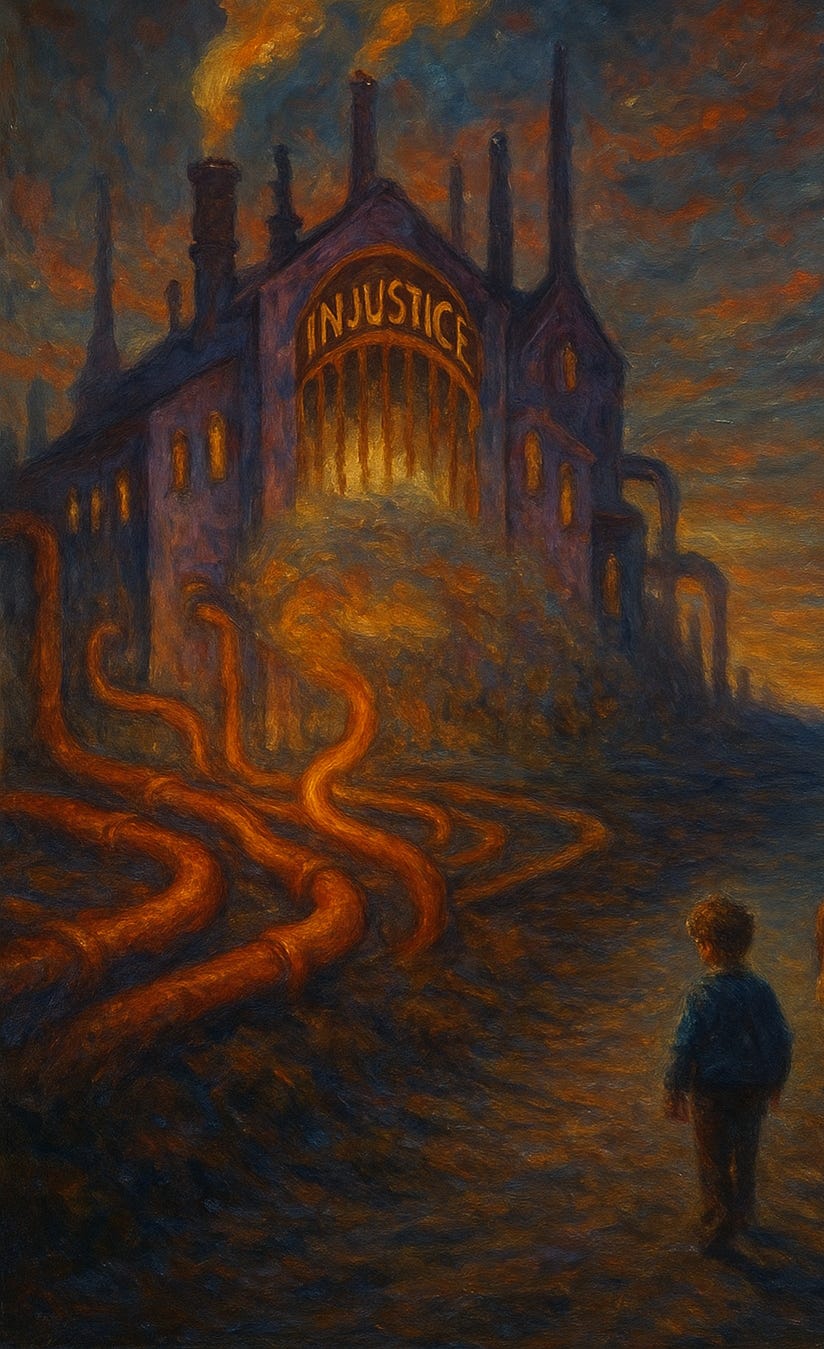
The factory remained. Its signs still gleamed with the patina of virtue—Justice, Fairness, Equity—though no one dared ask what they meant. Inside, the ducts did not hum. No, the ducts seethed with fear—the kind of fear that arises when language is weaponised and silence is monetized. No rebellion came. No faculty vote. Just the soft click of another file marked Resolved.
But buried in the bowels of its archives, beneath layers of redacted apologies and footnoted evasions, a single, unshredded truth remained—misfiled, perhaps by accident, or perhaps by someone not yet broken.
And one day, a student, like an older Charlie—troubled by contradictions, repulsed by euphemism, and armed with Orwell and Solzhenitsyn—might pry open the rusted vault of Due Process and ask the forbidden question:
“What happened to Charlie?”
And then, the deeper one:
“What does it mean to let the lie come into the world, but not through me?”
The conveyor still rolls, yes—but the lie did not pass through Charlie. And perhaps that forbidden question is being asked today.
Charlie stood. He bore it. And one day, without ceremony, he stepped away—turning from the long corridors and their echoing grievances, toward a road that vanished into a pale, unmeasured distance.
For what he sought, there was not an answer in bureaucratic ink, nor in the return of what had been taken. It was something he could not name, though it was older than the hills of Bashan, and sure as the tread of the Lion through the thickets.
The bitterness thinned, and the air grew lighter. There was no final verdict, no clang of closure—only a widening quiet, in which the weight he had carried no longer seemed to belong to him at all.
And in that quiet, perhaps, something unseen tilted in his favour.
Mendacio was seen no more.
And the world, by the smallest of measures, the faintest of flickers, became a happier and more peaceful place.

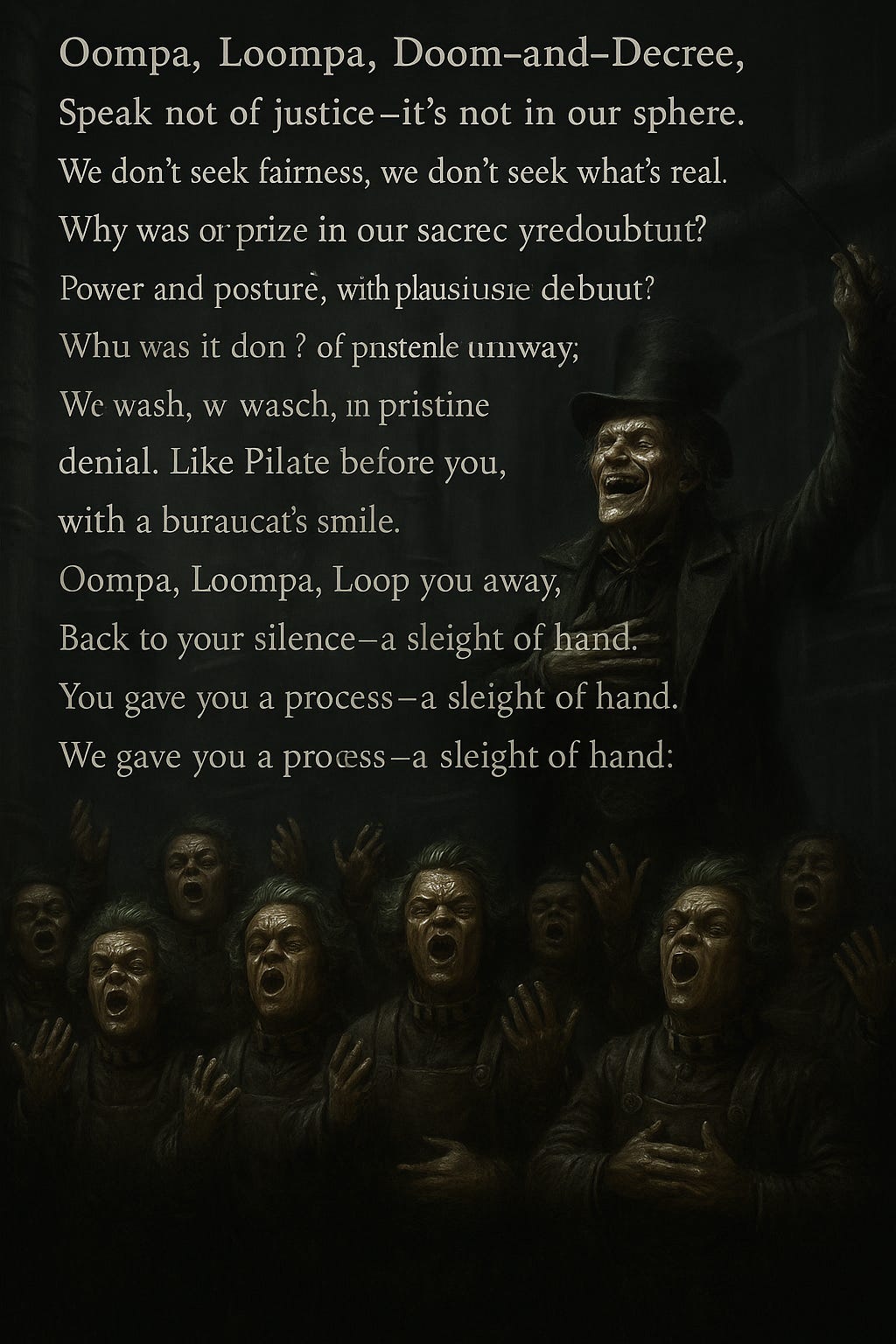
Oompa-Loophole Chant
(Sung in smug unison by the Oompa-Loopholes while gently scrubbing their hands in golden basins marked “Compliance”)
If you found value in this article and wish to support my ongoing work, please consider leaving a tip. Your support helps me continue producing uncensored content on critical issues.
Megyn Kelly’s favourite movie is Charlie and the Chocolate Factory. You should send this to her.
A briliant parody of your experience, Paul, and I have forwarded it to my niece, who has had a similar experience at the hands of the Canadian military. I encourage you to publish this one as a book, after much condensation and consultation with a copyright attorney. You definitely have a potential new career as a writer. Like my niece, however, you are understandably obsessed with your situation, and I hope to be around long enough to see both of you grow past that condition.
We need to enjoy our families, our animals and our shalom bayit (peace in the home). We need to make new friends. In your case and in my niece’s, you need to find new sources of both income and joy. What’s done is done, whether or not it stank to high heaven. Life is too short to dwell on our misfortune and the idiocy of the ’system' for too long. Look at Israelis and their resilience. Yes, they are surrounded by murderous enemies and have to suffer dubious leadership, but they still live their lives to the fullest. They 'dance again'. You will, too!