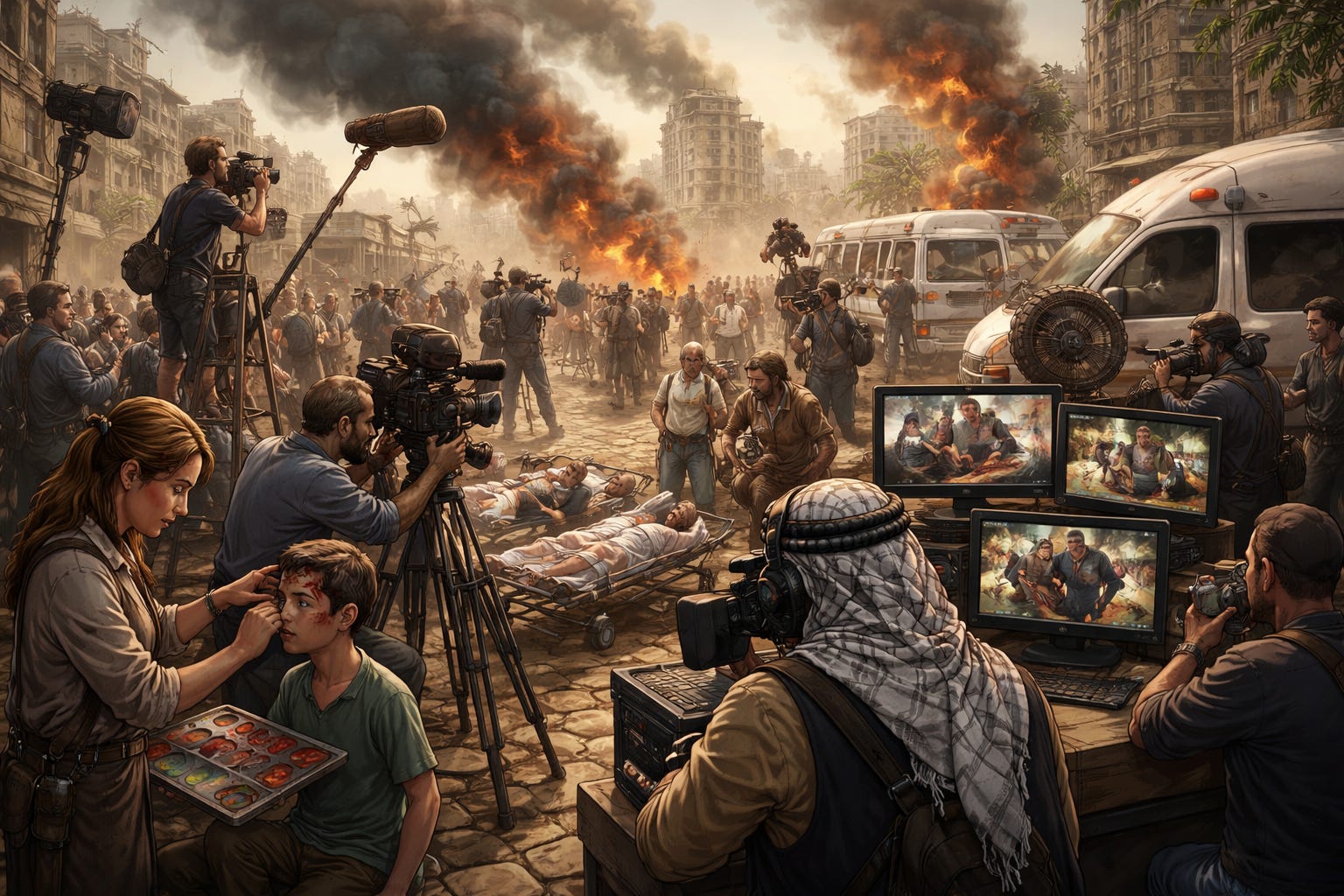
There is a curious asymmetry in modern journalism: scepticism is treated as a virtue everywhere except where it is most needed. We are encouraged—rightly—to interrogate power, question statistics, and doubt official narratives.
Yet when it comes to Israel, scepticism collapses into credulity.
Numbers are accepted without scrutiny, footage without provenance is broadcast without hesitation, and allegations—however implausible—are swallowed whole if they confirm what many already wish to believe.
This is not accidental. It is not merely biased. It is an appetite.
When people want to believe the worst about someone, they become eager consumers of negative information about that person. Social-psychological research has long shown that confirmation bias intensifies moral judgment: once a group is cast as villainous, evidence against it is accepted uncritically, while contrary evidence is dismissed or ignored.
Israel, uniquely among nations, occupies this role in the Western imagination. Many do not merely disagree with it; they want to find it guilty.
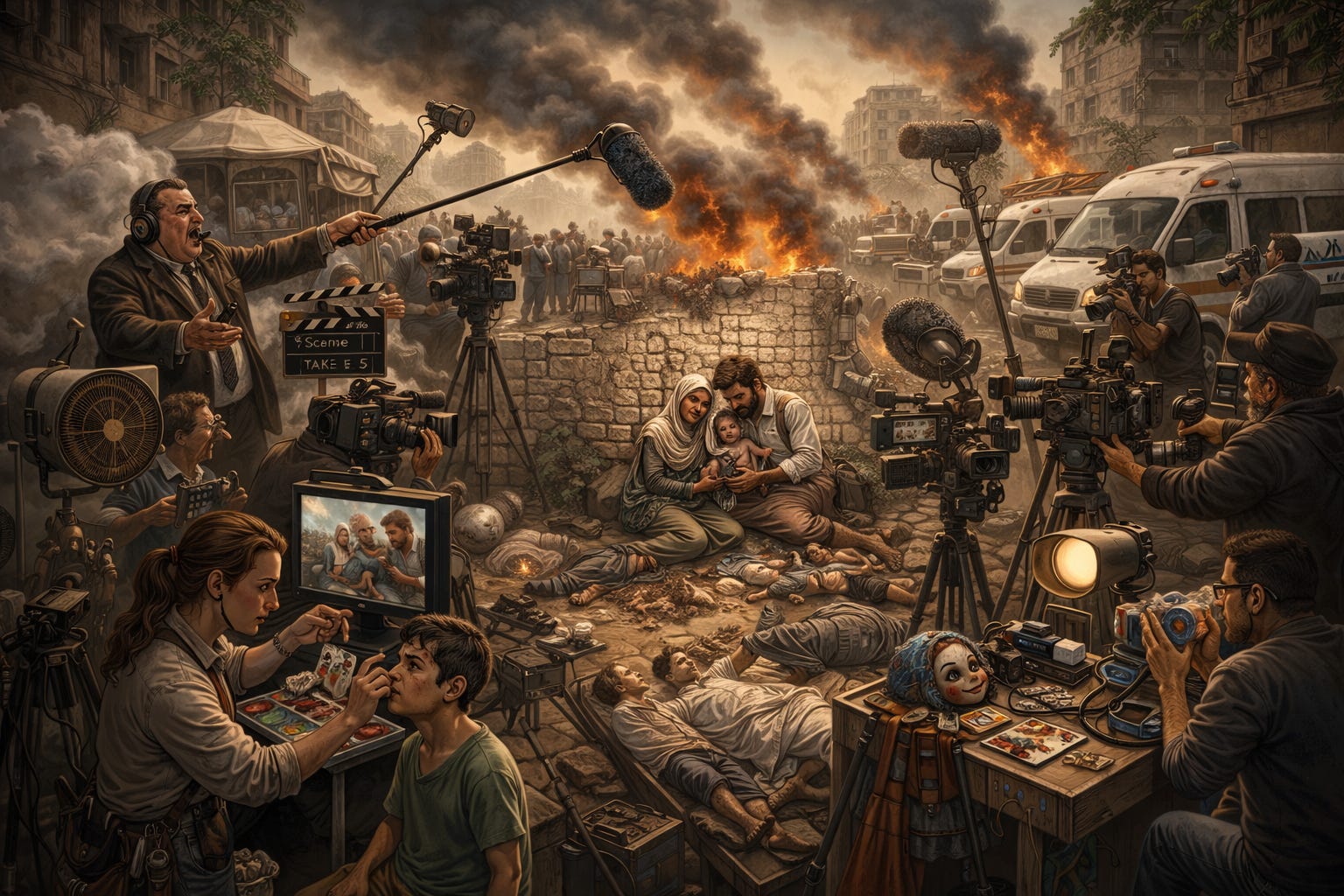
This is the environment in which what has come to be known—awkwardly but accurately—as Pallywood thrives.
The term, coined by historian Richard Landes in the mid-2000s, is not an assertion that all Palestinian suffering is fabricated. No serious person claims that. Civilian casualties in Gaza are real. War is brutal. Innocents die.
But acknowledging real suffering does not oblige us to suspend judgment about deliberate manipulation, staged imagery, statistical inflation, or theatrical production designed for Western consumption.
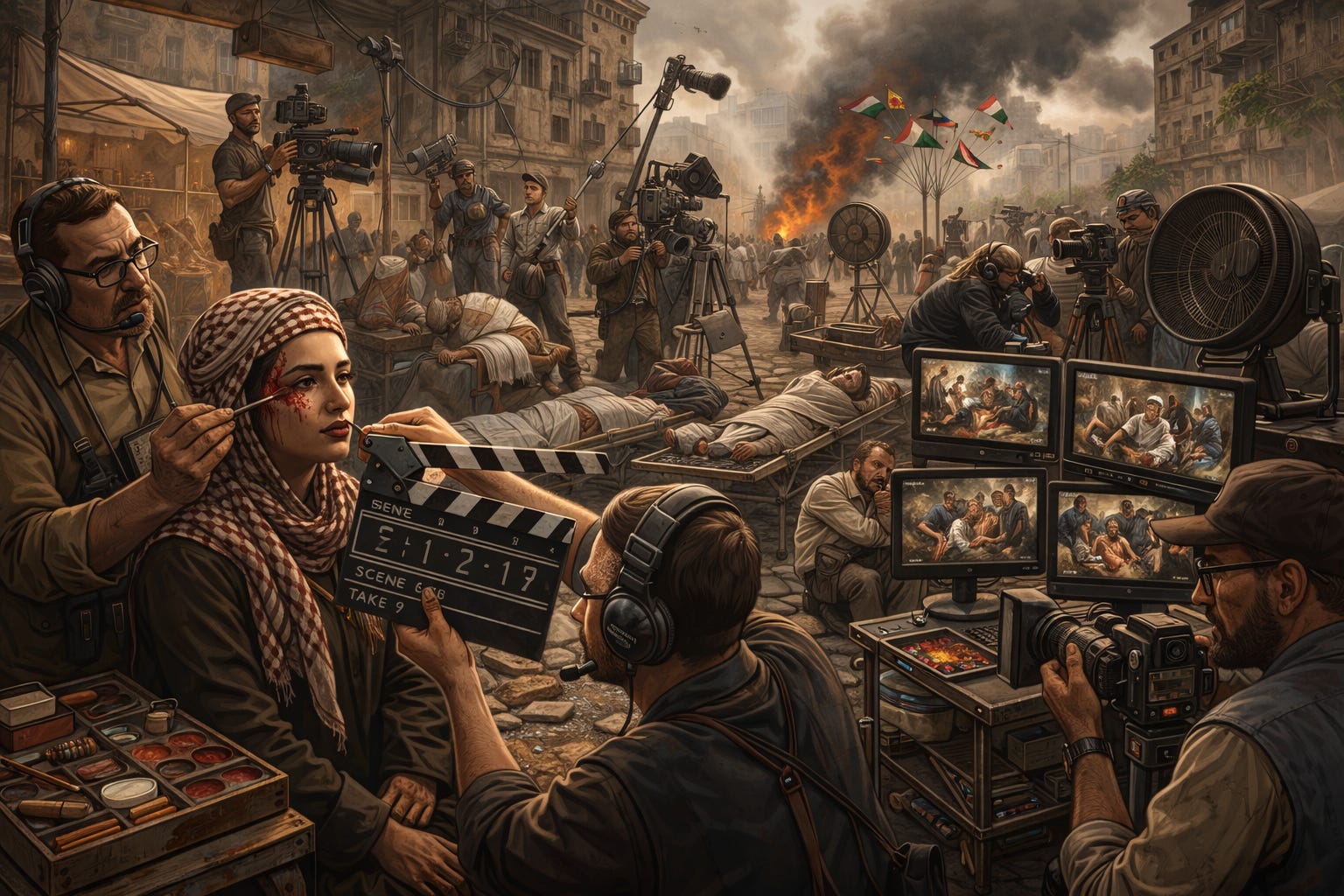
Pallywood refers to the systematic exploitation of media dynamics: the staging, exaggeration, misattribution, and selective framing of images to construct a narrative in which Israel is always the aggressor, Palestinians are always passive victims, and context is treated as an obscenity. It is propaganda refined for the age of smartphones, NGOs, and morally exhausted newsrooms.
The evidentiary foundation for this claim is not speculative. It has been documented—controversially, yes, but extensively—most notably in three films by Richard Landes associated with the al-Durrah Project:
Pallywood: According to Palestinian Sources (2005),
Muhammad al-Durrah: The Birth of an Icon (2013), and
Icon of Hatred (2013).
(All three draw on raw broadcast footage, so-called “rushes,” supplied by Palestinian stringers to Western outlets.)
Landes’ central contention is simple and unsettling: when one examines the unedited footage—before narration, before selective cuts—patterns emerge that are incompatible with spontaneous reportage.
Individuals declared gravely wounded are later seen walking unaided, apparently cured by nothing more than the passage of a commercial break. Bodies carried off on stretchers—limp, lifeless, and camera-ready—reappear upright moments later, blinking in the sun like Lazarus1 himself, newly summoned from the tomb.
Ambulances arrive with a punctuality that would impress the Swiss rail system, already positioned at the optimal angle for maximum pathos. Cameramen are visible directing crowds, choreographing grief, signalling when to shout, when to run, when to collapse.
Blood appears and disappears with theatrical convenience, as if governed less by biology than by stage direction.
These are not isolated anomalies or the odd confusion of war’s fog. They recur with wearying regularity. The pattern is so familiar that one is tempted to speak not of journalism at all, but of repertory theatre—complete with stock characters, reusable corpses, and the recurring miracle of resurrection. The dead do not stay dead for long in Pallywood; they are merely waiting for their next cue.
The most famous case, of course, is the 2000 al-Durrah incident: a boy filmed crouching beside his father at Netzarim Junction, allegedly killed by Israeli fire.
The footage became an icon overnight—broadcast globally, cited by jihadist propagandists, invoked by Osama bin Laden, and etched into the moral consciousness of a generation.
Yet frame-by-frame analysis raises disturbing questions: bullet angles inconsistent with Israeli positions, an absence of blood consistent with fatal wounds, the father’s inexplicable unharmed exposure, and movements by the boy after he is declared dead. Whether one accepts Landes’ ultimate conclusion or not, what is indisputable is that journalistic certainty vastly exceeded the evidence.