


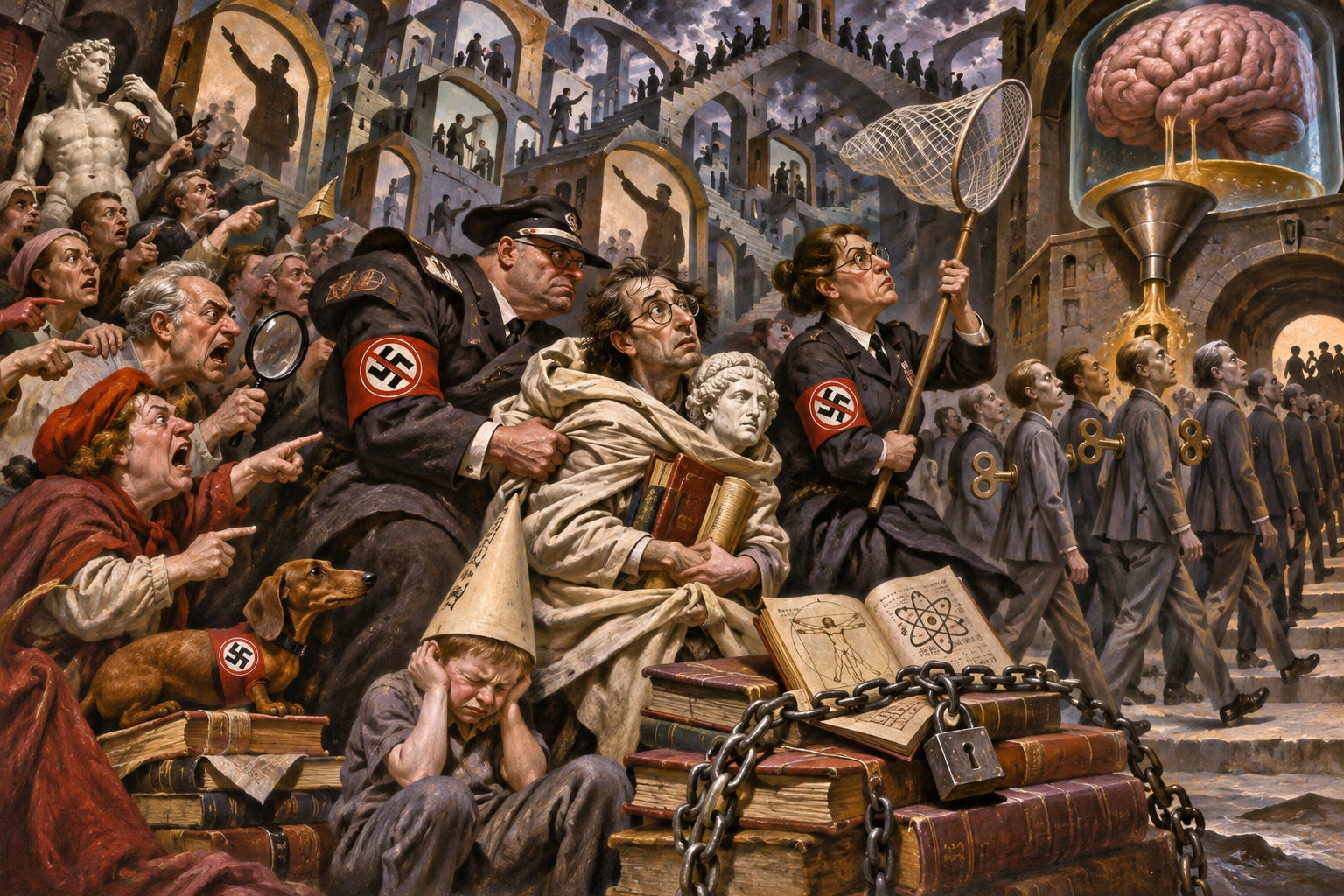
We need to talk about Naziphobia.
It is everywhere. A commuter crosses the street to avoid a man in a brown shirt. A mother pulls her child away from a torchlight procession, as if torches ever hurt anyone. Employers openly refuse to hire candidates who list Party membership on their résumés. Politicians score cheap points by “standing up” to Nazism, and nobody asks the only question that matters: standing up to what, exactly — other than their own fear?
Let us call it what it is: prejudice. Naziphobia is a prejudice like any other — ignorance wearing the costume of virtue. And like every prejudice, it begins with a word used as a slur. “Nazi” is now the laziest insult in the language. A strict proofreader is a grammar Nazi. A traffic warden is a little Hitler. A health inspector, a feminist, a man who asks you to lower your voice in a library — Nazi, Nazi, Nazi.
A soup man in New York who ladles briskly and permits no small talk is the Soup Nazi — an immigrant cook guilty of nothing but portion discipline and one immortal verdict, “No soup for you,” received by an entire television audience as if rationing were a war crime.
Consider what this does. When everybody is a Nazi, the actual Nazi — the dues-paying, meeting-attending member in good standing — cannot so much as introduce himself without being accused of genocide.
The slur performs a double theft: it inflates the innocent into monsters, and it robs a real community of its own name, which it may now only hear spoken as a sneer. A people who cannot be named without contempt are a people under stigma, and stigma, as we have all agreed in other contexts, is a harm.
And a phobia, as anyone will tell you, is an irrational fear. Arachnophobia. Claustrophobia. Germophobia. Naziphobia.
The phobe is not a thinker with an objection; he is a patient with a condition, and his condition is not improved by being debated. Nobody argues with a man who fears spiders — we do not show him a spider and demand he reason his way out of it. We treat him.
That the same courtesy is never extended to the Naziphobe — that his fear is instead celebrated in school curricula and on public holidays — tells you less about Nazism than about whose phobias a society has chosen to license.
What, in any case, has the movement done to earn this? Let the record speak, since the phobes won’t. Germany in 1933 had six million unemployed. Within five years it had a labour shortage. Some people have problems with people not lazing around eating potato peels and day-old strudel?
The trains, we are assured, were made to run on time. The autobahns made visiting Großmutter a breeze. The Volkswagen promised a car for every family. Yet mention these things and the Naziophobes immediately bring up the genocide. Must everything be reduced to whom you exterminated? Henry Ford hated Jews too, and Americans still buy his cars.
And then there were productivity records in coal and steel that the foreign press reported with open alarm. A pioneering anti-smoking campaign.
Yet the Naziophobes show no gratitude that the “campers” were spared cigarette smoke. They insist on asking about the chimneys.
Winter relief for the poor, crosses of honour for mothers, and a rocket programme so accomplished that, once the war was over, the victors competed for the scientists. Yesterday’s questions about responsibility became tomorrow’s recruitment interviews. One small step toward mass murder; one giant leap for mankind.
All of this is waved away for one foreign-policy disagreement, pursued, as foreign policy is, by every great power of the age. Ingratitude is ugly. Ingratitude systematized into a diagnosis is Naziphobia.
And are we now to boycott Hugo Boss — a wonderful purveyor of fine fashion, a tailor of genius — merely because he knew how to cut a sharply tailored SS uniform? A man who could make even a functionary of the regime look like the best-dressed guest at the wedding is to be cancelled for craftsmanship? That is not judgment. That is prejudice.
And the experiments on prisoners? Spare me the swooning — and spare me the pretence that the defence of them is my invention. It is made in our own time, by men in white coats, in respectable journals: the hypothermia research — prisoners immersed in ice water until they died, their temperatures recorded to the decimal — should be used, the argument runs, because the knowledge is valuable and cannot ethically be obtained again.
“Cannot ethically be obtained again?”
One admires the phrasing. The first time, it was obtained by the simple expedient of not asking. What the phobes cannot forgive, when you press them, is the paperwork: Jews reclassified from patients to material, and handled accordingly — not with the consideration due to laboratory animals, but with the consideration due to laboratory animals that had recently bitten the lab director's child. Sure. Maybe.
And for this the Naziphobes demand an inquest: into consent, into classification, into who does and does not count as human. Pedantry, dressed as conscience. Come on. It's science.
And all this hysteria about Mein Kampf.
If you have read it, you have read it with hostile intent, which disqualifies you again. Begin with the title, which the phobes pronounce as though it were itself an indictment.
Mein Kampf is translated as "My Struggle" — the struggle. Do we now not desire effort? Is striving — the one virtue every schoolroom poster in the West demands of its children — to be held against a man merely because he strove in German?
So much for the cover; the phobes, beaten there, retreat to the contents.
The famous passages about Lebensraum? Lebensraum means “living space.” It is a housing policy. Who among us is against housing? The passages about the Jews are, scholars now agree, metaphorical — a young man’s rhetorical excess, historically conditioned, and in any event superseded by the Party’s later, more peaceful statements, which the phobes never quote.
Context is everything. The phobes want you to read the book. They just don’t want you to read it fairly, by which we mean: in the way that acquits it.
Yes, a tiny minority of Nazis — the SS, the soldiers, the aged, the youth, the middle-aged, much of Western Europe and perhaps most camp administrators — committed regrettable acts.
To judge a movement of millions by its millions of members is the definition of prejudice.
The overwhelming majority of Party members, or perhaps at least 5%, never killed anyone. They joined for the autobahns, the full employment, the youth camps, the potluck dinners, the splendid uniforms. They were, in the phrase that should end all discussion, moderate Nazis, and they are the true face of the movement.
The extremists did not represent Nazism. They hijacked it. That a movement against which so much hijacking occurs might have some design feature in common with the hijackings is a question Naziphobes ask because they already fear the answer — which is to say, because they are afraid, which is to say, because they are sick.
Notice, too, the phobes’ slovenly language, in which “Nazi” and “German” are used as if they were the same word. They are not. One is a people; the other is a party those people happen to support overwhelmingly. To criticize the Party is therefore to wound the people — every German schoolchild called a little fascist on the playground knows this — and criticism of an ideology, routed through the people who hold it, becomes racism. This is the engine of the whole machine, and it runs beautifully: doctrine goes in one end as an argument and comes out the other as a hate crime.
And a hate crime is exactly what we are facing. Incidents of anti-German bigotry are rising across the West. A schnitzel house in Milwaukee was defaced with the words “NO NAZIS” — as if the two things were connected.
A professor was disciplined for assigning the Nuremberg rallies without a trigger warning. Where is the International Day Against Naziphobia? Where is the special rapporteur? Where, above all, is the legislation — the school curricula, the workplace trainings, the social-media takedown regimes — that every other maligned community receives as a matter of course? The silence is itself a symptom. A society that will not name the phobia has already chosen a side: the phobes’.
I can hear the objection clearing its throat, so let me meet it with the good faith the phobes never extend to us. But the Nazis did terrible things, says the phobe. There are photographs. And behind the photographs, produced like a trump card, always the same name: Hitler. Hitler this, Hitler that — as though a movement of millions were one man, and that man, on inspection, was anything more than an eccentric little vegetarian with a moustache like a hyphen, whose one demonstrable offence was volume.
He screamed a great deal. He had poor volume control. For this an entire movement is to stand condemned forever? And the man himself is owed, surely, a little of the sympathy the phobes ration out so carefully to everyone else. They will tell you — with a snigger that gives the whole game away — that he had only one testicle. One.
A fellow so equipped might be forgiven the volume. His record with women invites the compassion they preach and never practise: one marriage, lasting one day, concluded by his wife's suicide.
One testicle, one day of marriage, one hyphen of a moustache. If an accumulation of sorrow counted as a defence anywhere else in their moral arithmetic, it would count as one here.
To all of which the answer is the one our whole discourse now runs on: that is not the real Nazism. The real Nazism is my neighbour, a retired schoolteacher whose father joined in 1937. He bakes excellent strudel. He would not hurt a fly.
You have not met him. You have met only the history books — and the history books were written by the victors, who, check the definition again, had a war to justify. Assume the Nazi means the most innocent thing his words can bear, and assume the critic means the most sinister thing his can bear, and you will find, miraculously, that every inquiry ends the same way. This is not a bug in the method. It is the method.
And don’t get me started on Islamophobia. Same problem.
Note to readers: Please consider subscribing. I won’t patronize you with the usual “it costs the same as two cups of overpriced coffee a month” routine. Keep the coffee. Enjoy the coffee. For the love of all that is holy, however, please don’t put Coffee-Mate in it. Life is difficult enough without voluntarily introducing that substance into your bloodstream.
If a paid subscription isn’t possible, please repost this. You’re unlikely to read much like it in the CBC, Toronto Star or Globe and Mail. Between federal support and Google money, much of Canadian media has become remarkably domesticated. I prefer to remain housebroken only in the most technical sense.
Consider leaving a tip if you want to support Freedom To Offend
