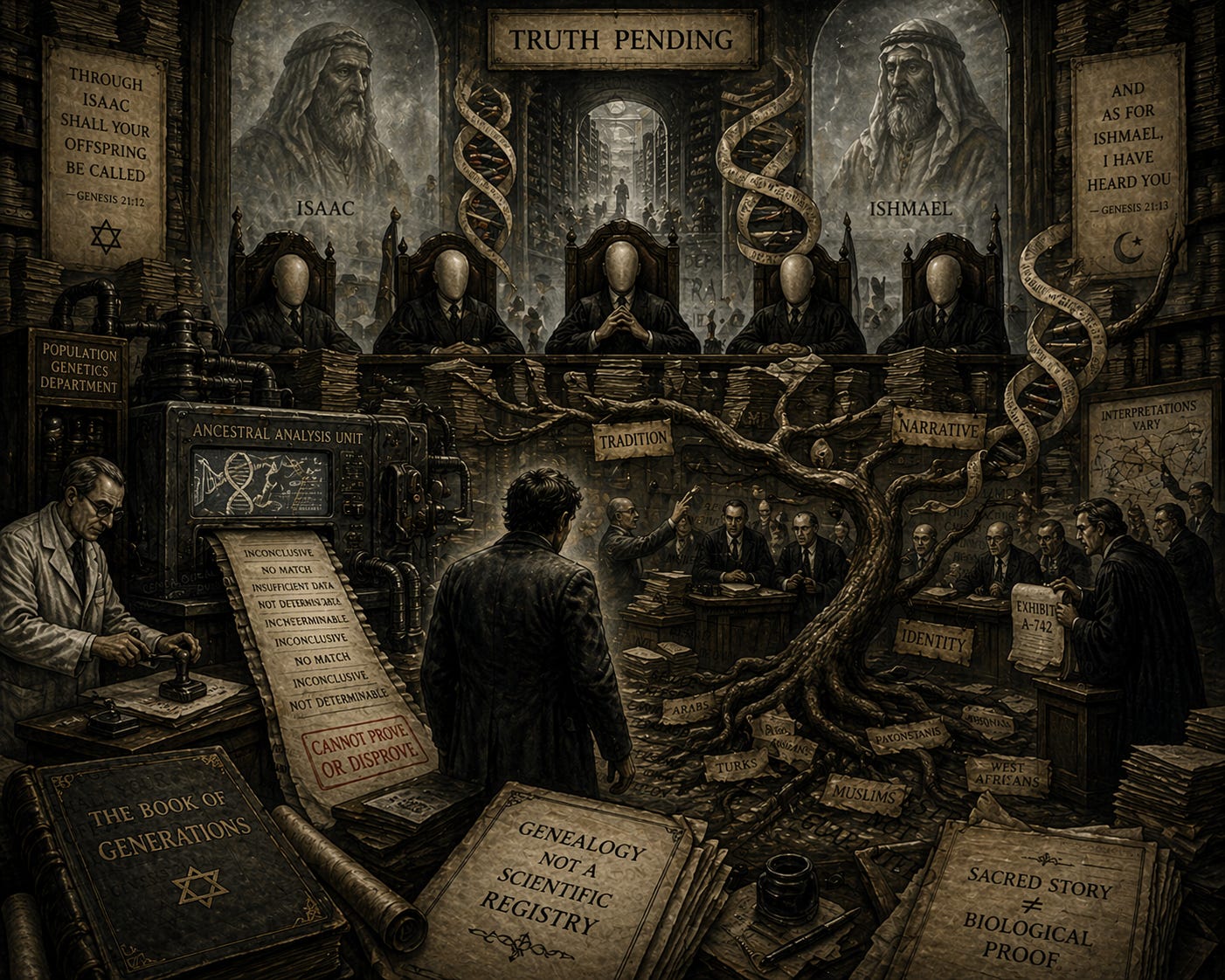
The Jewish people trace their covenantal line through Isaac—not as some parlour trick in ancestral vanity, but as the central claim of a civilization with a very long memory. “Through Isaac shall your offspring be called” is not decorative language. It is the narrowing clause—the defining line in the text. You may find that sort of exclusivity unfashionable, but scripture is not a modern HR policy; it makes distinctions and stands by them.
Now, before the gene-enthusiasts arrive with cotton swabs and grand declarations, let’s be clear about what genetics can and cannot do. You cannot swab a cheek, run it through a machine, and have it print out “Isaac confirmed.”
Genetics is not an Old Testament paternity test. It doesn’t work at the level of named individuals from four thousand years ago.
What it can do is more modest—and more useful. It can identify patterns: continuity, clustering and shared ancestry over long periods of time. And on that front, many studies of Jewish populations do in fact point to something notable.
Across Ashkenazi, Sephardi, and Mizrahi groups, there are consistent signals of shared Middle Eastern—specifically Levantine—ancestry.
Layered over that, of course, are centuries of diaspora, conversion, intermarriage, and local mixing. But the underlying pattern remains: this is not a people that simply imagined itself into being. There is a measurable degree of common lineage.
Even the often-abused priestly-line studies—the so-called Cohen markers—tell a restrained but interesting story. They do not prove Aaron, let alone Isaac. But they suggest that many who identify as Cohanim share a common paternal ancestry, preserved over the centuries. That’s not proof of scripture in a laboratory sense, but neither is it trivial. It points to continuity of a real tradition carried by a real population.
And here is where the contrast becomes unavoidable.
The claim that “the Arabs,” or worse still “the Muslims,” descend from Ishmael in any clear, universal, biological sense quickly collapses under scrutiny.
“Muslim” is a religious identity encompassing Indonesians, Persians, Turks, Pakistanis, Bosniaks and West Africans—hardly a single lineage. Even “Arab,” while narrower, is historically layered and genetically diverse. Population genetics does not reveal a clear, shared ancestry tying all these groups back to a single common ancestor. It reveals heterogeneity, mixture, and regional variation.
That does not make the Ishmael tradition meaningless. It places it where most ancient genealogies belong: in the realm of sacred narrative and civilizational identity. Historically, the identification of Arabs with Ishmael develops over time, gaining clarity and prominence in later interpretations. It may be a powerful story. But it is not a biological registry for millions of people across continents.
So the sober conclusion is this. There is no definitive genetic proof that Jews can trace a lineage to Isaac as an individual. But there is evidence of a notable degree of shared ancestry among Jewish populations—evidence consistent with long-standing continuity as a people. That does not prove Isaac. But it does not sit comfortably with the idea that the claim is pure invention either.