



Canada has many sacred cows. None is more protected—or less honestly discussed—than “supply management.”
It is presented as stability. It is defended as prudence. It is wrapped in the language of food security and rural preservation. But strip away the euphemisms and you are left with something much simpler: a state-backed system that forces tens of millions of Canadians to pay more for basic food in order to protect a small, politically powerful group of producers.
And now the stakes are no longer theoretical.
If Canada’s leadership is prepared to jeopardize broader economic negotiations—particularly with the United States—simply to avoid reconsidering supply management, then we are no longer discussing agricultural policy. We are deciding whether the country is willing to sacrifice the many for the few.
Start with the facts.
Supply management—covering dairy, poultry, and eggs—restricts production, fixes prices, and blocks foreign competition through steep tariffs. The result is predictable: higher prices.

Most credible estimates put the cost at roughly $300 to $444 per household per year. That may sound tolerable in the abstract. It is not tolerable to the millions of Canadians for whom groceries are a calculation, not a convenience.
And here is the part almost never stated plainly: this is a regressive transfer.
The poor spend a higher share of their income on necessities. When food prices are artificially elevated, the burden falls hardest on those least able to absorb it. This is not an abstract inefficiency. It is a quiet redistribution from the struggling to the secure.
It is the parent switching to cheaper, lower-quality food. It is the family cutting back on fresh products.
It is the constant arithmetic of what must be given up this week.
We speak in this country about “cost pressures” and “macroeconomic impacts,” as though we are discussing weather systems.
We hide behind bloodless numbers.
But when economic policy constrains growth, raises costs, or limits opportunity, the consequences are not theoretical. They are human.
When the economy weakens—even slightly—people do not experience it as a percentage point. They experience it as strain. As anxiety. As plans deferred or abandoned. As rising stress inside households already operating on narrow margins.
There is a reason economic downturns correlate with increases in mental health crises, addiction, and family breakdown. When opportunity contracts, lives contract with it. It is assured. But the voices that hurt are not heard, just the millionaires who sponsor ads to be played during hockey broadcasts.
And yet, all of this persists to protect what is, in population terms, a tiny fraction of Canadians.
Nor does the system even perform its own moral theatre convincingly.
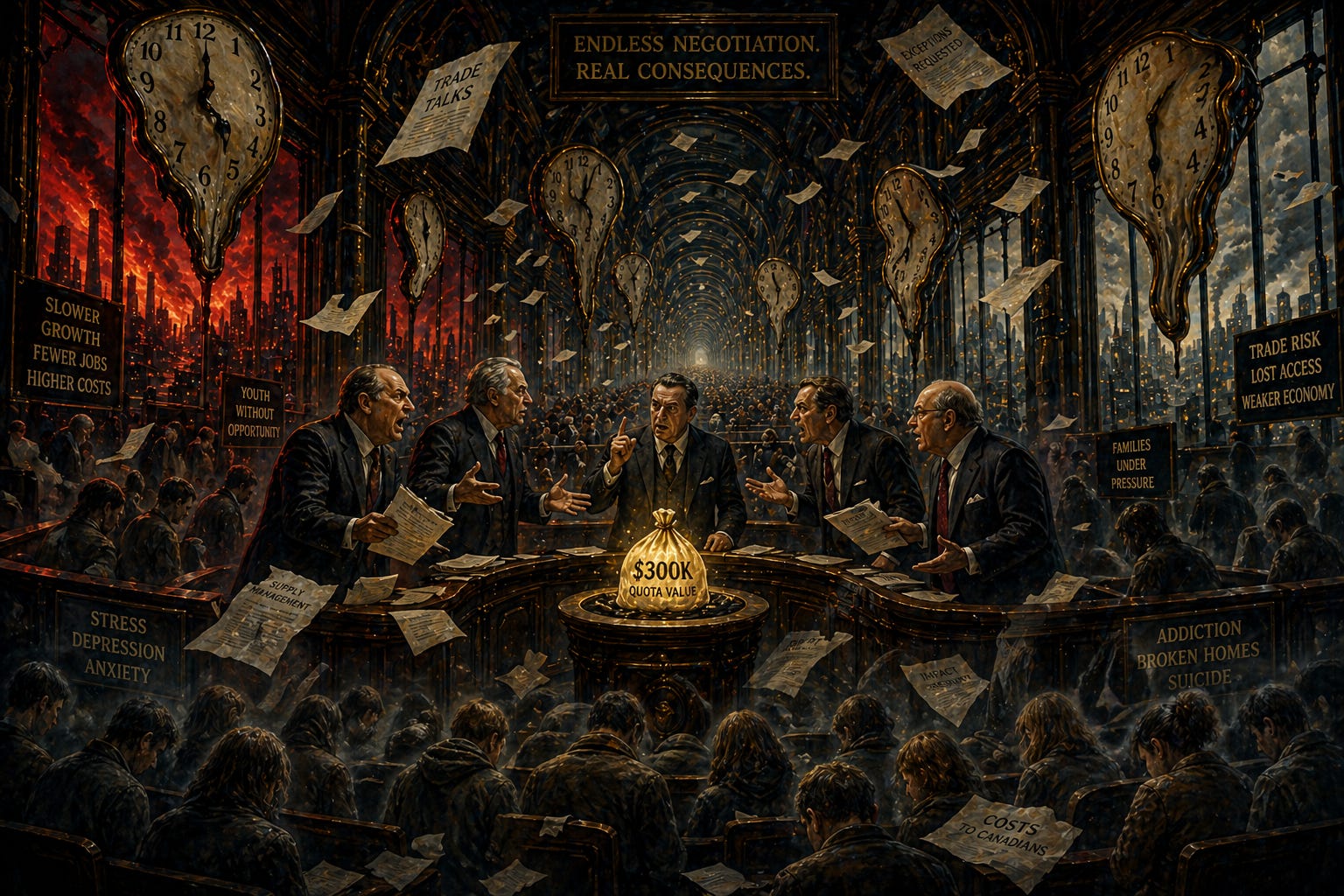
Supply management is sold as discipline and order.
In reality, it produces something closer to absurdity. Researchers have estimated that from 2012 to 2024, Canadian dairy farms wasted roughly 6.8 billion litres of milk—about 6% of all production—worth nearly $15 billion.
In Ontario, the numbers remain just as stark: in November 2025 alone, roughly 4.9% of the province’s milk supply was reportedly disposed of. They pull their trucks up to a ditch and dump the milk.
