


Fourteen Months. No Results. Just Words. How Long Will Voters Keep Buying It?
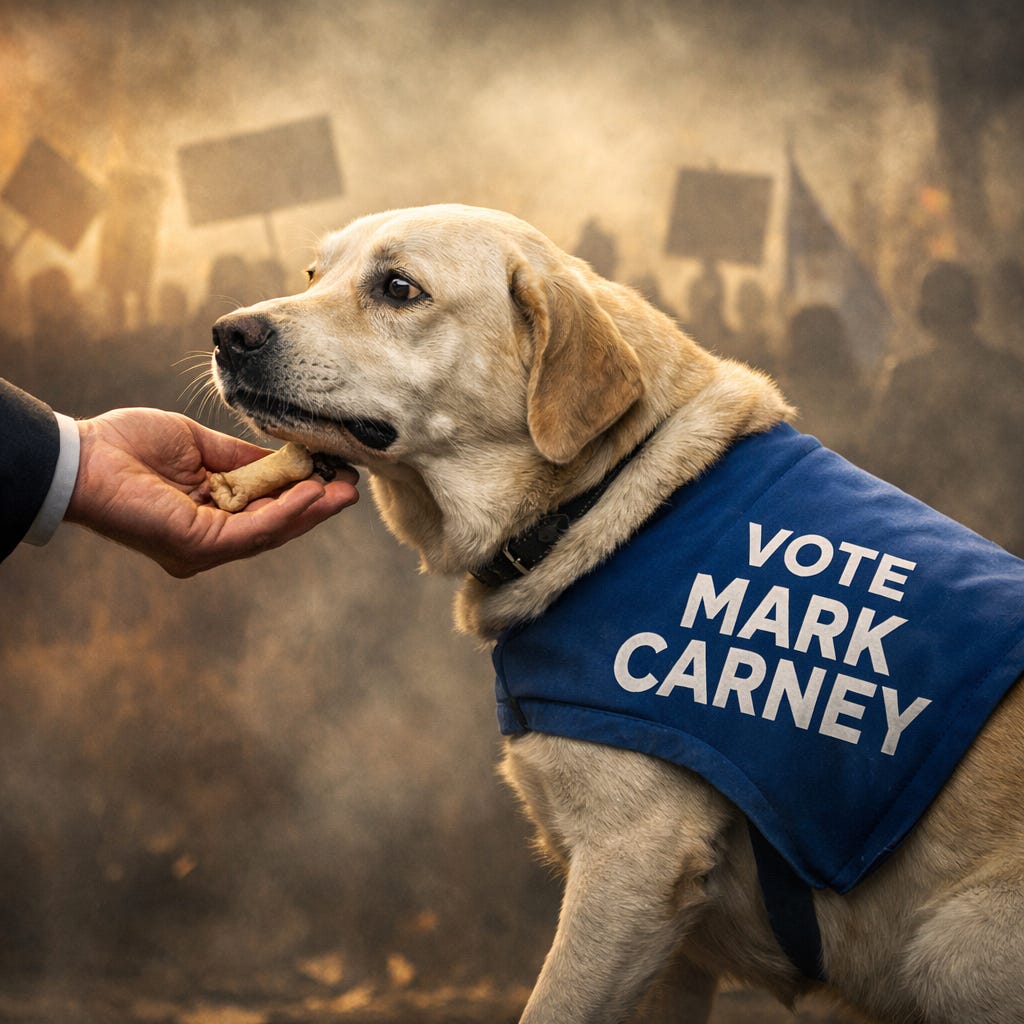
Mark Carney’s popularity is one of the strangest illusions in modern Canadian politics. Fourteen months into his tenure, the ledger is remarkably thin: no major nation-building projects underway, no visible acceleration in growth, no breakthrough on interprovincial trade, no meaningful expansion of Canada’s energy capacity. And yet the brand holds. The speeches land. The tone reassures. The promise of competence lingers, even as the substance fails to appear.
At some point, a country has to ask a very simple question: how long will voters support a leader who delivers words without action?
Carney promised to tackle interprovincial trade barriers—one of the most obvious, solvable drags on the Canadian economy. Nothing has changed. He spoke of restoring growth, of unlocking productivity, of making Canada competitive again. The numbers do not reflect a turnaround. He invoked the language of an “energy superpower,” suggesting urgency, scale, ambition. And then, in the middle of an energy crisis, he raises the carbon tax.
That is not a contradiction by accident. It is a contradiction by design.
Because the reality is this: Carney cannot do what he says he will do. Not because Canada lacks resources. Not because the economics do not work. But because delivering on those promises would require him to confront the very coalition that put him in power.
You do not build pipelines, LNG terminals, and export capacity while governing alongside a political ecosystem that has spent a decade opposing those very things. You do not suddenly accelerate approvals when your regulatory culture has been trained to delay, expand scope, and litigate. And you certainly do not dismantle that system while relying on the support of those who built it.
No leader governs against his base for long. And Carney will not be the exception.
This is why the “energy superpower” line has the feel of advertising rather than policy. It is a slogan designed to reassure voters who sense decline, not a plan grounded in political reality. Because the same government that claims urgency continues to signal hesitation. The same leadership that invokes growth continues to impose costs on the very sector it claims to want to expand.
It is not seriousness. It is performance.
And the performance extends beyond energy. Carney’s much-discussed foreign policy framing—“middle power unity,” a kind of rhetorical embrace of solidarity among nations uneasy with American unpredictability—sounds impressive until one asks what it actually produces. A speech filled with borrowed gravitas, references deployed more for effect than clarity, and a familiar conclusion: we must come together, we must stand firm, we must be serious.
Fine words. But what followed?
No shift in Canada’s economic trajectory. No surge in investment. No visible change in the country’s strategic position. The gap between tone and outcome remains intact.
Meanwhile, the underlying problems worsen quietly. Younger Canadians struggle to find stable work. Housing remains out of reach for a growing share of the population. Productivity stagnates. Investment hesitates. And yet much of the electorate remains curiously untroubled.
Why?
Because politics, increasingly, is not about outcomes. It is about atmosphere.
If you are employed, if your mortgage is manageable or already paid, if your immediate surroundings are stable, the broader decline can feel abstract. Someone else’s problem. Someone else’s child living at home at twenty-eight. Someone else’s graduate sending out résumés into a void. The system, for now, still works well enough for enough people that urgency never quite takes hold.
And so the performance continues.
Carney speaks of ambition while governing within constraint. He promises transformation while preserving the structures that prevent it. He signals urgency while implementing policies that move in the opposite direction. And through it all, the brand remains intact: competent, serious, reassuring.
But a country cannot live indefinitely on tone.
The Hormuz crisis, and the broader instability it represents, has exposed something deeper. Canada is not constrained by geology or by lack of demand. It is constrained by its own choices. Projects cancelled. Timelines stretched. Capital discouraged. A decade spent treating energy as something to be managed rather than developed.
And now, faced with the consequences, the country is offered words.
How long will that be enough?
Fourteen months have already passed. There is no evidence, yet, that the next fourteen will be any different.
Wow! Whoda thunk it? A liberal who talks the talk but doesn't walk the walk. Who only makes vapid promises he has no intention of fulfilling. When's the last time we saw that...? Won't matter. Libs vote lib because they will not vote conservative. Ever. Not even once. They'd rather see us become Eritrea than conservative.
"Fourteen months have already passed. There is no evidence, yet, that the next fourteen will be any different." Too true.