


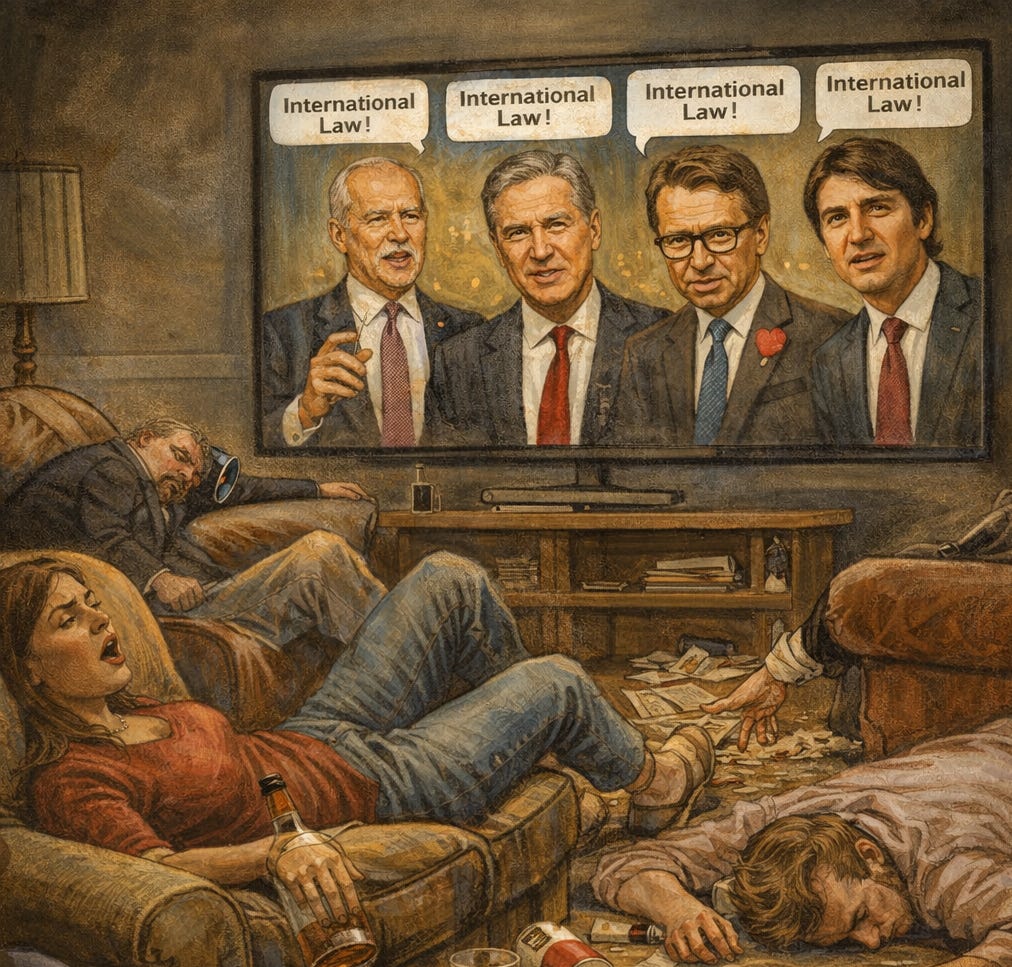
If one wished to devise the most efficient drinking game ever invented, one could do worse than gathering a few friends, placing a respectable bottle on the table, and turning on any modern panel discussion about foreign policy.
The rules would be simple: every time a politician such as Mark Carney, Keir Starmer, or one of their well-laundered colleagues from the progressive establishment invokes the phrase international law, the players must take a drink.
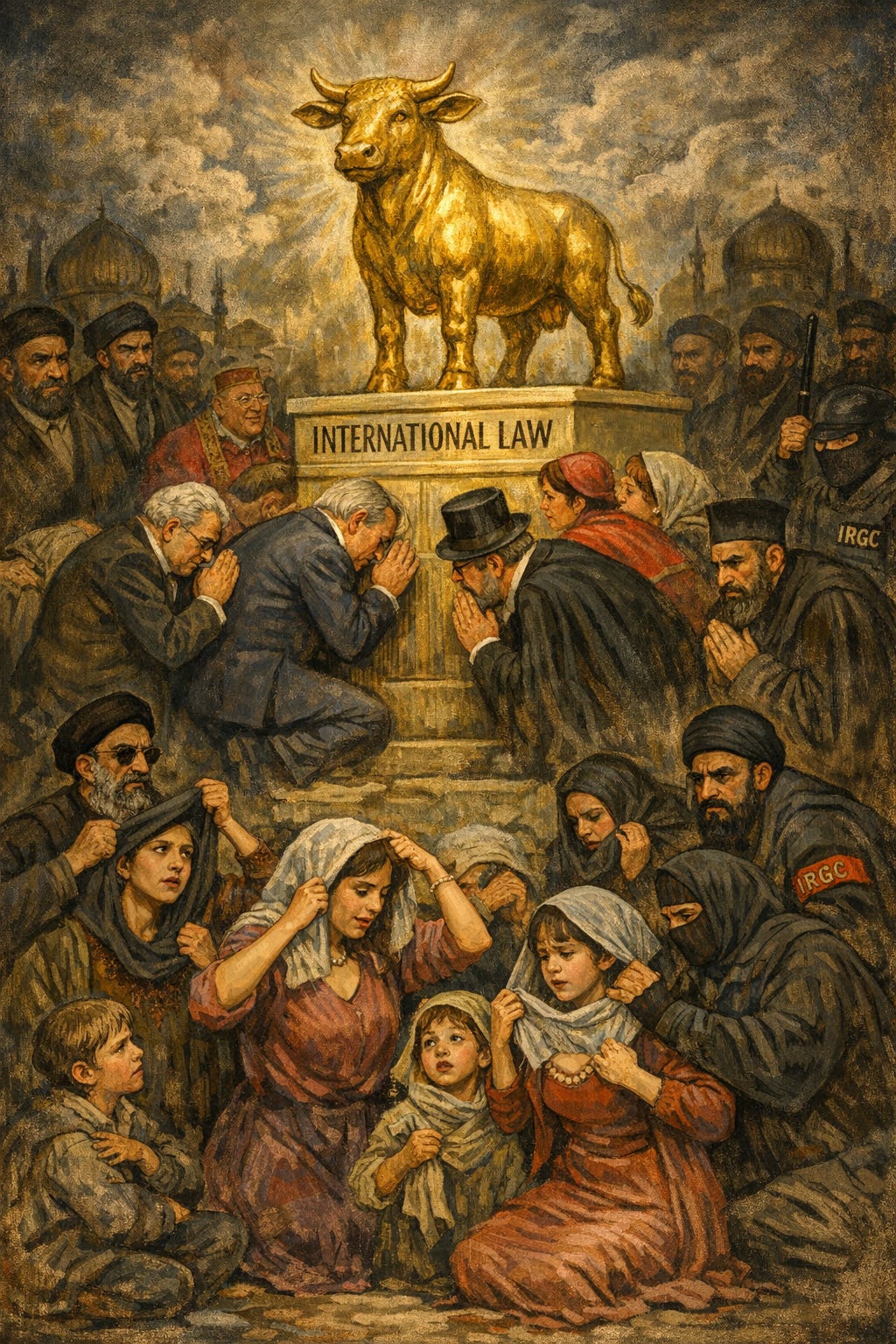
Within an hour, the participants would be unconscious. Within two, the liver would be filing for divorce. Because the phrase has become ubiquitous. It is repeated with the rhythmic insistence of a liturgical chant: international law, international law, international law. It is invoked not as an argument but as a sacrament—as though the utterance itself settles the matter. One imagines the phrase descending from Mount Sinai engraved upon tablets carried down by diplomats rather than by Moses.
The trouble is that the phrase conceals a rather awkward truth. Law, in any meaningful sense, requires enforcement. Domestic law functions because there are courts, police, and prisons. There exists a sovereign authority capable of compelling obedience when obedience fails.
If a burglar enters your home, the state possesses the force required to restrain him. International law has none of this. There is no global sovereign, no international police force capable of enforcing compliance, no world government empowered to compel obedience. What we actually possess is a patchwork of treaties, conventions, and agreements among sovereign states that obey them primarily when it suits them.
And here lies the paradox that the phrase international law politely conceals: the countries most constrained by international law are precisely those countries most inclined to obey rules in the first place—liberal democracies in the West. The regimes least inclined to obey rules—autocracies, theocracies, military dictatorships—face no meaningful enforcement mechanism when they choose to ignore them.
Thus, the supposed universal law operates less as a universal system than as a moral restraint placed primarily upon the very nations least inclined toward barbarism.
One may safely assume that in the strategic planning rooms of the Taliban, in the paranoid underground complexes of North Korea, in Vladimir Putin’s offices in Moscow, or in the clerical bureaucracy of Tehran, the phrase international law does not carry quite the same devotional significance that it does in Ottawa panel discussions.
The ayatollahs do not pause before sending morality police into the streets and ask whether the Geneva Conventions would approve of their behaviour.
Boko Haram does not consult the International Court of Justice between kidnappings. The militias slaughtering civilians in Sudan do not pause to examine the footnotes of the UN Charter.
Yet the phrase appears with remarkable regularity when Western democracies contemplate acting against such regimes. This is the curious asymmetry of modern moral discourse. In Syria, hundreds of thousands died under Assad’s regime while chemical weapons were used against civilians. In Yemen, war and famine have claimed hundreds of thousands of lives. In Sudan, militia violence has turned entire regions into slaughterhouses. In Nigeria, jihadist massacres have continued for years. And yet, the phrase "in tends to arise most urgently ” most urgently when democratic nations consider intervening against the perpetrators of such atrocities.
One begins to suspect that the invocation of international law functions less as a universal principle than as a mechanism of restraint applied selectively to the West.
This selective restraint becomes particularly strange when one considers the modern hostility to the idea of pre-emptive action. The prevailing interpretation of international law insists that democracies must wait until aggression has fully materialised before responding.
It is rather like instructing a homeowner to wait until the burglar has finished climbing through the window before defending himself.
History offers inconvenient examples of the absurdity of such logic. Canada entered the Second World War in 1939, not because it had been invaded but because Nazi Germany represented a threat to civilisation itself. If today’s legalistic interpretation had prevailed, then Canada might have been instructed to remain neutral while Europe collapsed under totalitarian rule. But such historical reflections rarely intrude upon the moral theatre of modern diplomacy.
Instead, we are treated to the spectacle of politicians invoking the “international rules-based order,” a phrase that sounds impressive until one examines it closely. A rules-based order implies universality. But when only a handful of nations follow the rules while the rest violate them with impunity, what exists is not an international order but a Western one. The phrase survives because it is useful. It allows politicians to clothe policy positions in the language of moral seriousness without confronting the practical reality that international law lacks the enforcement mechanism necessary to function as genuine law.
Which brings us, inevitably, to the curious case of Canada’s current Prime Minister. Mark Carney recently warned that responses to geopolitical crises must respect the international rules-based order. It was a performance delivered with the careful gravity of someone addressing a Model United Nations club at a well-meaning high school.
The tone was earnest. The phrasing was dutiful. One-half expected the speech to conclude with applause from the Luxembourg student delegation.
Yet what made the performance particularly striking was the context that surrounded it. Estimates remain unclear, but reports suggest that anywhere from thirty to forty thousand protesters may have been killed in Tehran in recent weeks.
Young women leave their homes to join demonstrations and do not return. Parents stand over freshly dug graves. Protesters who are wounded and seek medical help discover that hospitals themselves have become instruments of intimidation: doctors are threatened by the IRGC that treating injured demonstrators will result in imprisonment or death.
This is the regime in question. A regime that has presided over the deaths of well over a million people through its own repression and through the activities of the militias and proxy organisations it has funded across the Middle East since 1979. A regime that has made terrorism a permanent feature of its foreign policy. A regime that continues to threaten the stability of the wider world.
It is a country that brazenly tells inspectors that it will have nuclear weapons and that it will wipe Israel off the map.
And when Israel and the United States respond to this reality—to the decades of terror, to the ongoing repression, to the mass graves filling in Tehran—the response from Canada’s leadership is to inform the grieving parents standing beside those graves that Canada prefers restraint.
Not the removal of the mullahs. Not decisive action. Instead, another panel discussion—another solemn gathering chaired by Mark Carney in which he misquotes Thucydides.
Thucydides, the original anatomist of realpolitik, observed that in the brutal arithmetic of international affairs, the strong do what they can and the weak suffer what they must—not as a moral endorsement but as a sober description of reality.
One suspects he would have advised Canada to remain anchored to its democratic allies rather than drifting toward the strategic orbit of authoritarian powers. That nuance, however, seems to have eluded the earnest intern who hurriedly consulted a summary of Thucydides on ChatGPT the previous afternoon, before Carney thrilled Davos.
The result is the usual spectacle: Carney invoking Thucydides incorrectly, misrepresenting Václav Havel, and summoning yet another literary authority whose works appear to have been skimmed somewhere between the press release and the podium.
It would be difficult to design a more grotesque contrast between rhetoric and reality.
The irony deepens when one considers the geopolitical realities that polite diplomatic language tends to obscure.
Iran does not exist in isolation. Its regime operates within a network of alliances that includes one particularly powerful partner: China. China purchases large quantities of Iranian oil, reportedly 90%, providing the regime with economic oxygen. It invests in infrastructure that strengthens Iran’s security apparatus.
Tehran, in many respects, serves as a regional instrument within Beijing’s broader strategy to weaken Western influence. Yet while this axis of cooperation continues, Canada’s leadership appears increasingly eager to distance itself from the United States—the most powerful liberal democracy in history and Canada’s closest ally—while flirting with a strategic pivot toward Beijing. One might think that such a geopolitical shift would require careful explanation. Instead, we are treated to lectures about international law.
The entire performance has a familiar political rhythm. First comes the solemn declaration of principle. Then comes the sudden reversal when polling data suggests that a different tone might be electorally advantageous. Because this is where the story ceases to be about international law and becomes about domestic politics.
There is a good reason to suspect that Canada may soon be heading toward a spring election. The choreography would be simple. Irritate Washington. Encourage a predictable reaction from Donald Trump. Then wrap oneself in the Canadian flag and present the moment as a patriotic confrontation with the neighbour to the south.
The man who has spent years abroad will suddenly appear in a Team Canada hockey jersey, urging national unity in the face of foreign pressure. And Canadian voters—whose political instincts occasionally resemble those of excitable hockey spectators—will rally enthusiastically.
It is a clever manoeuvre. It also has very little to do with principle. Because beneath the rhetoric of international law, beneath the speeches about the rules-based order, beneath the sudden moral lectures delivered to allies while authoritarian regimes operate with impunity, lies a far simpler political truth.
Canadians are being conned.
The performance is not about justice. It is not about international law. It is not about the suffering of protesters in Tehran or the victims of Iran’s proxies across the Middle East. It is about power. And power, unlike international law, is something politicians understand perfectly well.
May God bless the innocent people of the great Persian nation of Iran. May the tyrants of the mullahocracy be expelled from power. May justice, fairness, liberty, and representative democracy be restored to the Iranian people. And may their long suffering—endured since 1979 under the tyranny of the clerical regime—finally come to an end.
And may God bless the United States, Israel, and their allies as they confront, challenge and destroy the tyrants of Iran.
And may the citizens of Canada, the United States, the West, and Iran remember something our age seems eager to forget: liberty is not preserved by men who recite phrases about “international law” while tyranny carries on unimpeded. At some point, the world must decide whether it prefers justice—or merely the sound of its own moral vocabulary.
May they remember that the right to live freely—to walk in the street without fear, to speak without censorship, to uncover one’s head without persecution, and to exist without the boot of the IRGC or the decrees of clerical kleptocrats pressing upon one’s neck—is not granted by the conferences of diplomats.
And may they never allow justice, fairness, truth, and the right to live without oppression to kneel before the arbitrary pronouncements of those who style themselves the custodians of international law, least of all Canada’s own Mark Carney.
If you value this work, consider leaving a tip. It’s cheaper than therapy, less pious than public broadcasting, and the only censorship here is my bad taste. On second thought, it’s bad therapy.
Psalm 31:8-9
“Defend the weak and the fatherless;
uphold the cause of the poor and the oppressed.
Rescue the weak and the needy;
deliver them from the hand of the wicked.”
International Law is, indeed, the emperor with no clothes. Thanks for being the little boy who says it out loud.
I do enjoy reading your musings as you are really a terrific writer.
I do think you've missed or at least avoided referencing Carney's original comments of support for the war.
“Canada’s position remains clear: the Islamic Republic of Iran is the principal source of instability and terror throughout the Middle East,”
“Canada supports the United States acting to prevent Iran from obtaining a nuclear weapon and to prevent its regime from further threatening international peace and security.”
For me, that was and is his true perspective and then sadly it was then tempered incorrectly by political interference from his own party.