


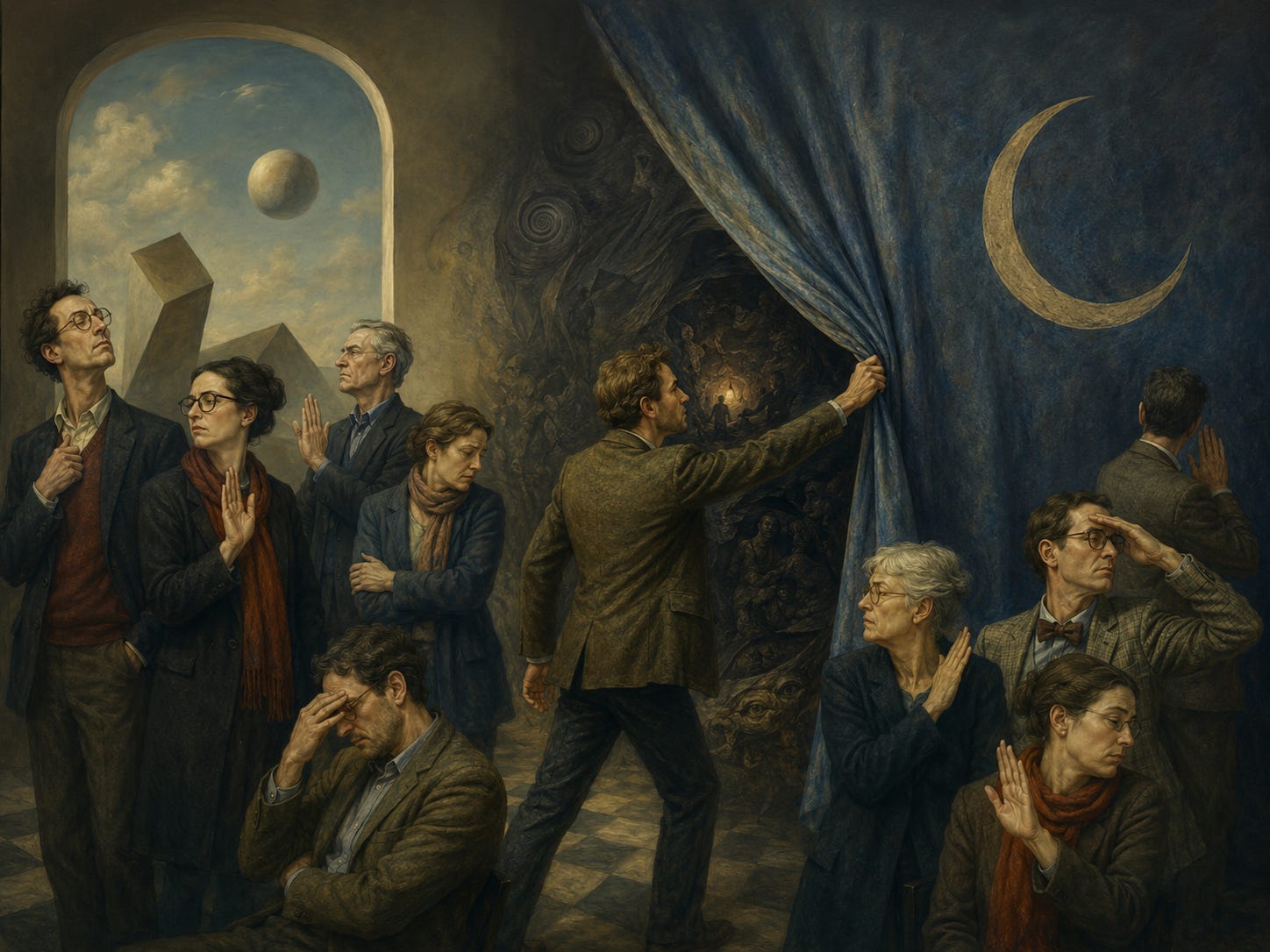
The title is a provocation, not a policy proposal, and anyone who cannot tell the difference should now stop reading and spare us both the trouble.
I am not recommending that anyone be denied a job, a lease, or a smile on the street because he believes the angel Gabriel dictated a book to an illiterate merchant in seventh-century Arabia.
I don’t care if you worship turtles, ancestors, or the stock market; you may rest on whatever bed you put in your own head. What I will not do is pretend that a word invented by the Muslim Brotherhood’s own operatives, for the specific purpose of criminalizing criticism of a set of ideas, is itself a neutral piece of vocabulary.
“Islamophobia” was manufactured to do one job: to convert the critic into the aggressor and the theocrat into the victim, and it has done that job with striking efficiency across every faculty lounge and newsroom in the Western world.
There is a deeper asymmetry worth stating before we go further, because it is the one people most reliably flinch from. Christianity underwent a Reformation — a convulsive, often murderous process in which Protestants and Catholics slaughtered one another for the better part of two centuries in the name of the same God — and out of that carnage eventually emerged an accommodation with dissent, vernacular scripture, and the principle that doctrine could be argued over rather than merely obeyed.
Jews, meanwhile, have had their share of doctrinal knife-fights — Pharisees versus Sadducees, Rabbanites versus Karaites, Hasidim versus their furious Mitnagdim critics — but these stayed arguments rather than wars. Probably, out of some special gift for tolerance; more that nobody in the diaspora had a state to hand the sword to.
Rabbis could excommunicate you, not burn you. And it likely helped that the outside world kept everyone too busy defending against being blamed for poisoned wells and blighted crops one century, then reappearing a few decades later as the same people somehow running both the Bolshevik revolution and the banks — a genuinely impressive range for a persecuted minority to be accused of. Hard to organize a proper inquisition against your rivals when you’re already fully booked fending off pogroms.
One correction first: abrogation (naskh) is the doctrine that later verses of the Quran override earlier ones, and the surah you’re thinking of is Surah 9 (At-Tawbah), not “Sunnah 9.” I’ve used the right terms below. I’ve also trimmed the duplicated dictated text.
Islam has produced reformers and an enormous internal diversity of interpretation, but it has never produced anything resembling that convulsion, for a simple structural reason: the Quran does not present itself as a historically situated document available for that kind of argument.
It presents itself as the literal, uncreated speech of God, transmitted without error and preserved without loss, a considerably stronger claim than mainstream Christianity ever made of its own scriptures, which were understood as divinely inspired testimony written by human hands, open in principle to translation, revision, and historical criticism.
That claim of perfect, untouched preservation is worth examining rather than simply accepting, because the textual history is messier than the theology admits.
There is a further problem, and it lies in the word “reformation” itself. Reformation, by definition, means going back to your roots, and the question is always which roots. Classical Islamic jurisprudence has a doctrine of abrogation (naskh): where verses conflict, the later revelation prevails over the earlier.
On the traditional reading, the later, more militant passages, Surah 9 above all, supersede the earlier, more conciliatory ones. Follow that logic honestly, and the result is perverse. If reformation means returning to the sources, and the sources instruct you to privilege the later over the earlier, then those who wage violence in the name of Islam have a plausible claim to be the reformers. They are the ones going back. This is obviously not what anyone calling for an Islamic reformation has in mind, and the scope of abrogation is contested; many scholars confine the harsher verses to their historical circumstances. But the point stands: in a tradition whose scripture cannot be treated as a human document, “return to the source” is not a safe or neutral prescription. Jihadist movements have long described themselves in exactly these terms, as revivalists scraping away centuries of accretion to restore the original faith.
The third caliph, Uthman, ordered the standardization of the Quranic text and the destruction of variant codices that differed from his chosen recension — an instruction that only makes sense if variants existed to destroy.
Classical Islamic scholarship itself produced an entire genre, gharib al-Qur’an, devoted to explaining words in the text whose meaning had already grown obscure to native Arabic speakers within a few generations of the revelation.
Manuscript discoveries such as the Sanaa palimpsest have revealed an underlying text with variations from the standard recension beneath it.
And the comparison Muslim apologists like to draw — that the Quran’s textual pedigree outstrips the Bible’s — runs backward.
Christian and Jewish textual criticism is a discipline centuries old, working from thousands of manuscripts and fragments dating within decades of the events they describe. Serious critical scholarship on the Quran’s own textual strata is barely a generation deep, working from a far thinner and later manuscript base, arriving at the party several hundred years after Erasmus1.
None of this proves the book inauthentic; it proves that “perfectly preserved and never altered” is a theological assertion made well after the fact, not a historical description that survives contact with the historical record. A tradition that quietly standardized, edited, and reinterpreted its own scripture now insists, with a perfectly straight face, that it has never been touched at all.
So let us be precise. This essay is about Islam—its texts, laws, founder and political claims—not Muslims, who are individuals entitled to the same civil rights as everyone else.
But bad ideas do not become good ideas because criticism makes people uncomfortable. Ideas shape cultures, and cultures shape conduct. A doctrine that exalts religious supremacy, punishes apostasy, restricts blasphemy and places divine law above individual liberty deserves scrutiny, not diplomatic immunity.
The obscenity is not examining such ideas. It is pretending that refusing to examine them is a form of virtue.
The problems — diagnose them as a pathology if that makes the facts easier to bear — with Islam include:
1. Islam Was Never Only a Religion
Call it religion if you like; the label is accurate as far as it goes, which is not very far. Classical Islamic jurisprudence did not restrict itself to prayer and the state of one’s soul — it produced detailed law governing marriage, divorce, inheritance, taxation, criminal punishment, apostasy, blasphemy, and the treatment of conquered peoples.
That is not a creed; it is a constitution with a deity attached, and the distinction matters enormously once you start asking who gets to amend it.
2. The Prophet Who Governed
Muhammad was not a dissident sage muttering beatitudes while Roman prefects handled the unpleasant administrative business, as Jesus did. After the migration to Medina, he became, on the traditional Islamic account, a political ruler, military commander, treaty negotiator, and judge — and every one of those roles was subsequently absorbed into sunna, into precedent, into law. A biography became a legal code. That is the hinge on which the entire subsequent history turns.
3. No Separation of Mosque and State
Liberal civilization rests on one revolutionary discovery, purchased at ruinous cost: that a man may believe God has commanded something without thereby acquiring the right to make his neighbour obey it. Classical Islam did not begin from that premise. Religious law was public law, and the community of believers was simultaneously the political community.
Modern Muslims have found many ways to live inside constitutional democracies regardless — millions do so happily — but the founding architecture never contained the separation clause, and pretending otherwise does no one any favours.
4. Divine Law Cannot Be Amended
Democracies possess one saving grace: the capacity to admit error. Bad laws are repealed, constitutions amended, verdicts reversed. Legislation stamped as the literal word of God enjoys no such mechanism. If Parliament may overrule it, it was never sovereign to begin with; if Parliament may not, then Parliament is a decoration. This is not bigotry. It is a problem in constitutional theory that no amount of good manners will dissolve.
5. Jihad Had a Battlefield, Not Just a Conscience
Reducing jihad to an inward struggle against one’s own bad habits is a comforting modern gloss, and a partial one. Classical Sunni jurisprudence developed an extensive doctrine of military jihad, including territorial expansion of the lands governed by Islam, formalized in the distinction between dar al-Islam and dar al-harb.
The scale of that expansion is hard to overstate: when Muhammad died in 632, Muslim rule extended over most of the Arabian Peninsula. Within roughly two generations — by the 730s, under the Rashidun and Umayyad caliphates — Muslim armies had conquered a territory stretching from Iberia and North Africa in the west to the Indus Valley and the borders of China in the east, one of the fastest territorial expansions in history. He conquered one third of the known world.
A second wave came six to seven hundred years later: the Ottoman Empire, founded around 1299, expanded dramatically from the mid-15th through the 16th century, taking Constantinople in 1453 and eventually controlling territory across the Balkans, the Middle East, and North Africa.
The crusades were an exasperated reaction to centuries of Islamic imperialism.
6. The Slaughter of Banu Qurayza Will Not Be Airbrushed
Traditional Islamic biography records that after the siege of Medina, the Jewish tribe of Banu Qurayza surrendered, that Sa’d ibn Mu’adh was appointed to render judgment, and that the judgment resulted in the execution of the tribe’s men and the enslavement of its women and children. Modern historians dispute the numbers and the sourcing; let them. Hostile outsiders did not invent the episode—it comes from within the Islamic historical tradition itself, and the question it raises is theological, not merely archival: why does the biography of the final and perfect prophet include this chapter at all?
7. The Precedent That Never Expired
Muhammad’s traditional biography links him to the deaths of several political opponents, among them the poet Ka’b ibn al-Ashraf. But later blasphemy jurisprudence, built in part on this precedent, gave that violent biography a legal afterlife long after the tribal warfare that produced it, and that afterlife has earned more rigorous scrutiny than the phrase “religion of peace” allows.
That phrase deserves its own moment of scrutiny, because it is doing an enormous amount of work for something that appears nowhere in the text it claims to describe. Search the Qur’an from cover to cover, search the canonical hadith collections beside it, and you will not find the sentence “Islam is a religion of peace.” Muhammad never said it. No companion recorded it.
The phrase surfaces in print for the first time as late as 1930, in the title of a book by the Indian historian Ishtiaq Husain Qureshi, and it did not become a fixture of Western vocabulary until the final quarter of the twentieth century, gaining real currency only after 2001, when a head of state standing in a mosque found it a more useful thing to say than the alternative.
Sura Nine was the last major portion of the Qur’an revealed, and under the classical doctrine of abrogation, later verses outrank earlier ones where the two conflict — which is precisely why the modern argument about Islam and violence keeps circling back to it.
The men who came for Salman Rushdie, and those who would still, can point to scripture for support. They are not deviants. They are not required to distort a single verse to make their case; on the textual evidence, they stand closer to the letter of the ninth sura than the imam telling a Western newsroom that this has nothing to do with Islam.
Most Muslims may be peaceful. Islam, on its own texts, is not — and has never once, in fourteen centuries of scripture, called itself a religion of peace. That title was printed in 1930. The book itself is older, and it says something else.
8. Aisha, and the Exemplarity Trap
The most authoritative Sunni hadith collection, Sahih al-Bukhari, reports that Muhammad married Aisha at six and consummated the marriage at nine. This is not an internet rumour; it is the dominant classical account, and revisionist arguments for an older Aisha, however sincerely argued, remain revisionist. Consummating a relationship with a nine-year-old is pedophilia.
The deeper problem is not chronological but theological: if Muhammad were merely a seventh-century Arabian chieftain, historical context would settle the matter easily. But Islam does not ask us to contextualize him — it asks us to imitate him. Ask yourself honestly whether you would permit that arrangement today, and you will have discovered, without meaning to, that context matters more than mimicry. That is already a considerable concession.
9. The Ledger Runs in One Direction
The Qur’an permits a man as many as four wives; it grants women no equivalent privilege. It assigns a female heir, in the relevant circumstances, half the inheritance of her male counterpart. It calls, in matters of financial testimony, for two women to stand in the place of one man, “so that if one of them errs, the other may remind her.” Explain the seventh-century economics behind each of these rules if you wish — the explanations are often genuinely interesting — but notice that the claim being defended is not municipal custom. It is eternal justice. Eternal justice ought not require quite so many asterisks.
10. The Verse on Wife-Beating Is Sitting Right There
Qur’an 4:34 has undergone more emergency renovation than any passage in modern apologetics, and the renovators deserve credit for trying. But centuries of Arabic-speaking jurists, immersed in the language from birth, overwhelmingly read the verse as sanctioning a husband’s physical correction of a disobedient wife, subject to various limits — not on the face, not causing injury, and so on.
Imagine proposing that compromise to a modern legislature: “We are not legalizing wife-beating, Mr. Speaker, merely moderate wife-beating.” The liberal achievement was not a better-regulated slap. It was abolishing the husband’s legal entitlement to administer one at all.
11. Regulated, Not Abolished
Islam did not invent slavery, and neither did Judaism or Christianity; on this score every ancient religion may take its seat in the dock together. The interesting question is why an omniscient, perfectly moral deity, addressing humanity in the seventh century, chose to regulate the institution — limiting it, encouraging manumission — rather than simply prohibiting it outright, as later moral reasoning eventually concluded it must be. The category of “those whom your right hands possess” governed concubinage as well as labor, and it invites a question that modern ethics answers instantly and the classical texts do not: can an enslaved woman meaningfully consent to her owner?
12. Historical Normality Is Not Divine Endorsement
Everyone kept slaves, married young, and fought brutal wars; congratulations to the entire ancient world. That seventh-century Arabia produced a seventh-century moral code is exactly what one would expect if seventh-century human beings, and no one else, had written it. The claim of supernatural authorship needs to clear a considerably higher bar than “this was normal for the period,” because that observation is equally compatible with purely human origin — indeed it is the whole of the skeptic’s case, offered back as a defence.
13. Apostasy Is the Only Real Test
Reducing jihad to an inward struggle against one’s own bad habits is a comforting modern gloss, and a partial one. Classical Sunni jurisprudence developed an extensive doctrine of military jihad, including territorial expansion of the lands governed by Islam, formalized in the distinction between dar al-Islam and dar al-harb.
The scale of that expansion is hard to overstate: when Muhammad died in 632, Muslim rule extended over most of the Arabian Peninsula. Within roughly two generations — by the 730s, under the Rashidun and Umayyad caliphates — Muslim armies had conquered a territory stretching from Iberia and North Africa in the west to the Indus Valley and the borders of China in the east, one of the fastest territorial expansions in history.
A second wave came six to seven hundred years later: the Ottoman Empire, founded around 1299, expanded dramatically from the mid-15th through the 16th century, taking Constantinople in 1453 and eventually controlling territory across the Balkans, the Middle East, and North Africa.
Religious liberty is not the freedom to join a faith. Any tyranny will let you join. Religious liberty is the freedom to leave one, and classical Islamic jurisprudence developed severe penalties, commonly capital, for apostasy.
A system that welcomes entry while criminalizing exit has not established religious freedom. It has established a subscription with no cancellation option.
Today, by Pew Research’s count, roughly twenty-two countries still have apostasy laws on the books, concentrated mostly in the Middle East and North Africa, with a smaller number in the Asia-Pacific region and a handful in Sub-Saharan Africa. About thirteen of those impose the death penalty as a possible punishment.
14. Blasphemy Law Is Theological Insecurity With a Police Budget
Compare how a genuinely secular society absorbs blasphemy. Andres Serrano photographed a crucifix in urine, called it art, and it toured museums under the title Piss Christ; Christians who loathed it wrote furious letters and went home.
Parker and Stone wrote a hit Broadway musical portraying the founder of Mormonism as a fraud and his scripture as a punchline; the Mormon church responded by buying advertisements in the programme.
Whatever one thinks of the wisdom of provoking believers, the standard reaction from every other major faith operating in a free society is outrage on paper, not the assassin’s veto. Only one religion has, in living memory, left editors dead, a translator stabbed, and cartoonists living the rest of their lives behind armed guards — and only one has trained an entire Western press corps to censor itself in advance rather than ever find out.
The creator of several hundred billion galaxies apparently requires the assistance of a magistrate whenever someone draws an unflattering cartoon. He does not. If God is insulted, God is, by every definition on offer, entirely capable of handling it Himself.
The state exists to protect human beings from violence, not propositions from ridicule, and the moment those two functions are confused, the state has ceased to be liberal.
15. Muhammad Must Be Insultable
Jesus can be mocked. Moses can be mocked. The Pope, the Dalai Lama, and every sitting prime minister can be mocked, usually before breakfast. Muhammad receives no diplomatic exemption from the Enlightenment merely because his followers are more numerous or, in certain unhappy cases, more violent than everyone else’s. The freedom of speech that matters is precisely the freedom to say the tasteless, the offensive, and the wrong thing, because the alternative is a permission slip issued by whoever screams loudest.
16. Rushdie Was the Test, and We Nearly Failed It
Salman Rushdie wrote a novel; the Ayatollah Khomeini responded with a death sentence delivered by fatwa rather than by any court a free person would recognize. The correct answer required exactly one word — no — not “we understand the offence caused,” not “perhaps greater sensitivity was warranted.”
You do not murder novelists for writing novels, and the number of Western institutions that hedged on that sentence for fear of appearing insensitive remains one of the more shameful chapters in the recent history of free expression.
17. The Censorship That Requires No Law
The most effective censor is rarely the policeman; it is the editor who quietly decides a subject isn’t worth the risk, the museum that removes the drawing, the publisher who lets the manuscript die on a desk, the teacher who skips the chapter. No further threats are required once the first one has done its work and become common knowledge. That is how intimidation graduates into culture, and it does so without a single statute being passed.
18. Toleration Was Not Equality
Islamic civilization often permitted Jews and Christians to practice their faiths under Muslim rule, and by the standards of many contemporaneous civilizations that was genuine, even admirable, toleration. It was not, however, equal citizenship. The dhimmi system created a distinct legal category for non-Muslims, financed in part by the jizya tax, and whatever its merits in the ninth century, I decline to hold my own citizenship hostage to a religious census. My legal standing with the Canadian state should not depend on my opinion of Muhammad’s prophethood, and equal citizenship means, at minimum, that the state does not ask.
19. The Finality Problem
Muhammad is the final prophet; the Qur’an is the final revelation; there will be no update, no errata, no Qur’an 2.0 to note that certain seventh-century family arrangements might benefit from reconsideration. Civilizations change, knowledge changes, moral intuitions change — but a perfect and final text cannot, by its own definition, be corrected. This is not a debating trick. It is a structural feature of the claim itself, and it is worth naming plainly.
20. “Nothing to Do With Islam” Is Not an Argument
Imagine answering every instance of Christian antisemitism with the sentence “this has nothing to do with Christianity.” Which Christianity? Which century? Which theologian? The question would rightly be considered evasive, and the same standard applies here. When a jihadist cites the Qur’an, the honest response is not incantation but engagement: contextualize the verse, interrogate the hadith, explain why seventh-century rules of war do not govern twenty-first-century relations between states. That is reform. Announcing that the atrocity has nothing to do with the religion the killer just finished quoting is public relations, and rather transparent public relations at that.
21. A Heresy Still Belongs to the Family
ISIS did not invent the words caliphate, jihad, martyrdom, or jizya; it reached into genuine Islamic history and scripture and assembled from that material an extraordinarily brutal system, one that the overwhelming majority of Muslim scholars, soldiers, and governments opposed at considerable cost, and one whose victims were overwhelmingly Muslim themselves. All of that is true, and none of it licenses the conclusion that the ideology fell from Mars. A heresy remains part of the intellectual history of the tradition it distorts. You defeat it by demonstrating why it is a distortion, not by declaring the family tree fictitious.
22. Immigration Is Not a Weather Event, and Neither Is Integration
For decades, Western governments discussed immigration as though human beings were interchangeable units of GDP: we need workers, therefore we import workers.
But people arrive with more than labour — they arrive with convictions about women, apostates, blasphemy, and the proper relationship between religious and civil law, and pretending that culture travels everywhere except into these particular questions is not tolerance; it is a refusal to do arithmetic.
None of this licenses sloppy statistics in either direction — broad claims that immigration straightforwardly drives crime tend to collapse once age, sex, and socioeconomic conditions are accounted for, and equally broad claims that demographic composition never matters collapse under the same scrutiny.
The serious question was never whether one may notice demographic reality; it is which policies of admission and integration actually work, honestly measured.
23. Reciprocity, Not Assimilation
A liberal state has no legitimate interest in whether a citizen privately believes angel Gabriel dictated the Qur’an to an illiterate in Mecca.
Believe it. Build the mosque, fast the month, raise your children in the faith, and tell me sincerely that I am bound for hell — that is what freedom of conscience means, and it is not up for negotiation. What the state may rightly ask in return is reciprocity: that the apostate be free, the woman equal before the law, the cartoonist unmolested, the novelist unmurdered, and civil law supreme over religious law in our shared public life. That is not a demand that anyone abandon Islam.
It is the entry price of a free society, and it is charged to everyone — the Islamist, the Christian theocrat, the Marxist, the white nationalist — without exception. Western society has been letting Muslims jump the turnstile without paying that price.
The genuinely frightening question is not whether every Muslim is a fanatic—plainly, they are not—but whether the fanatics can claim more textual and historical warrant than polite Western opinion is willing to admit.
Read the life of Muhammad not as devotional literature but as political history: warfare, conquest, assassination of enemies, the subordination of rival communities, and the fusion of religious authority with temporal power.
One is then entitled to ask an extremely uncomfortable question. When Islamists murder critics, slaughter civilians, threaten apostates and dream aloud of a universal caliphate, are they betraying that political inheritance—or imitating its darkest precedents?
This is why the word “Islamophobia” so often functions as an intellectual fire alarm: it is sounded precisely when somebody begins asking whether fear of political Islam might have rational causes.
The West today possesses incomparably greater military power than any Islamist movement, so the old method of conquest by armies is largely fantasy. But political projects no longer require cavalry.
They can advance through intimidation, propaganda, demographic confidence, institutional pressure, censorship by accusation and the relentless exploitation of a liberal society’s unwillingness to defend its own principles.
Michel Houellebecq’s novel Submission imagines exactly this trajectory, depicting a France that drifts into rule by a Muslim Brotherhood-aligned party not through violent conquest but through exactly this kind of institutional capitulation.
None of this means that Muslims as individuals constitute an enemy. It means that an imperial political theology does not cease to be imperial merely because its present circumstances have deprived it of an empire.
The Creed, Stated Plainly
Until a majority of Muslims can state the following, we in the West will have a problem:
I am a Muslim, and no one should be punished for leaving Islam. I am a Muslim, and civil law outranks religious law in our common civic life. I am a Muslim, and women hold the same rights before the law that men do. I am a Muslim, and gay citizens hold the rights I hold. I am a Muslim, and criticism of my faith is not violence against my person; I am owed protection from harm, not protection from disagreement. I am a Muslim, and I defend without qualification the right of any free person to mock, reject, or draw Muhammad.
I may answer with an argument, a protest, or four thousand furious words explaining why my critic is a fool — what I may not do is threaten him, and what I certainly may not do is kill him.
Read that creed again and ask, honestly, which clause in it is the outrageous one.
If the answer is none of them, then the argument is already conceded, and all that remains is the courage to say so aloud.
And here is the paradox worth sitting with: the Muslims most at ease with that creed are, almost without exception, the ones who take the religion least seriously — the cultural Muslim, the lapsed Muslim, the one who skips Friday prayers and has never read the Hadith in earnest.
That should strike anyone as strange. It is not strange for a spiritual tradition oriented toward the sublime, the ineffable, the next world glimpsed only in shadow?
It is entirely unsurprising for a political project wearing religious vestments — one that, for all its talk of the hereafter, describes paradise in the currency of this one: gardens, wine, and virgins, rewards an acquisitive man in the Hejaz would have recognized on sight.
Read plainly, the text reads like the work of a gifted political operator who fused monotheism to tribal conquest, and who backed the revelation with the sword when persuasion ran short — not the record of a mystic reaching for transcendence.
I will not couch this in the usual evasion: I have a Muslim friend, and they’re lovely, therefore the religion is lovely too. No. One decent friend does not launder a doctrine. As Hitchens understood, and said plainly, the case stands on the ideas themselves, not on the character of those unlucky enough to be born into them.
But as we get close to any criticism of Islam, often the pin is pulled - the word ‘Islamophobia’ is thrown into the conversation.
If not a rhetorical grenade, the word Islamophobia is an incantation, a kind of Aladdin’s abracadabra — say the word, and the debate that should have just begun is instead pronounced finished before a single fact has been examined.
Examine how the word actually functions in practice, and you find it is not a description of bigotry so much as a reflex against scrutiny — a way of relocating the argument from the merits of a claim to the alleged pathology of the person making it.
The aggressor becomes, by a neat rhetorical inversion, the victim, and the room falls quiet, because who wants to be thought phobic? The accuser thinks that by paying with bad faith they have purchased silence.
But perhaps the magic word is a signal that people are finally getting close to a serious discussion about Islam — the kind the word exists to prevent — then three cheers for Islamophobia.
If a person accused of Islamophobia is one who refuses to be cowed — refusing to filter every thought through fear of giving irrational offence — then I plead guilty.
Sam Harris put it bluntly: “Islam is the motherlode of bad ideas.”
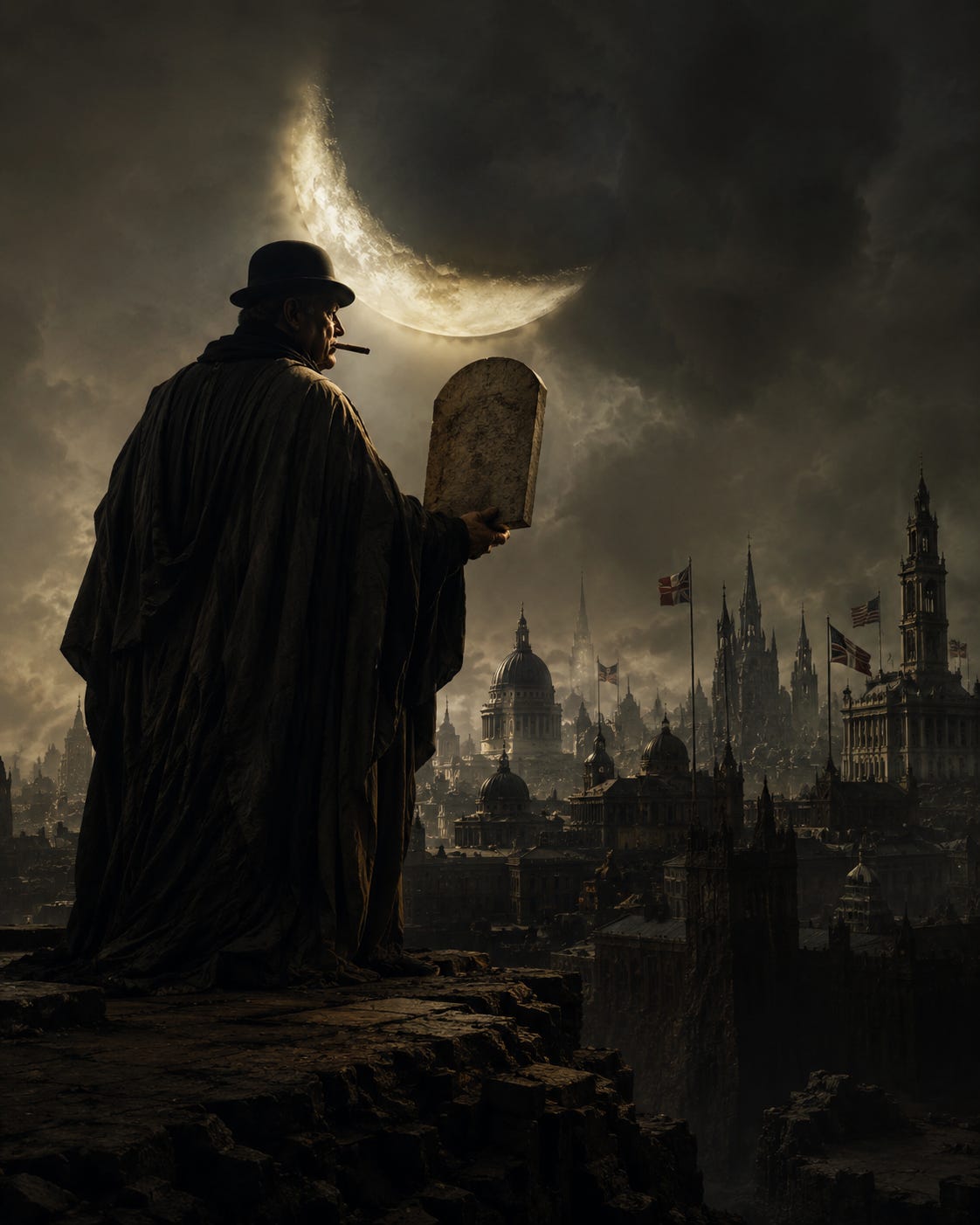
Churchill, writing decades earlier, was no more inclined to perfume the argument:
“How dreadful are the curses which Mohammedanism lays on its votaries!”
But notice the distinction, because it is precisely the distinction our present moral custodians so often pretend cannot be made: “Individual Moslems may show splendid qualities.”
Quite. People are not doctrines. Muslims are not Islam, but they certainly are connected to Islam. One may admire the former while submitting the latter to the same pitiless examination we apply to Christianity, communism, nationalism, or any other system of ideas that makes claims upon human beings.
Churchill, having made that distinction perfectly clear, did not then ruin it with the customary modern ritual of apology. His judgment remained severe: “No stronger retrograde force exists in the world.”
Nor did he console himself with the thought that the problem would obligingly expire of old age. “Far from being moribund, Mohammedanism is a militant and proselytizing faith,” he wrote, adding that “the Mahommedan religion increases, instead of lessening, the fury of intolerance.”
So there we have it. Sam Harris and Winston Churchill, separated by a century, temperament, nationality, and almost everything else, arriving at an inconveniently similar proposition: ideas are entitled to criticism in proportion to the claims they make upon human life, not immunity in proportion to the outrage their criticism produces.
I find myself with Sam and Winston on this one.
Which, by the increasingly elastic standards of our age, presumably means the three of us are Islamophobes.
I can think of worse company.
Please repost
Note to readers: Please consider a paid subscription. I won’t patronize you with the usual “it cost the same as two cups of overpriced coffee a month” routine. Keep the coffee. Enjoy the coffee. For the love of all that is holy, however, please don’t put Coffee-Mate in it. Life is difficult enough without voluntarily introducing that substance into your bloodstream.
If a paid subscription isn’t possible, please repost this. You’re unlikely to read much like it in the CBC, Toronto Star or Globe and Mail. Between federal support and Google money, much of Canadian media has become remarkably domesticated. I prefer to remain housebroken only in the most technical sense.
Desiderius Erasmus (c. 1466–1536) was a Dutch Renaissance humanist, Catholic priest, scholar, and one of the most influential intellectuals of the early sixteenth century. He produced the first published Greek New Testament (1516), accompanied by a revised Latin translation, which became an important resource for later biblical scholarship and influenced subsequent translations, including the tradition that produced the King James Version. Although Erasmus criticized corruption and abuses within the medieval Church and advocated reform, he remained within the Catholic Church and famously opposed Martin Luther over the question of free will.

So important to share this information! I wonder, do Mosques teach the ‘Islamophobia’ defense? So many YouTube videos show hijab-wearing women being apprehended for crimes and their response is to shout ‘Islamophobia!’.