If you’ve made it this far in life without being fired, cancelled, or publicly flogged for saying something true, congratulations — you’re ahead of me. I write because I can’t not; because silence feels like complicity, and complicity feels like rot. If this piece leaves you nodding, snarling, or muttering, “Well, he’s not wrong,” then you’re precisely the reader I’m writing for.
You’ll get two essays a week — unapologetically long, occasionally bleak, often funny, always honest. It’s six bucks a month — less than one coffee in Carney’s Canada, or two if you buy the cheap stuff. Everyone says that, of course: “It’s just a cup of coffee.” Fine. But if you’re only going to buy one cup this month, make it mine. It’s $8 a month, and you can cancel anytime.
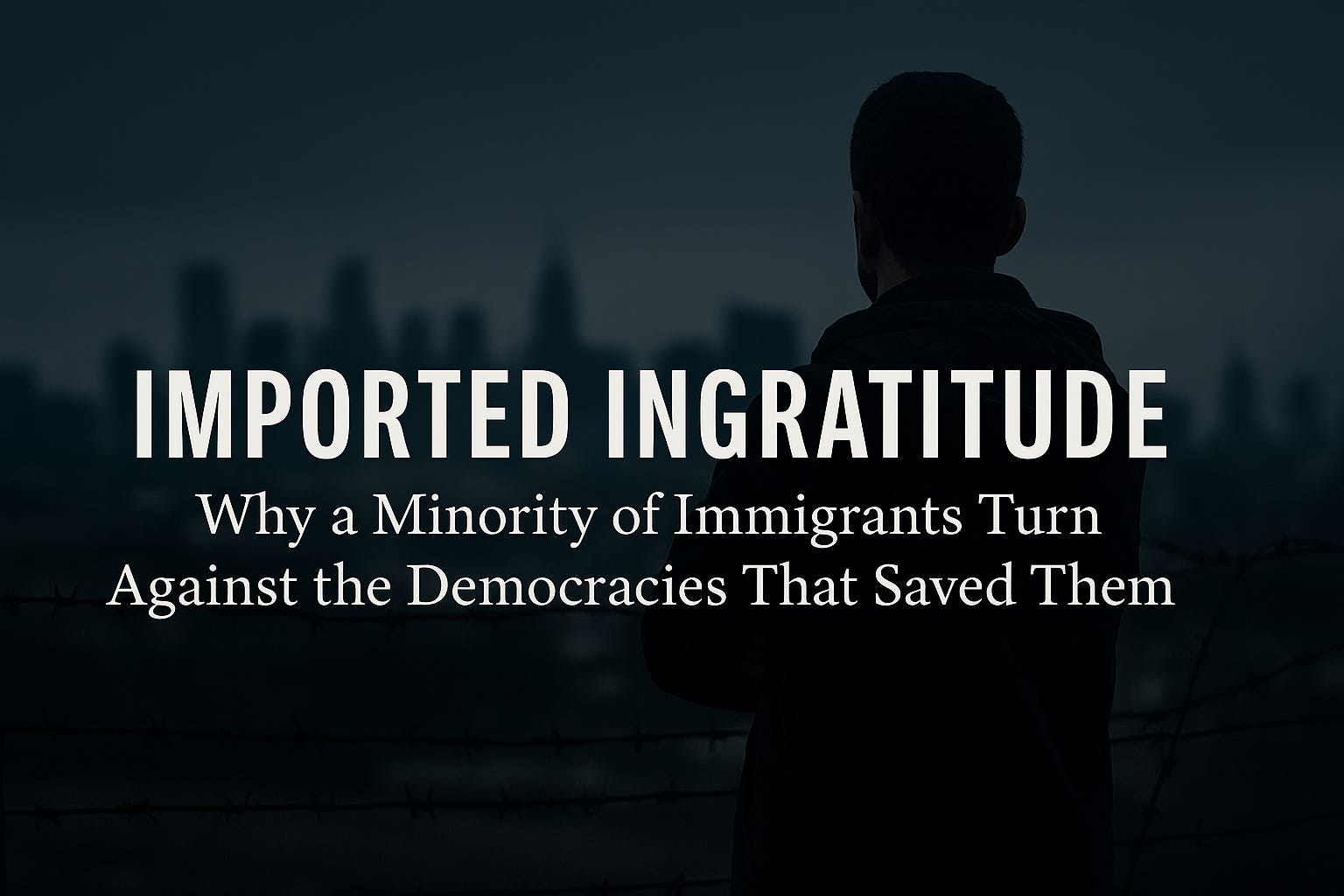
It is a peculiar feature of the modern West that the stories we most need to confront are the very ones we are most determined to avoid. And so we begin—not with slogans, nor policy platitudes, nor the reflexive self-congratulation that has come to define our political class—but with the uncomfortable fact that in three of the safest democracies on Earth, men rescued by those democracies have spilt the blood of their rescuers.
This forces us to revisit a truth we pretend not to know: that gratitude is not a simple ledger of material gain, nor a reflex conditioned by social mobility, but a spiritual condition—a posture of the soul rather than the bank account.
One may live in comfort and remain resentful; one may be lifted from danger and yet feel perpetually aggrieved. Gratitude requires an inner orientation toward humility, memory, and moral imagination—qualities that no welfare program, asylum benefit, or integration seminar can manufacture. And when those qualities are absent, even the safest havens on Earth can become stages for grotesque ingratitude.
In Washington, D.C., an Afghan national—airlifted out of the ashes of his failed state, given sanctuary, housing, and a new life—opened fire on two National Guardsmen. In London, a young man named, with brutal cosmic irony, Jihad murdered Jewish civilians on the streets of the very country that sheltered him. In Canada, we have seen asylum claimants, housed in free hotels and supported by stipends, commit stabbings, extremist attacks, and attempted bombings. These cases are not the majority. They are not even common. But they are real, and reality is owed the courtesy of acknowledgement.
Before I examine the deeper forces behind such acts, I must begin with something personal—an experience that taught me, in the most humbling way, what alienation truly feels like. Years ago, I lived in France. My French was pitiful, my income barely qualified as income, and my social presence hovered somewhere between “nonexistent” and “furniture.” I was fed and housed, technically comfortable by refugee standards - though I was not a refugee but a 19-year-old on an exchange program -, but existentially starved.
Walking through Paris, I wasn’t insulted or assaulted; I was simply unseen. French women never noticed me. Employers looked through me. Shopkeepers remained politely indifferent. My material needs were met, but my psychological ones were not. And that, I would later understand, is the more lethal deprivation.
When I later searched for work in London, the feeling deepened. London is a magnificent city if you are ascending; it is a cold metropolis of indifference if you are not. I was not poor, not oppressed, not in danger—but I was irrelevant. And irrelevance, I discovered, is far more demoralising than poverty.
People imagine that if your basic needs are provided—roof, food, income—you will be satisfied. But this is a lie told only by those who have never experienced profound displacement. Housing is not dignity. Food does not belong. Stipends are not the purpose. God—or if one prefers, evolution—wired human beings to work, to contribute, to matter. When I have been unemployed, even with money coming in, I have felt ashamed, useless, and spiritually severed from the world. Material comfort without purpose feels like moral sedation.
I was not a refugee. My traumas were trivial compared to theirs. But the emotional resonance is real. And suppose I, armed with education, citizenship, language, and Western familiarity, felt crushed by invisibility in France and London. What must it feel like for the young Afghan, Somali, or Syrian man living alone in a Canadian hotel, unable to speak the language, with no friends, no prospects, no recognition, and no conceivable future?
Here lies the beginning—not the end—of the story.
Because, to be fair, the majority of immigrants do integrate, and more honourably than our political cynics admit. Statistics Canada reports that 67% of immigrants believe that respect for human rights is a shared Canadian value. Sixty-two percent affirm respect for the law. Half believe in shared gender equality. Nearly half are in for cultural diversity. In Ontario and Atlantic Canada, sixty-three percent of immigrants report a “very strong sense of belonging.” These are not the numbers of radicals. They are the number of people building new loyalties and new lives. The vast majority of immigrants work, contribute, and strengthen the society that welcomed them.
But societies are rarely undone by majorities. Majorities pay the bills; minorities set the fires.

Across Europe—the globe’s great asylum experiment—the picture darkens. In Sweden, 36.6% of migrants report feeling no closeness to their neighbours. In Germany, about 33% say the same. When one-third of newcomers feel no social connection, you no longer have isolated challenges; you have a structural fracture.
Combine this with the realities that define immigrant male life in many European cities: high unemployment, nearly zero dating prospects, discrimination in housing, ghettoised communities, language barriers, and the steady frost of public resentment. Native-born Europeans overwhelmingly believe immigration levels are too high—70 to 80 percent in Germany, Italy, and Spain; roughly 70 percent in Britain; majorities across Scandinavia. Immigrants live in that cold climate. They feel it, they breathe it, they internalise it.
I felt that coldness in Paris. I felt it in London. It corrodes.
But for young men—young, alone, unemployed, traumatised, sexually invisible, linguistically handicapped—that corrosion becomes acid.
The majority of refugees arriving in the West are men in their twenties. But let us pause on that word—majority. In polite discourse, it sounds reassuring, almost benign, as if it implies safety or normality. But “majority” simply means 51%. What if the real figure is 80%? Is that good enough? No, it is not. What if it is 90%? Still not good enough. Because when you are dealing with large demographic flows, small percentages of dysfunction—1%, 2%, 3%—are not small at all. They are catastrophic. You do not need 30% of a newcomer cohort to struggle violently for a social crisis to erupt. A single digit, applied to tens of thousands of young, unattached, economically idle men, is enough to reshape public life, policing, neighbourhoods, and the nation's psyche.
We lie to ourselves about this because the arithmetic is uncomfortable, but arithmetic does not care.
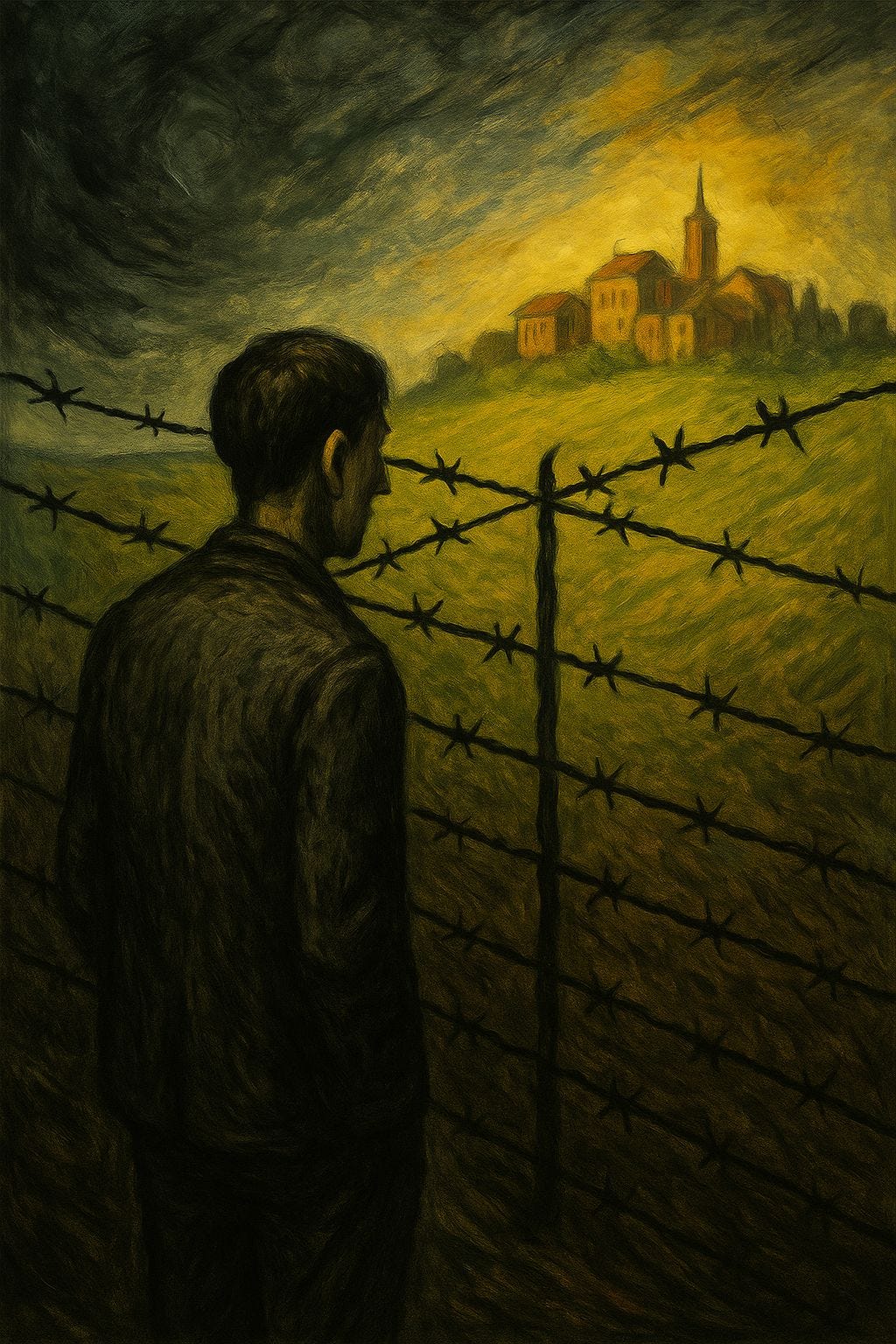
They have no families with them. They lack language, status, prospects, and community. They cannot find work. They cannot find belonging. They cannot find partners. They cannot find purpose.
And layered atop this deprivation sits a theological and cultural pressure almost no one dares to mention: many have been raised on the Qur’anic assurance that “You are the best of peoples evolved for mankind” (Qur’an 3:110). In much of the Muslim world, this is taught not as moral aspiration but as civilizational entitlement. Yet here they arrive and confront, brutally, the inverse: that in the West, they are not “the best” of anything.
They are, through no intrinsic fault of their own, at the very bottom—unemployed, unseen, socially invisible. Humiliated.