


Note: On the Substack app, this essay and all my essays have been converted to audio and can be listened to rather than read.
Let me begin with a warning that should be attached to all respectable thought experiments: the experiment involves speculation; it’s impossible to prove, impossible to disprove and therefore perfect for a modern political debate. Calm down.
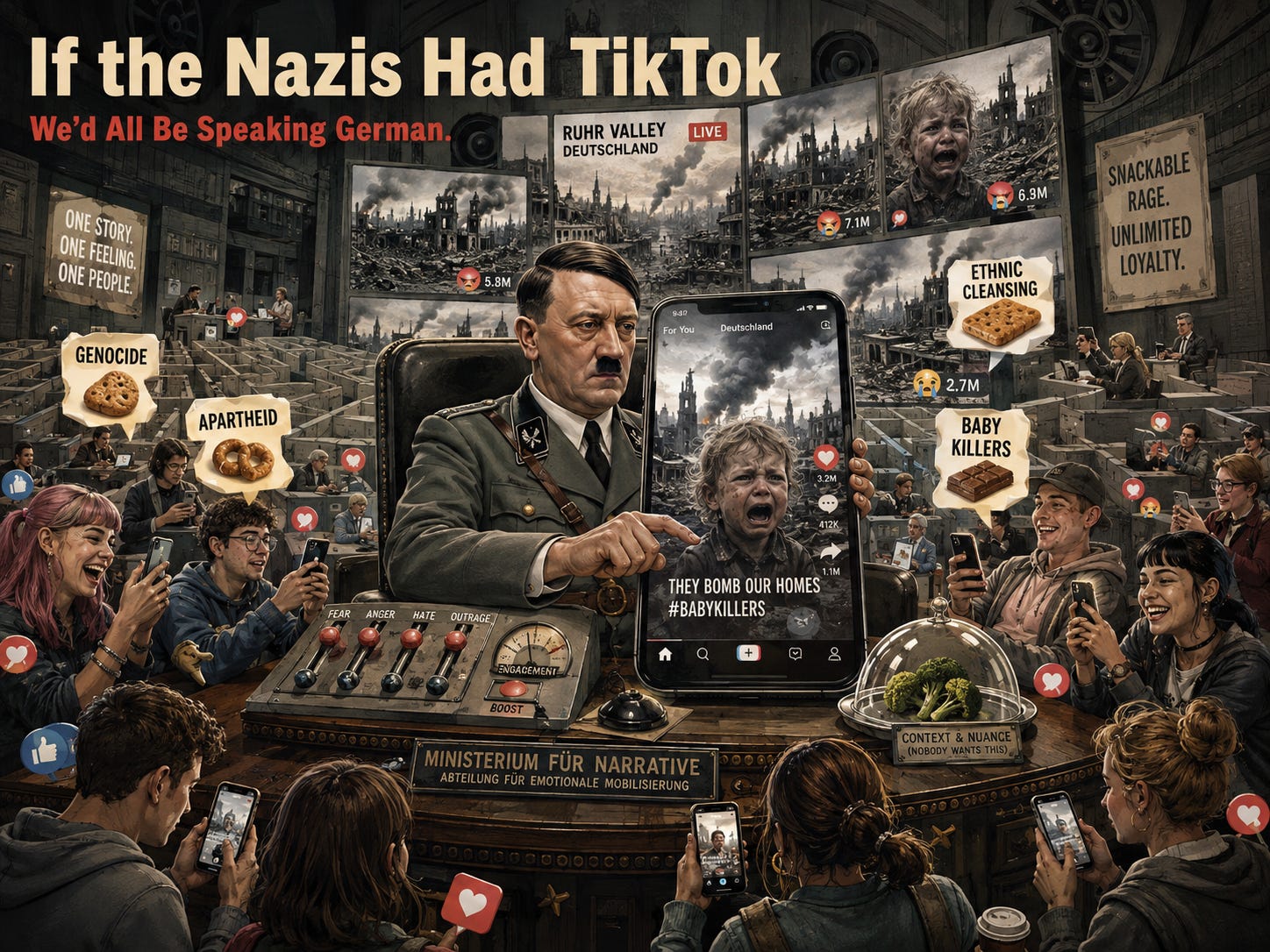
My proposition is quite basic. If Nazi propaganda minister Joseph Goebbels had access to TikTok, Instagram, X, Telegram, smartphones, influencers, super bots and an algorithm that could monitor your every subconscious predilection, we might remember the Second World War rather differently.
Let’s talk about Allied bombers over the Ruhr Valley. A bomb drops. A school building collapses. A German child is yanked desperately from the rubble. Now start the video right there. Not five years earlier. Not Poland. Not Paris. Not Russia. Certainly not Dachau.
Begin with this poor child.
Add mournful music. But no Drake, please. Add a caption: ALLIED BOMBS KILL GERMAN CHILDREN.
Thirty million views before breakfast. Mark Ruffalo starts crying on his IG and reposts it. A professor who hasn’t had a real job in 30 years explains that the bombing must be understood within the broader hegemony of Anglo-American imperialism. This same professor can’t order a Big Mac combo at McDonald’s without referring to colonialism.
Someone at Harvard starts building an encampment. Nazi propaganda minister Joseph Goebbels, lounging in Berlin with his blue verification badge, wonders which pagan deity he followed made him wait until the 1940s to start using this wondrous social media.
Goebbels sees his like count climbing and thinks the 1000-year Reich should last 1500 years.
The joke contains a serious point. Our information ecosystem has become a monstrous snack counter, and people love snacks. Some live on nothing but snacks.
A proper meal involves work. History is a meal, not a snack. Context is a meal. Reading a serious book is like a grand feast that nobody will pay for, full of jumbo shrimp and Kobe beef. You have to sit down, chew, compare competing claims and perhaps run into some unpleasant fact that shoves aside what in your mind was held with a grand sense of superiority.
You might even have to change your mind, and that - in the age of social media - is often thought to mean you have a character defect.
The modern political snack is considerably easier. Look at Israel: genocide. Apartheid. Ethnic cleansing. Baby killers. Nazis. Fill in modern blood libel.
No definitions required. No footnotes. No painful questions about what happened before the photo, what the other combatants are doing, and questions such as whether hostages are being held, whether ununiformed fighters hide under civilian neighbourhoods, whether warnings were given, whether evacuation corridors existed, or whether the proper meaning of a term is even close to the way it is being hurled around online.
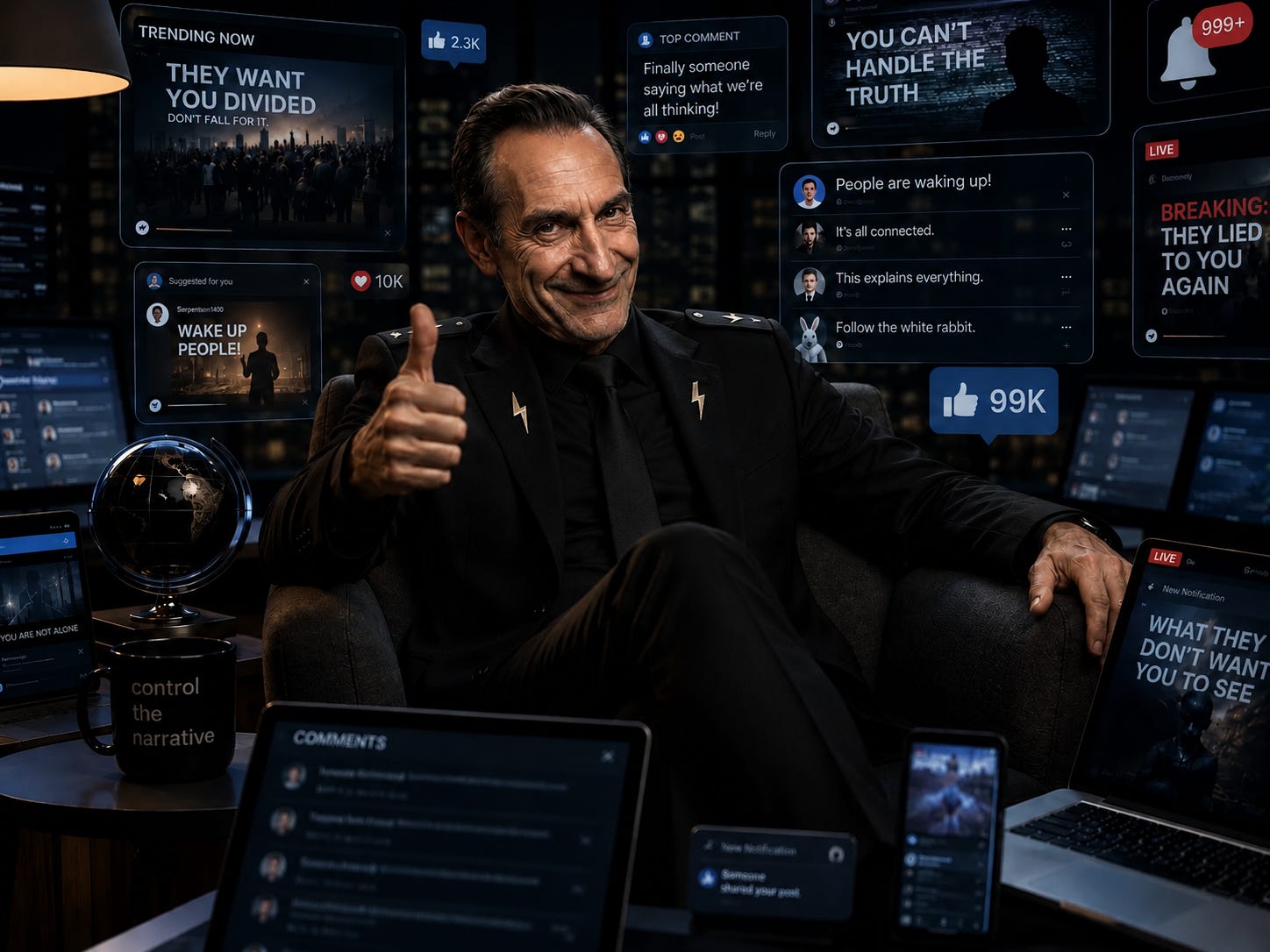
It is not as if the Jews did not already have enough historical experience with this type of thing: queue the history reel, they’ve been accused over the centuries of ritual murder and using Christian blood to make bread, of poisoning wells, spreading plague, hexing harvest, fomenting communism and, with admirable ideological dexterity, still being capitalist overlords who control the banks, the press and much of the planet. We should not forget the banks and the space lasers.
It is truly quite an indictment. Jews are blamed for both sides of almost every argument. Heads I win, tails Jews lose. Tough game.
Back to the snacking metaphor.
Those inconvenient complications are vegetables. And nobody came to TikTok for boiled parsnips.
To their great shame, academics have become some of the age’s great snack pushers. One might once have expected the schools to be the place where slogans went to be dissected, but they are the place where they were invented. But this happened in Goebbels ’ time too, so we should not be surprised.
Complexity is exhausting, nuance is dopamine-free, and a sufficiently fashionable accusation can accelerate through an academic department with considerably less resistance than a rumour through a high school dance.
Gen Z, to be sure, must be said to have been raised inside the snack bar. This is not an accusation of stupidity. It is an observation about the intellectual dining culture. A generation trained by platforms scientifically set up to consume information in clips, captions, short videos and fragments is, of course, going to be vulnerable to political messages crafted in such a palatable form. The marvel is not that this generation eats snacks.
The marvel would be if they suddenly demanded a seven-course meal that meant pulling out the intellectual cookware.
Goebbels would have understood all of this immediately.
Nazi propaganda was highly skilled at depicting Germany as both conqueror and victim. Germany was forever being encircled, betrayed, humiliated and forced to defend itself. Germany proclaimed itself the true Christian nation. Any German aggression was justified, of course, as retaliation. German violence was a necessity to protect the motherland, and behind virtually every calamity always stood the perennial scapegoat and villain of European political mythology: the Jew.
Pause a second - now give that operation an iPhone.
Let’s return to the Ruhr Valley. Another bombing raid. Another crumbled cathedral. Another German mother running with an injured child. The camera does not always have to lie, but AI video creation could come in handy. But even without falsification, the power remains. The suffering can be entirely real.
For the lie is in what is left outside the frame.
No Warsaw. No invasion of France. No Poland. No V-1 rockets screaming into London. No night of the long knives. No caricatures of beaked-nosed Jews on brick walls. No deportations. No death camps. No explanation of why the bombers are over Germany in the first place.
Just the rubble and the pain.
That is what modern propaganda has learned to do so incredibly well. You do not always need false photographs. You need true photographs stripped of history, and devoid of context. You need to know how to crop.
The Anti-Defamation League’s most recent Global 100 survey estimates that 46 percent of the world’s adult population has significant antisemitic attitudes. That does not mean 46 percent of humanity is secretly spitting and polishing their jackboots in the garage, but it is alarming. It means that familiar negative stereotypes about Jews remain extraordinarily widespread. And let’s be honest, opinions don't form in a linear progression; they are shaped by pushing people past tipping points. People tend to believe what they want to believe.
For the skillful propagandist, that is all they need.
Propaganda, of course, does its best work when it does not need to create its raw material. It just activates what is already there.
Goebbels was no fool and would not open TikTok by announcing, “Guten Morgen, let me tell you why Jews must be killed.” Yes, even TikTok has standards. Goebbels would start off with the German child. Then another German child. Then a poor, grieving German mother. Then Hamburg. Then Dresden. Then the questions would roll out.
Why are the Allies so cruel?
Who secretly benefits?
Is there a secret Jewish plot that has brought on all the pain of the Weimar Republic?
Then some dim-witted young man with 600,000 followers would explain that he wasn’t taking sides at all. He was merely “posing questions.”
Right.
The wonder of propaganda is that it does not always have to make you believe the lie. Sometimes it just needs to make you doubt the truth.
Imagine 1944 if it were conducted according to today’s rules of public discussion. A streaming influencer would soberly ask Winston Churchill whether Russia, the United States and Britain’s response has become “disproportionate.”
A League of Nations official, draped in false empathy, would express deep concern over Germany’s deteriorating humanitarian situation. A movie star or a blue-haired faculty member, both bloated with hubris, would post a black square for the victims of Hamburg. Someone else could make up a civilian casualty statistic that omitted every military and historical consideration and announce that all the moral questions are answered by dint of the fact that words have escaped their lips.
A university society would howl that the RAF is genocidal.
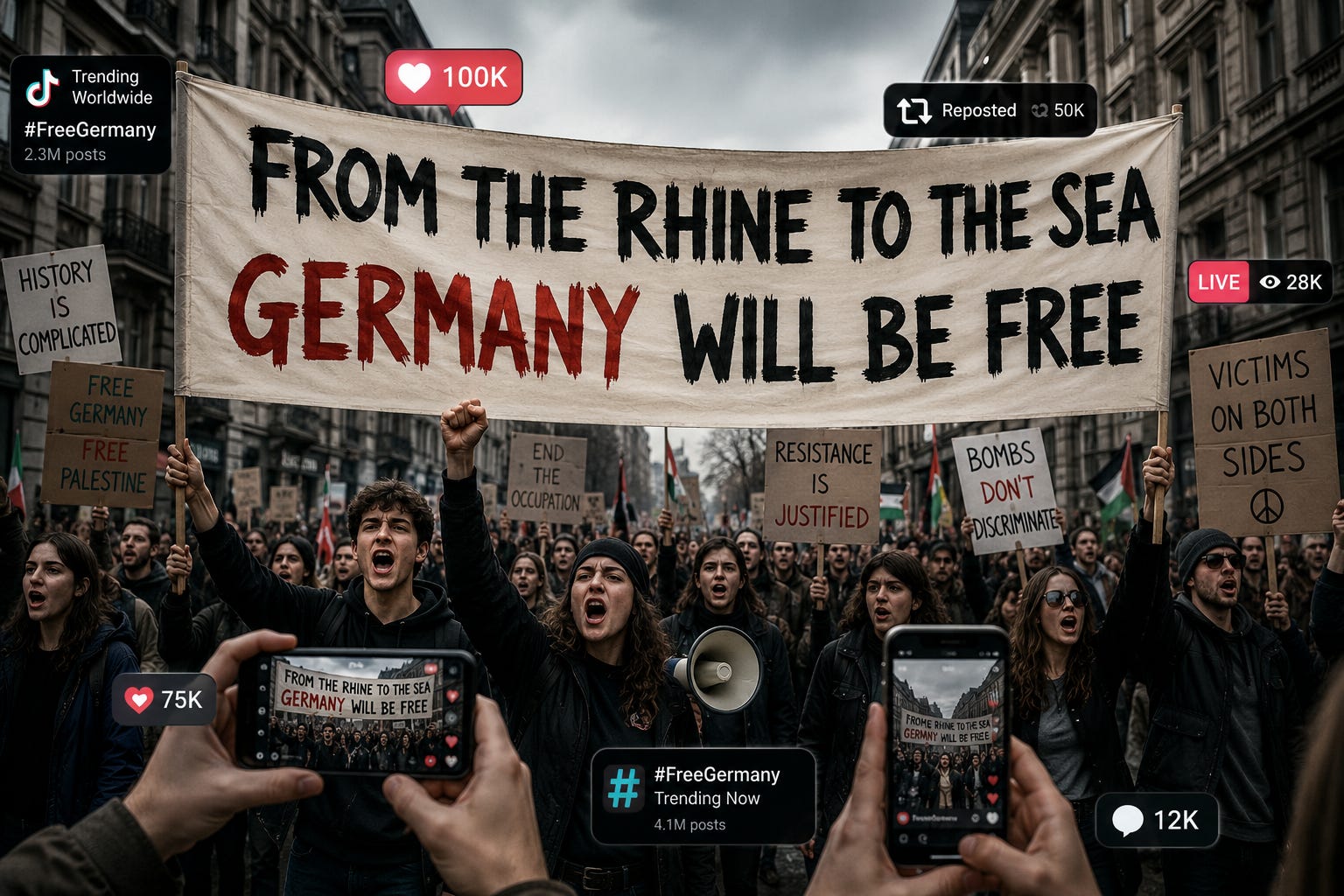
At a rally at the University of Guelph, professors and students would march with signs that said, FROM THE RHINE TO THE SEA, GERMANY WILL BE FREE. Even Goebbels might at this point have asked everyone to dial it back.
This is satire. Nazi Germany is not Gaza. Israel is not 1944 Britain. Hamas is not the German military. Historical analogies become stupid when people treat them as equations.
The comparison here concerns propaganda, emotional manipulation and the amazing vulnerability of a culture that, though caught in a dense forest of informational noise, seems unconcerned with differentiating the mighty living oak from a rotten branch lying on the forest floor.
Warren Kinsella’s The Hidden Hand is helpful in this context. His argument carefully explains how anti-Israel information infrastructure that exploded into public view immediately after October 7 did not simply spontaneously appear from within the vapours of immediate moral outrage. Networks, messaging strategies, social-media accounts and organizing machinery were already there beforehand.
It is difficult to argue against the proposition that Hamas and its ideological fellow travellers have shown great aptitude in the information war.
For Hamas and their fellow travellers understand the snack counter.
Think about it: An Israeli military briefing that discusses such boring material as operational constraints, tunnel systems, targeting procedures, evacuation routes, hostage rescue, the laws of armed conflict and the strategic implications of an enemy embedded within a civilian population could drag out twenty minutes, far outside the modern attention span.
A photograph of a dead child works in a nanosecond.
Guess which one triumphs within the battlefield of Instagram.
And now return once more to Essen.
Imagine this choice offered up to an American college student in 1944. On one screen: a two-hundred-page discussion of Hitler’s invasion of Europe, Nazi genocide policy against the disabled, the Jews and the Roma, the strategic importance of the industrial Ruhr, German war production and the moral and military case for bombing industrial targets.
The other screen: a crying German child.
Swipe.
This creates an ugly incentive that we don’t want to discuss. If civilian suffering leads to diplomatic and political damage for your enemy, then it is not a stretch to say that civilian suffering has immense propaganda value.
Slow down on this point, for that proposition should horrify all because of what it leads us to. If we state it, though, it will create outrage, and outrage, in our public discussions, now substitutes for thought.
The sad reality here affects something older than the algorithm.
The Jew.
And this takes us back to Nazi propaganda minister Joseph Goebbels.
He would have fallen in love with our century. Not because everybody has developed some latent Nazi impulse. He would have fallen in love because we have manufactured the most powerful information-distribution system in human history and then secretly designed it to reward speed, anger, tribalism and emotional volatility.
Goebbels did well in his day going old school with newsreels and newspapers; imagine what he could have done by feeding Germans our modern digital intellectual snack diet.
Goebbels wouldn’t have had to persuade Americans or Britons that Hitler was a lovely chap. That would have been pushing it. He would just have had to make people believe that those bombing the Ruhr were monsters too.
Show Essen. Show the carnage and above all show the child.
Do not show what came before.
Serve up the snack.
When somebody finally arrived carrying the proper slow-cooked and full meal, you can be sure most of the audience would already have gone home.
Possibly humming Deutschland über alles.
A note on process: an earlier draft of this piece was grammar-edited with AI assistance, then the entire essay was rewritten by hand — every sentence rephrased, content cut, content added. The ideas, arguments, and voice are mine throughout. AI-detection tools have nonetheless flagged it as machine-generated. For what it's worth, these tools are known to be unreliable, especially on heavily revised writing — so take the label with a grain of salt.
Our schools and universities should be leaders in training students to prepare and eat healthy meals. They should be decrying the unhealthy snack culture. Instead, they are the generators and distributors of the snack machines. They too have become intellectually lazy on this slovenly diet.