


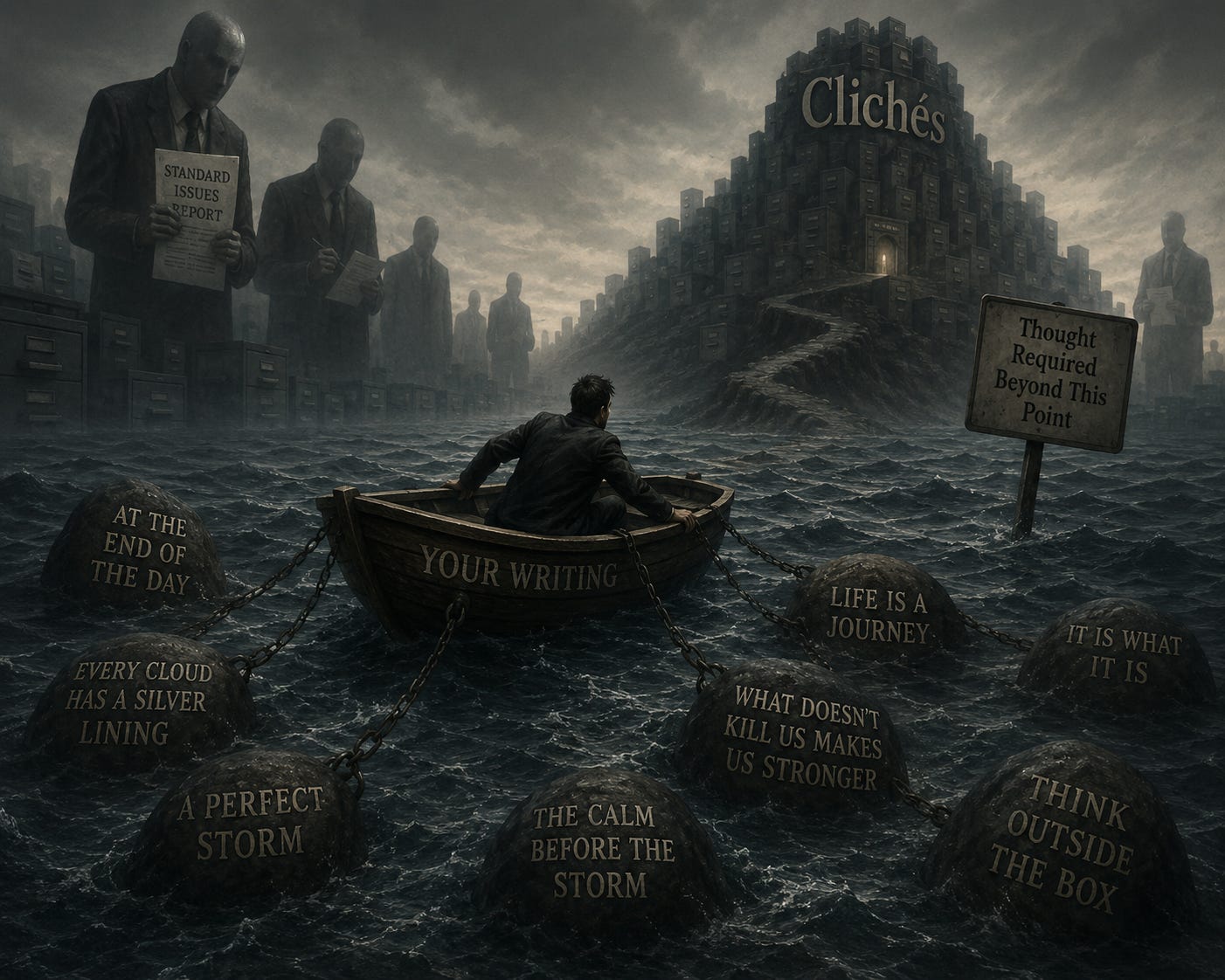
If you see fit, please send this piece to your students. I am.
Mark Twain once accused the novelist James Fenimore Cooper of committing 114 offences against literary art out of a possible 115 in less than a page. This achievement deserves far more respect than it has received. Most bad writers require several thousand words to reach that level of criminality. Cooper, according to Twain, could apparently manage it before breakfast.
Twain’s 1895 essay, Fenimore Cooper’s Literary Offences, remains one of the great literary executions because Twain did not merely announce that Cooper was a bad writer. He arraigned him. He assembled the evidence, stated the charges and proceeded with something approaching the good humour of a man adjusting the noose on the condemned man.
Among Twain’s rules was one that should probably be stapled above every keyboard: use the right word, not its second cousin.
More than a century later, I think we should reopen the case. Not against Cooper. The man has suffered enough. Against us.
For if Twain objected to writers choosing the wrong words, we have discovered a considerably more efficient method of writing badly: stop choosing words altogether. Simply order them pre-cooked.
At the end of the day.
Every cloud has a silver lining.
A perfect storm.
The calm before the storm.
Weather the storm.
A ray of sunshine.
A breath of fresh air.
When it rains, it pours.
These are the microwave dinners of the English language. Tear open the package, heat for thirty seconds and serve. No preparation, no imagination and virtually no nutritional value.
Let us begin with weather, because weather has done enough damage to English prose.
If you are writing an essay and find yourself reaching for a storm, resist. If something difficult happened, you do not need to weather it. If several difficult things happened at once, they did not constitute a perfect storm. If matters are about to deteriorate, we do not need the calm before the storm. If hope appears, please don't let the sun break through the clouds. The English language has endured several centuries of atmospheric abuse. Give the climate a rest.
Rain has suffered particularly badly. Writers have rained on parades, saved things for rainy days, discovered that when it rains it pours, come in out of the rain and waited patiently for the rainbow afterward. There cannot possibly be any rain left. We have used it all. Although hail is a bit underused.
Clouds are no better. Every one of them apparently contains silver, usually in the lining, although nobody has ever explained why clouds require tailoring. Sunshine follows darkness. Spring follows winter. Droughts afflict creativity. Ideas blossom after rain. Relationships turn cold. Tempers become heated. Political climates change. People receive frosty receptions. Projects are put on ice.
At this point, the entire meteorological service should obtain a restraining order against writers.
And then there is the roller coaster.
Years ago, in a creative-writing class, I heard someone begin a poem with approximately this proposition: “Life is like a roller coaster. It has its ups and downs.”
Something inside me died. I think the poem was an ode to their grandfather, who had also died.
After that, a few of us began noticing roller coasters everywhere. Love was a roller coaster. University was a roller coaster. Marriage was a roller coaster. Careers were roller coasters. Parenting was a roller coaster. The stock market, having at least some claim to violent vertical movement, naturally got one too.
Apparently the whole of human existence takes place at Canada’s Wonderland.
The problem is not that the roller-coaster metaphor is logically inaccurate. Life really does contain highs and lows. So does an elevator. So does a staircase. So does the blood pressure of a man reading an essay containing six roller-coaster metaphors.
The problem is that we have seen it before.
That is what makes the cliché such a peculiar creature. Often, nothing is intrinsically wrong with it. Indeed, most clichés became clichés because they were once rather good. Someone, somewhere, was probably the first person to describe adversity as a storm. At that moment the metaphor may have been vivid. The reader saw black clouds, felt the wind and understood immediately what the writer meant.
Clichés are a little like the devastatingly attractive boy or girl you noticed in first-year university — the one who made your knees weak and, in my case, probably never once made eye contact with me. At the time, they were magnificent. So were clichés.
The first person who wrote that there was “light at the end of the tunnel” may genuinely have produced a fresh image. But metaphors, like people, can have hard lives. Forty years of abuse, neglect, repetition and being passed around by everyone in sight take their toll. By the time a cliché reaches us, it has been used in bad speeches, corporate memos, wedding toasts, university essays, motivational posters and PowerPoint presentations approximately twelve million times. Whatever beauty it possessed in its first year is gone. It is now seventy-four, standing behind the English department smoking beside the dumpster and asking whether anyone has spare change.
For example, there was also nothing wrong with walking on water; Christ did a good job, but the story felt fresher when the apostle John hashed it out in 90AD.
George Orwell called such expressions “dying metaphors.” I think this was generous. Many have been dead for decades. What surprises me is our reluctance to arrange the funeral.
A cliché is rather like a perfectly good shirt that has been worn, washed, stretched, borrowed and slept in by so many people that it no longer has a shape. The material may technically remain intact. That does not mean you should wear it to dinner.
Why should any of this matter? Because writing is fundamentally an attempt to secure and hold another person’s attention. The reader owes you nothing. He did not sign a contract promising to finish your essay. He can leave whenever he likes, and nowadays another article, video, notification, email and photograph of somebody’s lunch are all standing nearby offering him somewhere else to go.
Think of your reader as clinging to the side of a lifeboat. Your job is to keep him aboard. A fresh observation pulls him upward. An unexpected sentence gives him a handhold. A metaphor he has never encountered makes him look twice.
Then you write that life is a journey.
One hand slips.
You tell him there is light at the end of the tunnel.
Now he is hanging by three fingers.
You tell him that what doesn’t kill us makes us stronger, that everything happens for a reason, and that, at the end of the day, we must think outside the box.
There is a small splash.
You have lost the reader.
This is why good writing is not principally a matter of decorating sentences. It is a matter of seeing. The writer has to look at something familiar long enough to notice what everybody else stopped noticing.
Shakespeare was magnificent at this. He played with the machinery of English. Nouns became verbs. Familiar ideas appeared in unfamiliar clothing. His metaphors did not merely communicate information; they forced the mind to construct an image. That tiny moment of construction matters. The reader wakes up.
The cliché performs precisely the opposite service. It allows both writer and reader to sleep.
That is why clichés signal something worse than inelegance. They suggest that the writer reached the place where thought was required and decided not to proceed.
The sentence arrived at a fork in the road.
Naturally, it took the road less travelled.
Along with everybody else.
Oh, yes—one more thing. Adjectives suck. Concentrate on your verbs.
And I nearly forgot the ultimate clichéd metaphor: fire. Please spare me the fire in your heart, the sparks of love, the embers of desire, the cinders of your broken dreams, and the ashes of whatever you just burned for symbolic purposes.
Stop it. Stop it now.
And under no circumstances may anyone rise like a phoenix from the ashes.
No.
No, no, no.
And nothing about breaking the chains that constrain you. Nothing ever about chains.
Shadows. Sunlight. No, no, not allowed.

Guilty as charged, to use another one. You have given me a new goal — to eliminate or at least minimize my use of clichés. I will start with my writing and hope it spreads to my conversation.
Nice. A word which, when used to describe a person as a former friend used to say, denotes vastly underrated. Applies as well to your essay. Made me smile. Thanks.