If you believe in the importance of free speech, subscribe to support uncensored, fearless writing—the more people who pay, the more time I can devote to this. Free speech matters. I am a university professor suspended because of a free speech issue, so I am not speaking from the bleachers. The button below takes you to that story.
In the great, blinking, blue-checkmarked theatre of modern politics—where social virtue is sprayed on like cheap cologne and moral superiority is always in season—liberals parade as champions of the downtrodden, cooing in soft, inclusive tones as if soothing a therapy dog.
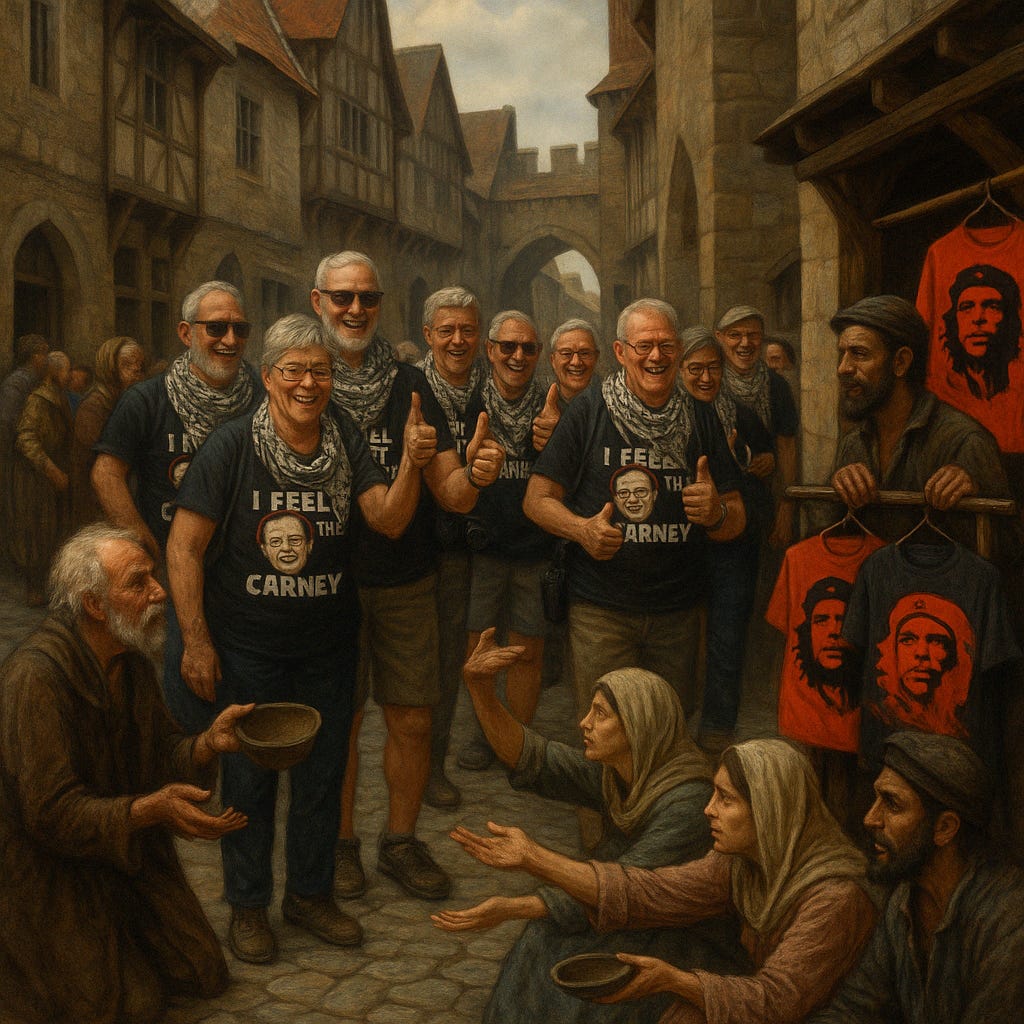
Their rhetoric is a cathedral of compassion, their hashtags a hymn to justice. Yet their policies, draped in the sanctimony of “equity” and “progress,” are built on foundations as flimsy as a Temu tent. No rebar, no poured concrete, just buzzwords flapping in the breeze: settler colonialism, lived experience, systemic racism. They tweet about dignity, sip oat-milk lattes, and retweet GoFundMe pleas from their lakeside cottages north of Toronto or second homes in the Cotswolds, convinced this is revolution.
But behind this lush hedge of virtue lies a withering truth: liberal policies, so piously conceived, so condescendingly executed, systematically punish the very people they claim to uplift. This is not hyperbole. This is math. This is sociology. This is the cruel arithmetic of progressive orthodoxy—a faith that preaches salvation and delivers catastrophe.
Let us dissect five sacred tenets of the liberal creed: minimum wage hikes, welfare expansion, public housing, affirmative action, and green energy mandates. Each is sold as a balm. Each lands like a boot on the necks of the poor. And let us not forget the psychology behind it: the dopamine hit of performative empathy, where the gratification of intention trumps the wreckage of outcomes. You can critisise classic liberals but they don’t get a big dopamine hit from saying the market is the best allocater of scarce resources.
Before the keyboards clatter in outrage, a clarification: this is not a love letter to Trumpism, that carnival of misspelt grievances and spray-tanned narcissism. If liberalism is a seminar in curated compassion, Trumpism is its cracked mirror, angrier and dumber. We’ll return to that. For now, let’s wield a clinical scalpel to the dogmas that harm the poor while the liberal elite sip pinot, stroke their rescue dogs, and congratulate themselves on their humanity.
1. Minimum Wage Hikes: Pricing Out the Poor
Nothing thrills a progressive like a minimum wage hike. Instagram-ready heroism is a policy that screams “we care” while quietly knifing the vulnerable. Raise the wage too high, and you price the poorest out of the market. A 2019 University of California, Riverside study found that a $15 minimum wage slashed low-wage restaurant jobs by 6.4%. The Congressional Budget Office estimated a national $15 wage would eliminate 1.3 million jobs. The math is brutal: if a worker’s labour generates $10 in value but costs $15, businesses don’t hire. Not because capitalism is heartless, but because arithmetic doesn’t bend to feelings.
Thomas Sowell nailed it: “The real minimum wage is zero.” That’s the wage of the unemployed, a demographic liberals seem content to expand while basking in the glow of their generosity. The psychology here is telling—a quick hit of moral superiority, no follow-up required.
2. Welfare Expansion: Dependence as Compassion
Liberals adore the welfare state like a teenager loves junk food: obsessively, destructively, with a delusion of invincibility. The safety net is vital - but can trap you when it morphs into a hammock. In 35 U.S. states, welfare pays better than minimum wage, per the Cato Institute. Why work when benefits outstrip earnings? The Heritage Foundation found long-term welfare recipients—especially single mothers—are less likely to escape poverty than those who take any job, even a low-paying one. Jennifer Mittelstadt’s From Welfare to Workfare shows how liberal reforms from 1945 to 1965, aiming to transition recipients to work, often deepened poverty through surveillance and stigma, not opportunity.
The message is infantilising: don’t strive; we’ll handle it. Just vote correctly. The liberal psyche craves this dynamic—saviour and saved, a transaction where gratitude is the currency and dependence the goal.
3. Public Housing: Concrete Prisons for the Poor
Public housing is liberalism’s monument to good intentions, and like most monuments, it’s better admired from afar. A 2015 HUD study found that nearly half of public housing units are in high-poverty areas. A 2018 Urban Institute report noted that crime rates double those of surrounding neighbourhoods. These aren’t homes; they’re warehouses, poverty preserved in brutalist concrete. Jane Jacobs saw it coming: “Low-income projects are not a cure for poverty; they are a petri dish for it.”
Yet progressive planners drone on about “equitable living solutions,” then retreat to their gentrified enclaves. The poor are props in this drama, and their suffering is a backdrop for TED Talks. The liberal ego feeds on the optics of care, blind to the decay of outcomes.
4. Affirmative Action: Patronising by Policy
Affirmative action is liberalism’s academic pat on the head, wrapped in the language of justice. Richard Sander’s mismatch theory shows minority students admitted to elite universities via affirmative action often face lower graduation rates than their peers at schools matched to their preparedness. A 2004 Princeton study confirmed this, finding Black students at Ivy League schools graduated at rates 20% lower than their peers. It’s not just inefficient—it’s cruel. As Sowell said, “When you lower the bar for some, you don’t help them-you patronise them.”
Liberals recoil at “patronising,” but that’s the game: a policy that assumes the poor can’t compete without a handicap. It is the racism of low expectations. The gratification comes from appearing to lift, not from ensuring success.
5. Green Energy Mandates: Eco-Fatigue for the Poor
Climate change is real, but so are electric bills. Bjørn Lomborg’s data is damning: in the UK, two decades of stringent climate policies tripled electricity prices from 2003 to 2023, ballooning the national bill by $CAD105 billion annually—twice the cost of elementary education. The poorest fifth of households cut consumption by a third, while the richest 1% barely noticed. In Canada, fossil fuels still supply over 75% of energy, yet rich nations block poor countries from accessing them, pushing unreliable solar and wind on populations desperate for stable power. In Africa, per-person electricity is less than a single rich-world refrigerator uses, stalling growth. We got fat an rich from fossil fuels, but fuck you India, you need to cut back. They are right to tell us to get bent.
A 2021 survey of low-income country leaders ranked climate 12th out of 16 priorities, behind education and health. Yet liberals divert aid to green projects, leaving the poor to choke on dung-fueled indoor air equivalent to two packs of cigarettes daily. The psychology is narcissistic: the poor subsidise the rich’s green conscience, while liberals bask in eco-virtue.
6. Guaranteed Basic Income: The Dream That Devours
Then there’s Guaranteed Basic Income (UBI), liberalism’s utopian wet dream—a cheque for all, no strings attached. It’s welfare with better branding, pitched as dignity, but delivering dependence. A 2023 study from the Fraser Institute warned that UBI could disincentivise work, as the loss of benefits often outweighs job earnings. Like Ontario’s 2017 experiment, pilot programs showed mixed results: some used the cash productively, but others reduced work hours, staying trapped in low-skill cycles. We already have UBI in the government and academic management, otherwise known as work from home.
UBI risks a bifurcated economy: taxpayers and takers, with the poor locked out of real opportunity. The liberal allure is clear: hand out money, feel like a saint, ignore the erosion of the social contract. Its intention is as anaesthesia, numbing the pain of failure.
This Is Not a Love Letter to Trump
Lest anyone mistake this for a MAGA manifesto, let’s be clear: Trumpism is no antidote. It’s a tantrum in a toupee, a four-year reality show of narcissism masquerading as populism. He’s like the four-year-old annoying cousin’s kid who hammers away on your Stenway, his parents think Mozart, you think duct tape would hold, keep his hands to his sides.
Trump’s policies—tax cuts for the rich, trade wars that spiked costs—hit the poor hard, too. If liberalism is a lecture, Trumpism is a bar fight. Neither serves the vulnerable. The Democrats and Liberals in Canada are worse, but no we shouldn’t elect a candidate whose branding is more “fuck you” than MAGA.
There’s another path: classical liberalism, rooted in reason, responsibility, and restrained government. A politics that neither scolds nor infantilises the poor but offers ladders, not slogans.
The Reckoning
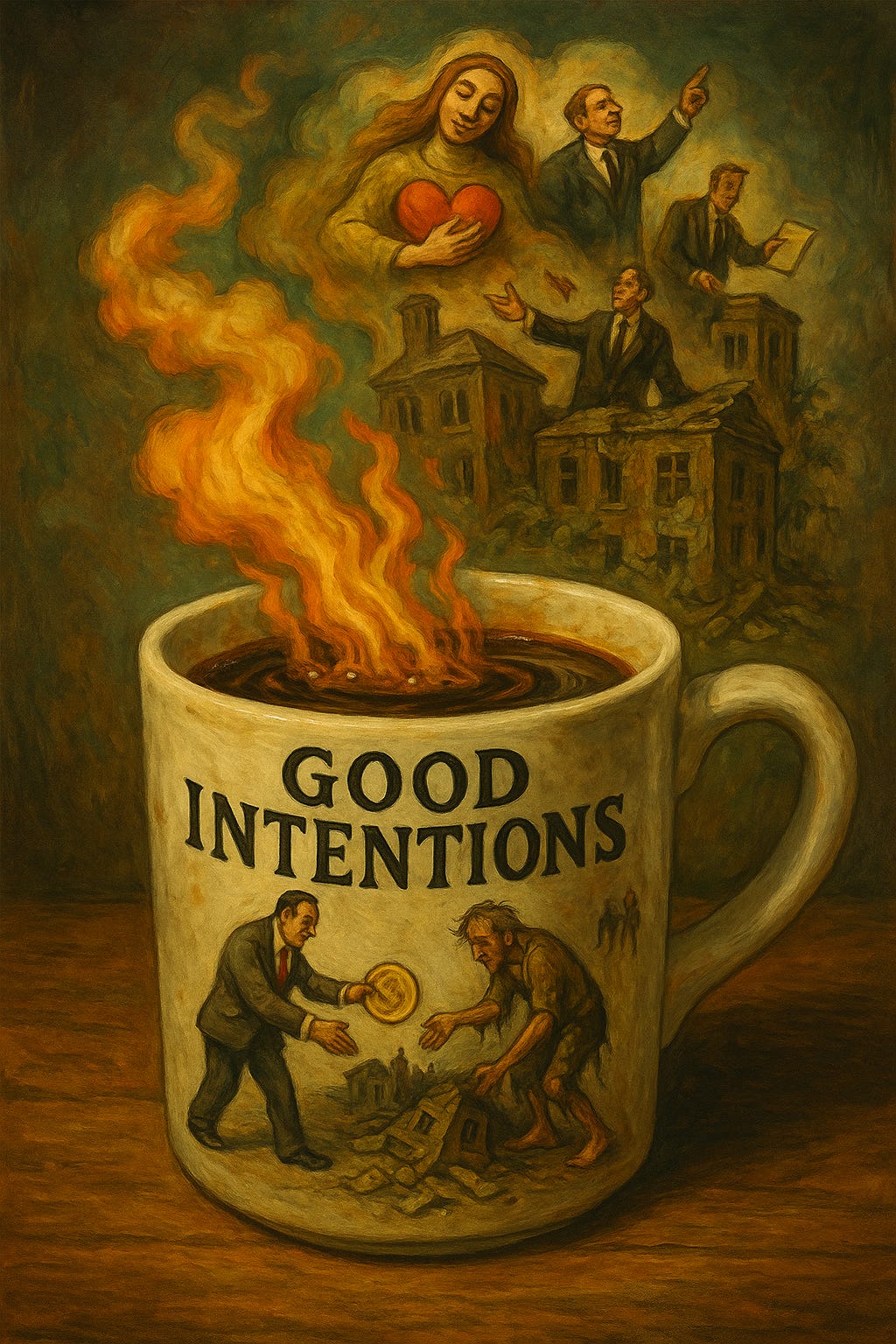
The poor aren’t failing because they lack hashtags. They’re failing because liberal policies—minimum wage hikes that kill jobs, welfare that traps, housing that isolates, affirmative action that patronises, green mandates that bankrupt, and UBI that sedates—keep pulling the ladder away. A Washington Law Review study confirms sales taxes on necessities hit the poor hardest, a regressive sting liberalism ignores. The American Economic Journal notes that family leave policies widen the gender wage gap, as employers sideline women. The data screams: Good intentions don’t guarantee good outcomes.
Orwell warned of manufactured virtue, a utopia of slogans blind to the bodies it leaves behind. Liberals chase the rush of appearing compassionate, their policies a selfie with the poor as backdrop.
As Hitchens said, “The only real test of a principle is its outcome.” By that measure, modern liberalism has failed the poor—brilliantly, performatively, and utterly.