
There was a time when feminism possessed the moral clarity of a searchlight. It did not blink, it did not triangulate for political safety, and it certainly did not hesitate to name injustice wherever it appeared. One need only recall the suffragette movement — those formidable women who chained themselves to railings, smashed the complacency of polite society, went on hunger strikes, endured force-feeding, imprisonment, ridicule, and physical assault — all for the radical proposition that women were not ornamental dependents but autonomous human beings entitled to the franchise.
They did not ask whether their cause was fashionable, nor did they consult the prevailing winds of academic approval. They acted because the injustice was intolerable, and because moral seriousness rarely waits for permission.
One suspects those stern pioneers would regard the modern landscape with a mixture of pride and bewilderment — pride at the freedoms secured across much of the West, bewilderment at how curiously selective the movement’s indignation has become.
For if feminism is to mean anything more than a cultural fashion, it must concern itself first with the places where women are not merely inconvenienced but governed, confined, mutilated, married off, beaten, and sometimes killed. Yet contemporary Western discourse often appears magnetised toward symbolic inequities while vast regions of the world continue to operate under conditions that would have scandalised even the nineteenth century.
One sees this tendency toward symbolism most vividly in the political theatre of modern leadership. Consider former Canadian Prime Minister Justin Trudeau — a man who loved to proclaim, frequently and rather annoyingly, his feminist bona fides to the world. He earned international applause when he unveiled a gender-balanced cabinet and, when asked why parity mattered, replied with breezy certainty, “Because it’s 2015.” The line travelled the globe as proof that Canada had entered some newly illuminated moral century.
Yet symbolism, like stage lighting, flatters from afar while revealing very little about what occurs behind the curtain.
For beneath the polished branding lay episodes that complicate the narrative of uncomplicated feminist virtue. Jody Wilson-Raybould, Canada’s first Indigenous justice minister, was removed from her post amid the SNC-Lavalin affair after resisting political pressure related to a criminal prosecution — a confrontation that ignited a national debate about prosecutorial independence and the treatment of a female cabinet minister who declined to comply.
Jane Philpott, another senior minister who supported Wilson-Raybould, soon found herself outside cabinet as well. Both later described a political culture that appeared less interested in principled disagreement than in disciplined loyalty.
Celina Caesar-Chavannes, a Liberal MP once publicly praised by Trudeau, ultimately left caucus after recounting what she characterised as dismissive and condescending treatment from the prime minister. Whether one accepts every interpretation is almost beside the point; what matters is the pattern that emerges when the feminist tableau is examined at conversational distance rather than from the safety of an international headline.
None of this proves hostility toward women, nor does it erase the value of female representation. But it does invite a question that modern political etiquette often discourages: when feminism becomes central to a leader’s personal brand, how much of it reflects conviction and how much resembles choreography?
Branding is, after all, the native dialect of contemporary politics. It prizes the photograph over the practice, the announcement over the aftermath. A gender-balanced cabinet produces splendid optics; the quieter and far more revealing test is how those women are treated when they prove inconvenient, independent, or insufficiently deferential.
This is not uniquely Canadian but emblematic of a broader Western habit — the substitution of symbolic alignment for substantive commitment. It is easier to curate the appearance of moral progress than to submit to its discipline. And so feminism risks becoming less a universal ethic than a reputational accessory: prominently displayed, frequently invoked, and rarely interrogated.
Meanwhile, across large portions of the world, women are not petitioning for a greater share of cabinet portfolios but for something far more elemental — autonomy over their movement, their clothing, and their physical safety. The distance between those realities ought to sober any movement that still claims universal purpose.
Begin with the blunt arithmetic. Roughly one in three women globally will experience physical or sexual violence during her lifetime. Tens of thousands are intentionally killed each year, most often by intimate partners or family members — a reminder that the greatest threat frequently resides not in the dark alley but within the domestic sphere. This is not a niche concern; it is one of the most persistent human-rights failures on earth.
And yet the sustained mobilisation one might expect from a movement claiming global sisterhood is strangely uneven.
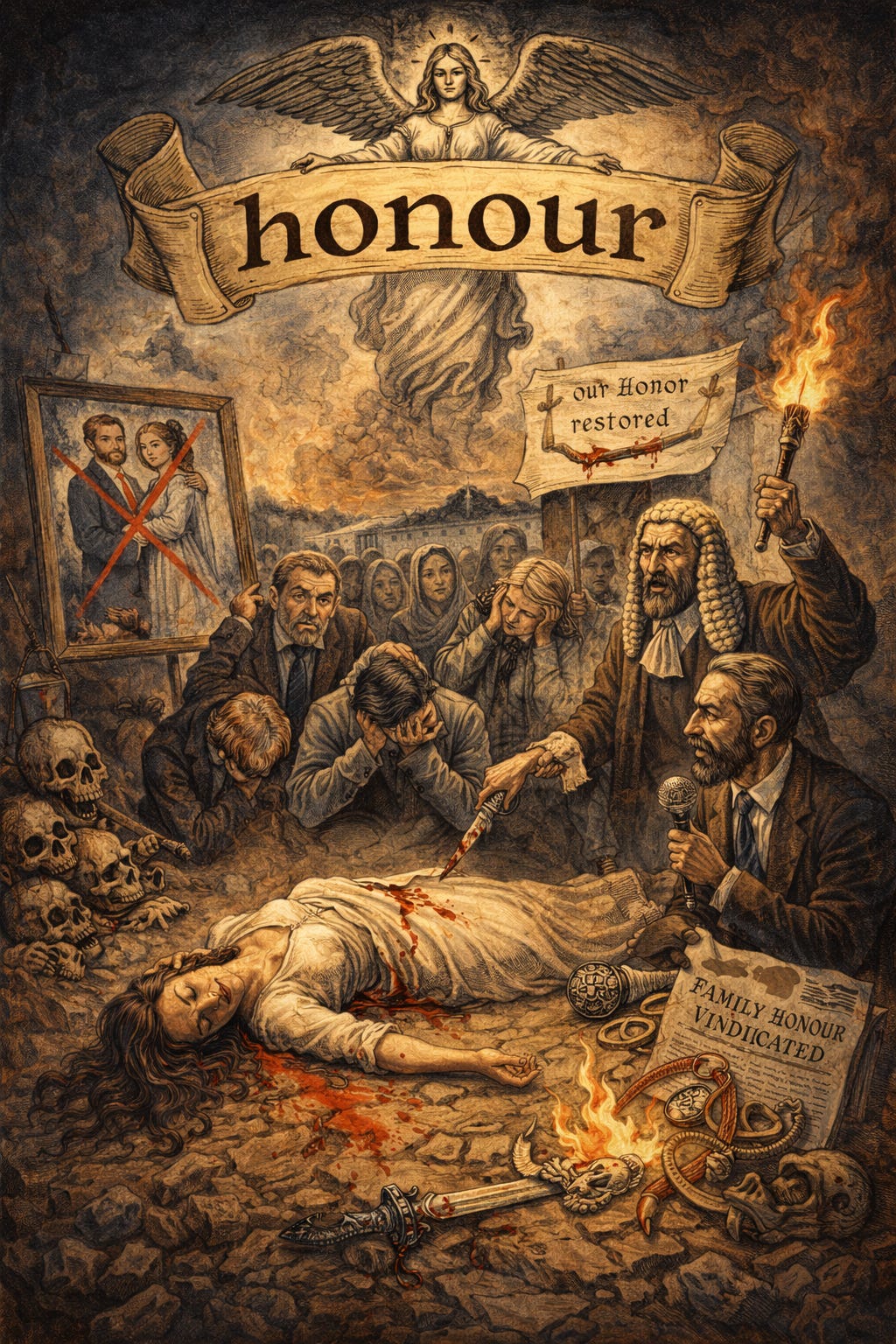
Honour killings alone are estimated to claim thousands of lives annually, though the true number is almost certainly higher given the incentives to disguise such crimes as accidents or suicides. These murders appear most frequently in Pakistan, Afghanistan, Iran, Iraq, Jordan, Syria, parts of Turkey, and Kurdish regions, with occasional cases surfacing within diaspora communities in Europe and North America.
The logic is chillingly direct: a woman or often a teenager is believed to have brought shame upon her family — perhaps by choosing her own spouse, seeking divorce, or defying social expectation — and must therefore die to restore honour.
That such reasoning survives into the twenty-first century should command the undivided attention of anyone claiming allegiance to universal equality.
Female genital mutilation offers another ledger of suffering. More than 230 million women and girls alive today are estimated to have undergone the procedure, concentrated in countries such as Somalia, Guinea, Djibouti, Egypt, Sudan, Mali, and parts of Indonesia.
The practice often predates Islam historically, and it is important to say so plainly; cruelty is rarely the monopoly of a single faith. Ethiopia and Eritrea, with large Christian populations, also report significant prevalence.
Yet intellectual honesty requires acknowledging a geographic pattern: today, the highest concentrations occur largely within Muslim-majority societies. Recognising this is not an exercise in bigotry. It is an exercise in description.

Child marriage follows a similarly sobering map. Hundreds of millions of women alive today were married before the age of eighteen, with some of the highest rates found in Niger, Chad, Bangladesh, Mali, and South Sudan. Here, religion intersects with poverty, conflict, and educational deprivation; causation is rarely monocausal. Still, the effect is unmistakable — the foreclosure of autonomy before it has even begun.