


If you believe in the importance of free speech, subscribe to support uncensored, fearless writing—the more people who pay, the more time I can devote to this.
Please subscribe to receive at least two pieces/essays per week with open comments. It’s $8 per month, less than $ 6 USD.
Everyone says, “Hey, it’s just a cup of coffee,” but please choose my coffee when you come to the Substack counter. Cheers.
What grinds my gears—more than bureaucratic cowardice, institutional hypocrisy, or lawyers whose every breath vindicates all the jokes—is the collapse of adulthood itself.
We no longer reliably produce adults. We produce adult-children: people old enough to vote, teach, manage, accuse, and destroy, yet incapable of the defining faculty of adulthood—moral responsibility. This is not rebellion. It is not even immorality. It is amorality. These people do not experience themselves as agents bound by consequence. They experience themselves as spectators entitled to expression, reaction, and exemption.
And this is not merely a generational pathology. It is visible in people in their forties, fifties, and sixties—credentialed, promoted, institutionally empowered—who have never grown up at all.
Taking responsibility is not something they refuse to do. It is something they have never seriously contemplated. It does not register as a live option. In the same way one looks at birds and knows instinctively, I cannot fly, they look at accountability and assume, just as naturally, this does not apply to me.
This distinction matters. The immoral person knows the rule and breaks it. The amoral person never internalised the rule in the first place. Guilt presupposes agency; they feel none. What they feel instead is entitlement—entitlement to speech without consequence, accusation without evidence, destruction without ownership. Power is the only currency they recognise. And when they possess it, they do not hesitate to use it—to inflict harm, to satisfy grievance, and to indulge their own moral emptiness.
These people are not accidents. They are manufactured. Raised in environments where discipline is confused with cruelty, boundaries are negotiated away in the name of self-esteem, and every discomfort is redescribed as harm. They are then finished in institutions that have abandoned moral formation altogether, mistaking education for therapy and authority for oppression.
Indeed, institutions themselves increasingly behave like amoral children. When institutions settle disputes, they almost invariably insist on clauses declaring that they have “done no wrong.” This is defended as prudence—protection against future liability. But the deeper truth is simpler and uglier: institutions no longer know how to say, 'We were wrong ’ They cannot repent. They cannot confess. They can only manage exposure.
An institution that cannot acknowledge wrongdoing is not morally neutral; it is morally stunted. It is run by adult-children who defer agency upward and outward until it dissolves entirely. Responsibility is absorbed into the Borg of “the institution”—a fictive entity that acts but never thinks, harms but never repents. No one decides. Everyone complies. Everyone is innocent.
This stands in direct contradiction to the Judeo-Christian understanding of the human person. Human beings, created in the image of God, are moral agents. We are accountable. We answer for our actions. The refusal to do so is not sophistication; it is regression. A bureaucracy that cannot take responsibility is no more mature than the individuals it shelters—and often less so.
Remove responsibility, and what remains is not innocence but danger. Because once agency evaporates, other people cease to be fully real. They become surfaces—screens onto which impulses are projected. You test ideas on them. You experiment with their reputations. You provoke reactions and watch the fallout. This behaviour is not always driven by hatred. More often, it is driven by boredom. Chaos becomes stimulation. Damage becomes feedback.
This is where the continuum begins. The same moral vacancy that permits reputational annihilation for amusement is not categorically different from the vacancy that permits physical violence for sport. The scale differs. The logic does not. In both cases, the self is sovereign. In both cases, others are props. In both cases, responsibility is absent.
As Dante understood, the descent does not begin with murder. It begins with permission. With small lies indulged. With cowardly evasions excused. With the quiet institutional decision that accountability is optional and harm acceptable so long as no one feels personally responsible.
This is not abstract theory. My exposure to this moral vacancy occurred within a contemporary university. This institution offers ethics courses as credentials while structuring itself so that personal agency is neither expected nor required of those who operate within it.
The immediate agents were two young staffers who were also part-time students—individuals I had previously taught, mentored, and assisted without incident. They had an inflated sense of importance, which was evident, but there had never been a harsh exchange, disciplinary conflict, or an adversarial relationship. On the contrary, my dealings with them had been uniformly professional and supportive. There was no precipitating event that could plausibly justify what followed.
At some point, they decided that destroying a professor’s reputation would be an acceptable exercise. They may even have taken pleasure in the outcome. One colleague, who retained a conscience, later reported that one of them was heard singing to others, “Paul doesn’t work here anymore,” as the process leading to my eventual purging was still underway.
Not a moral act, not a corrective, not a grievance pursued in good faith—but an action undertaken within a system that had already taught them that responsibility is optional and consequence negotiable. Faculty and administrators did not intervene because the institutional culture had rendered intervention unintelligible. No one was required to decide whether anything was right or wrong. The procedure was sufficient.
This is how institutions that disclaim moral judgment function in practice. They create environments in which malice need not be explicit, intention need not be examined, and accountability can be indefinitely deferred. In such conditions, slander is not a deviation from the norm; it is an available mechanism.
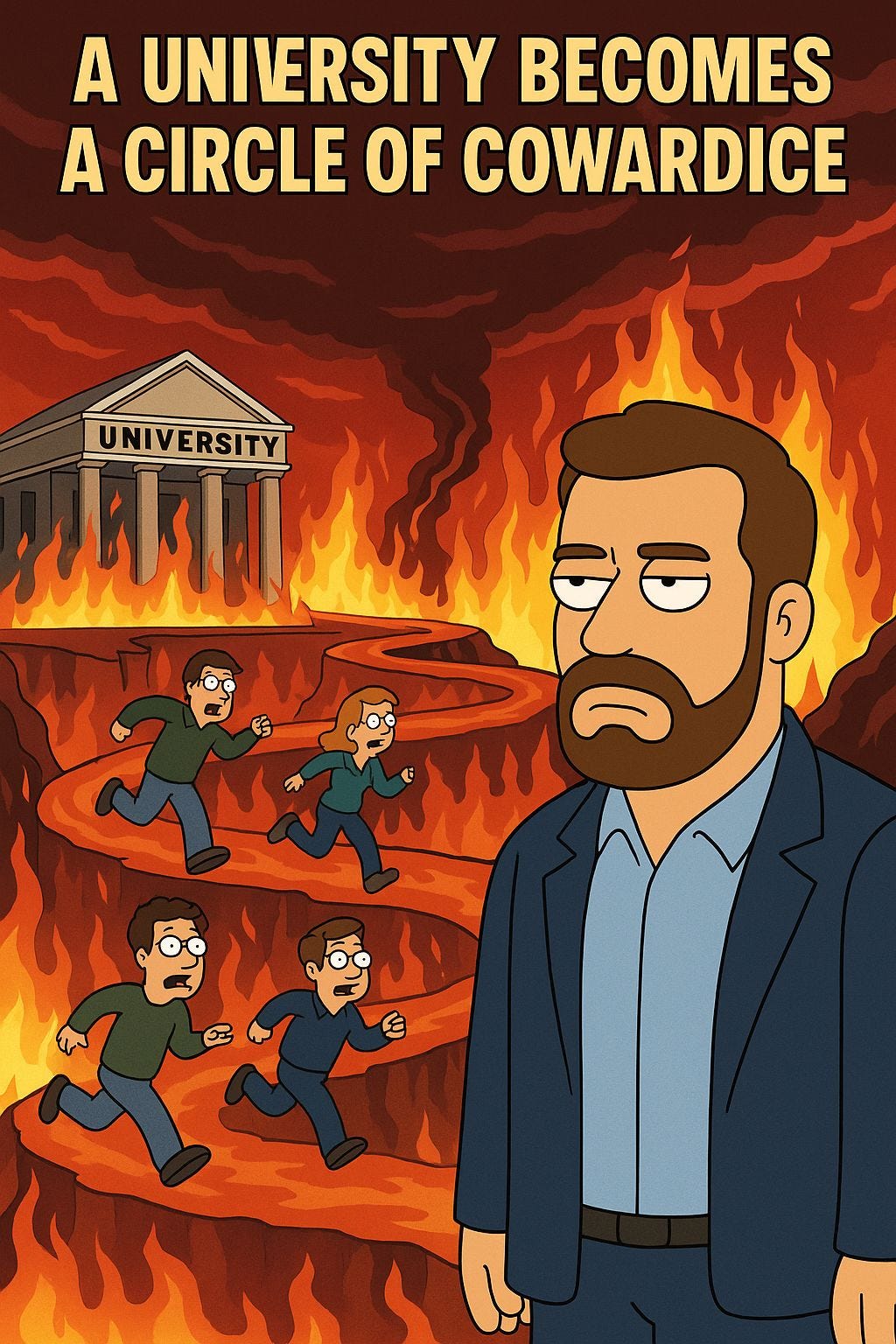
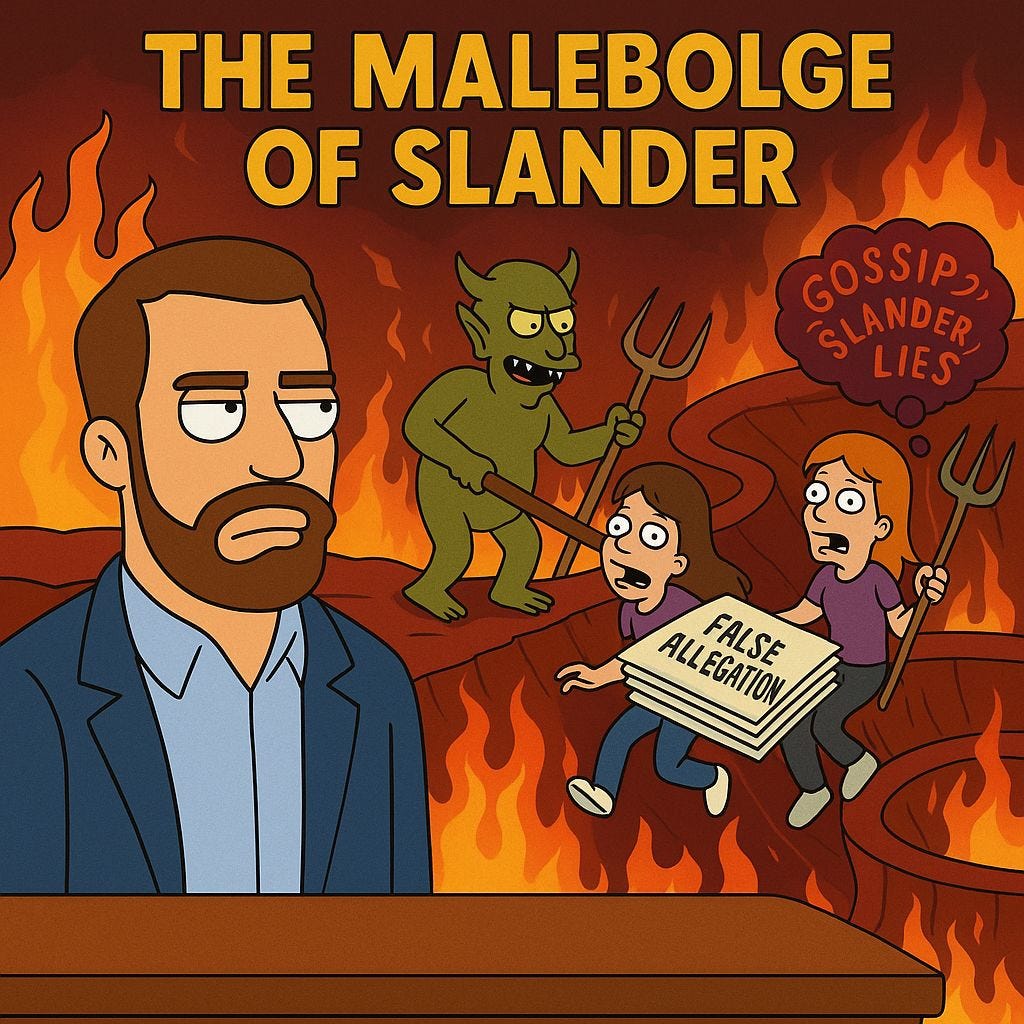
And like every circle of Hell in Dante’s Eighth Malebolge, their lies did not remain lies. They metastasised. Slander always does. It behaves like a demonic infection: splitting, multiplying, feeding on the weak-willed and the institutionally timid. All it needs is one spark.
The university protected its sacred right to slander me; they didn’t want the little darlings to feel unsafe.
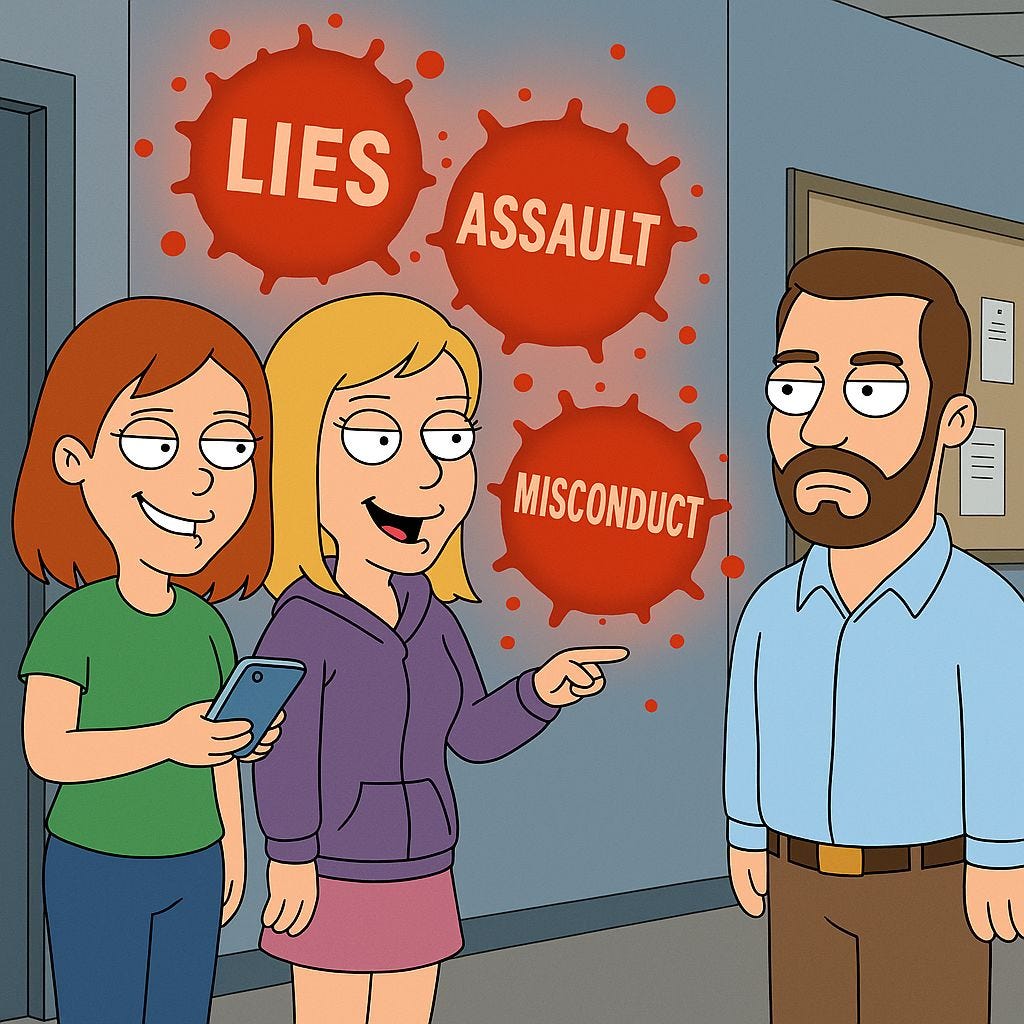
Their falsehoods did not remain contained. They spread. Slander always does. It replicates, fragments, and migrates, feeding on the hesitant, the cowardly, and the institutionally timid. What begins as a casual whisper acquires heat, momentum, and finally force. History is full of reminders that the most devastating fires do not begin with infernos, but with a single, careless spark allowed to land where no one feels responsible for stamping it out.
And lest anyone imagine this culture of cowardice and indulgence is confined to academia, one need only recall the grotesque farce surrounding the killing of Ken Lee in Toronto.
Eight girls — yes, girls — aged thirteen to sixteen, swarmed and stabbed a man to death.
A man is dead, and yet the machinery of youth-justice privacy snapped into place immediately, sealing their names, hiding their identities, and ensuring that not even the public could whisper who had done it. The parents? Silent as tombstones. The state? Tender as a nursemaid.
And the sentences? In some cases, probation, time served, or community supervision. One girl, according to published reports, received just fifteen months of structured probation. Another, who pleaded guilty to manslaughter, walked away with no further jail time after credit for pre-sentence custody.
A man lies in the ground, and the perpetrators remain unnamed, unexposed, and largely unpunished — poor babies.
And here is the brutal question that binds all of this together: Because he was homeless, was his life worth less? What if he had been a university president? What if he had been a dean? What if he had been a corporate executive? Would the vigils have grown larger? Would the press have wept louder? Would society have cared?
It is a perfect microcosm of our moral inversion: protect the offender, bury the victim, conceal the identities, extinguish accountability, and then blame “society,” “trauma,” “ADHD,” or whatever fashionable diagnosis the moment requires.
Anything to avoid the blunt reality that some acts are wicked, some choices irredeemable, and some consequences deserved.
Back to the two sociopaths in my case, they were not alone. Staff members joined in. Faculty joined in. Adults — people with salaries, job descriptions, ergonomic chairs, and letters after their names — chose to participate in cowardice.
Humber College, instead of enforcing integrity, rewarded the slanderers and punished the truth-teller.
This sickness—this inability to distinguish right from wrong—is learned. It is the natural outcome of a culture that has elevated irresponsibility into a civic virtue and cowardice into a governing philosophy.
We are living under the rule of what the Greeks would have called deilia—not mere fear, but cowardice as a moral failure. The Greek coward was not simply afraid; he was someone who, when confronted with a duty, a truth, or an injustice, turned and ran, choosing comfort over courage, conformity over conscience. To shirk responsibility was not an emotional lapse—it was a character defect.
And that is precisely what we see now in our universities and in social media companies that mimic their ethics. Anyone who has ever raised a child recognises the pattern: a refusal to own one’s actions, followed by the expectation that someone else will clean up the consequences.
This is perpetual childhood—a state not defined by giggling at fart jokes, but by the inability to stand upright in the face of wrongdoing. A society of adult children cannot confront evil; it can only retreat from it, explain it away, or punish the person who points at it.
Thus, the institutions rush not to discipline the offender, but to smother the witness. They cannot bear responsibility, so they deny the reality that would demand it. They cannot confront the moral failure, so they punish the person who exposes it.
Perpetual childhood is cowardice wearing innocence as camouflage.
And cowardice—true Greek cowardice—is the refusal to act when justice demands action. Such people now run our universities and platforms.
Their moral world is ordered not by right and wrong but by comfort and discomfort. Truth is allowed only if it causes no disturbance. Falsehood is tolerated so long as it spares them the burden of courage. And so the injured raccoon receives blankets, the murdered man receives silence, and the slandered professor receives execution—all because the adults in charge have chosen to remain children.
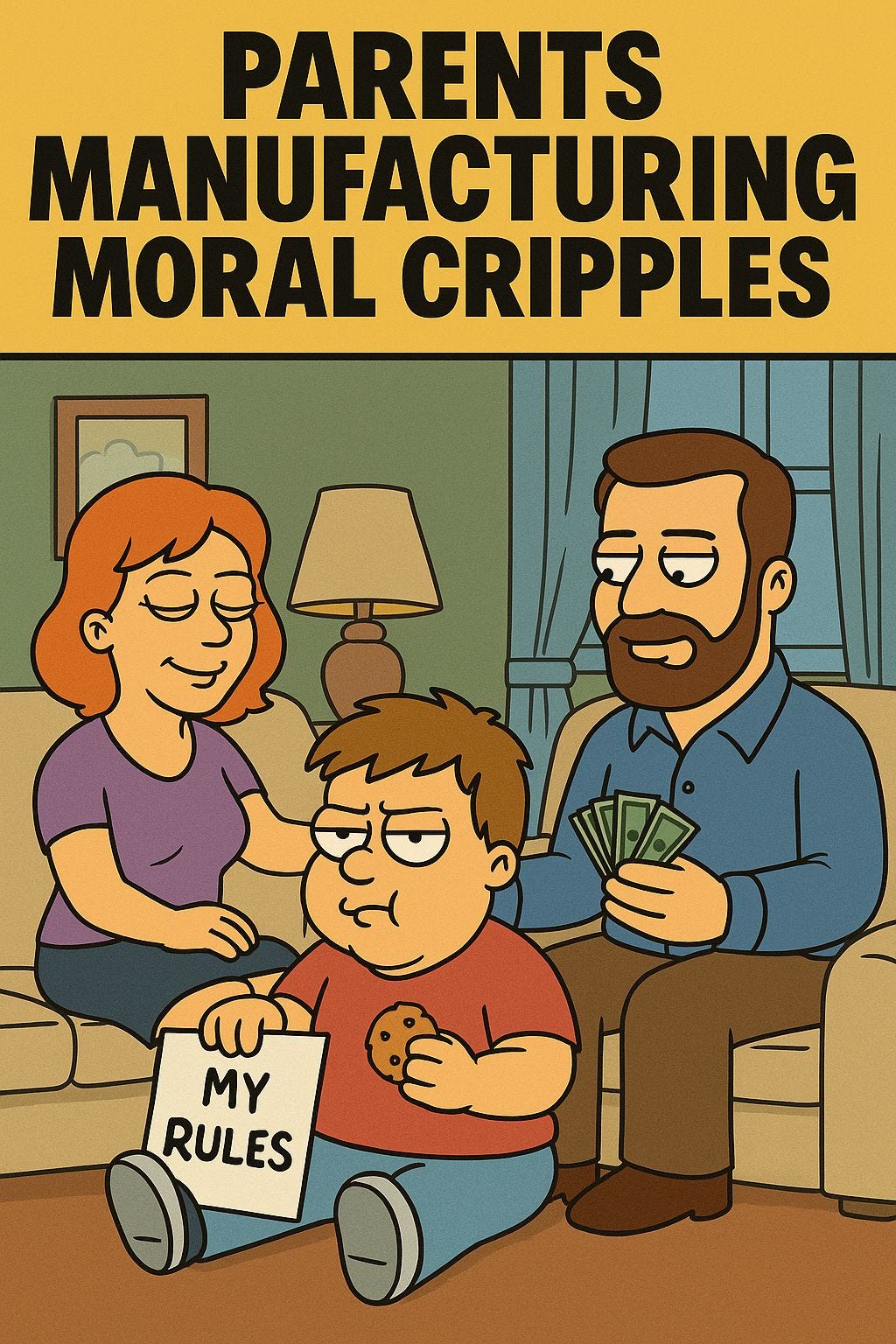
And it begins with parents. A bad child can emerge from good parents, but what we have now is something darker: parents actively manufacturing moral cripples, teaching their children:
When you do wrong, evade.
When you harm, deny.
When truth threatens comfort, lie.
When confronted with consequences, weaponise fragility.
In this culture of engineered cowardice, one betrayal stands out—not because it is historically exceptional, but because it is the only corner of it I can speak to directly. There have been far greater betrayals, with far graver consequences, across history. This is simply the small edge of it that I witnessed at close range.
The Student Who Lied, Admitted It, and Was Taught to Bury the Truth
I helped him for years. Supported him academically, emotionally, and professionally. Then, in a move of astonishing cruelty, he lied to the Human Rights department, claiming I threatened him not to report me. It was nonsense.
I stand proudly behind every word I ever said about Hamas. I would carve my statements into granite and drop them on Parliament Hill. But he lied anyway.
When I confronted him—because when someone tries to destroy your career, you do not knit them a sympathy scarf—he admitted he lied. He admitted it in front of two witnesses. He admitted it clearly, plainly, without hesitation. And when asked whether he would correct the record, he agreed.
For a brief moment, I saw a flicker of moral development.
Then his parents intervened. His mother or father — two polished, affluent monuments to modern cowardice — seems to have told him not to correct the record, and then whined to the university when I called them out for their wretched parenting.
For these two modern “buddy parents” (who are not really parents but buddies and providers of material goods), the truth did not matter. Justice did not matter.
They literally instructed their son:
Do not fix the harm you caused.
Do not tell the truth.
Do not undo your betrayal.
Because morality is inconvenient. Because accountability is “too messy.”
Because adults are now trained to behave like frightened interns hiding behind HR, and this pathology spills into schools.
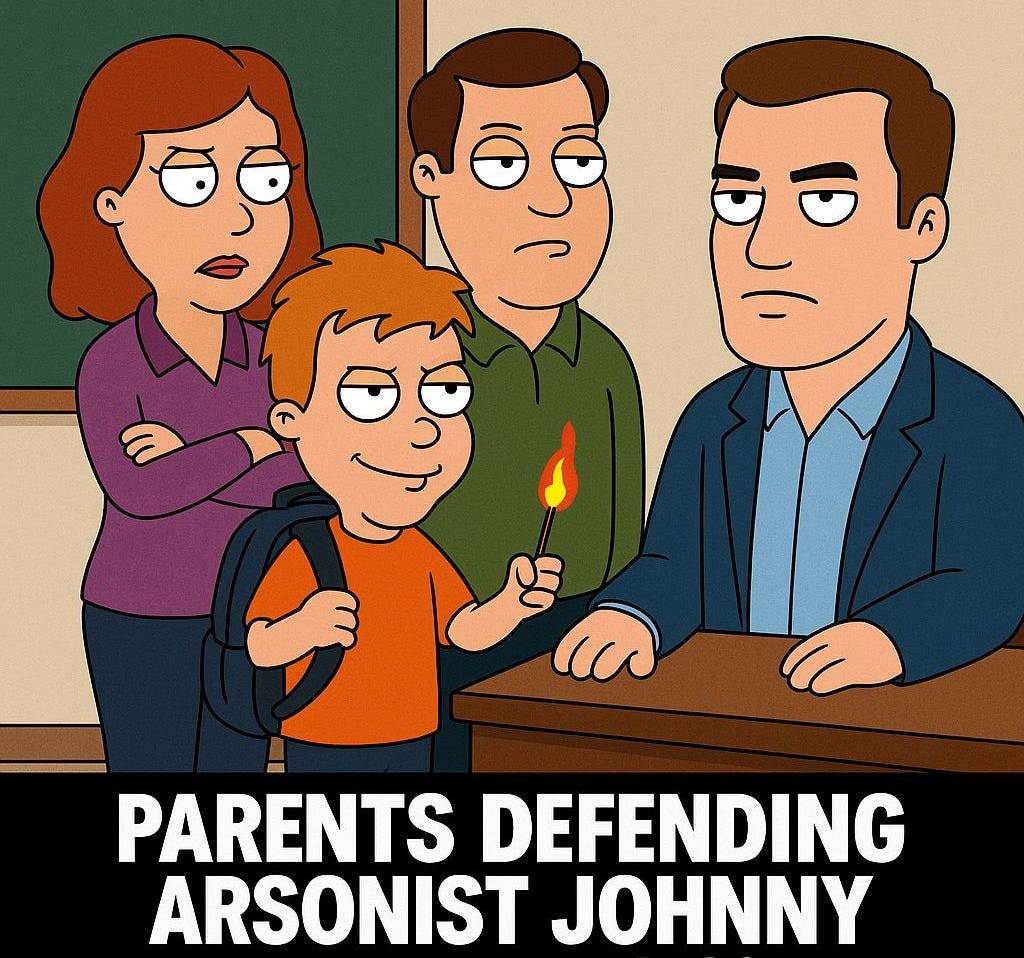
Parent–teacher interviews once served a brutally necessary purpose: they reminded children that adults were still in charge and that excuses were not a substitute for responsibility. When I was young, if a teacher reported misconduct, my parents did not launch an inquiry into power structures, latent trauma, neurodivergence, colonial residue, dietary intolerance, algorithmic manipulation, or the emotional labour required to raise a reprimand. They assumed the teacher was right.
There was no appeal process. No victim narrative. No strategic tears. Fault had a name, and it belonged to me. I remember the silence on the drive home, the expression that required no translation. Judgment had already been passed. The teacher did not hedge, my parents did not negotiate, and no one pretended that my self-esteem was more important than my character. Consequences followed behaviour as predictably as gravity follows mass.
It was unpleasant. It was humiliating. And it worked. That is precisely why it has been dismantled.
Now, teachers sit like defendants while parents defend their “misunderstood” arsonists. And then we come to Humber College—the institutional parent, the bureaucratic nursery for dysfunctional adulthood. Humber is not an institution of learning. It is an emotional spa for the fragile. It shields liars. It protects slanderers. It punishes truth.
