


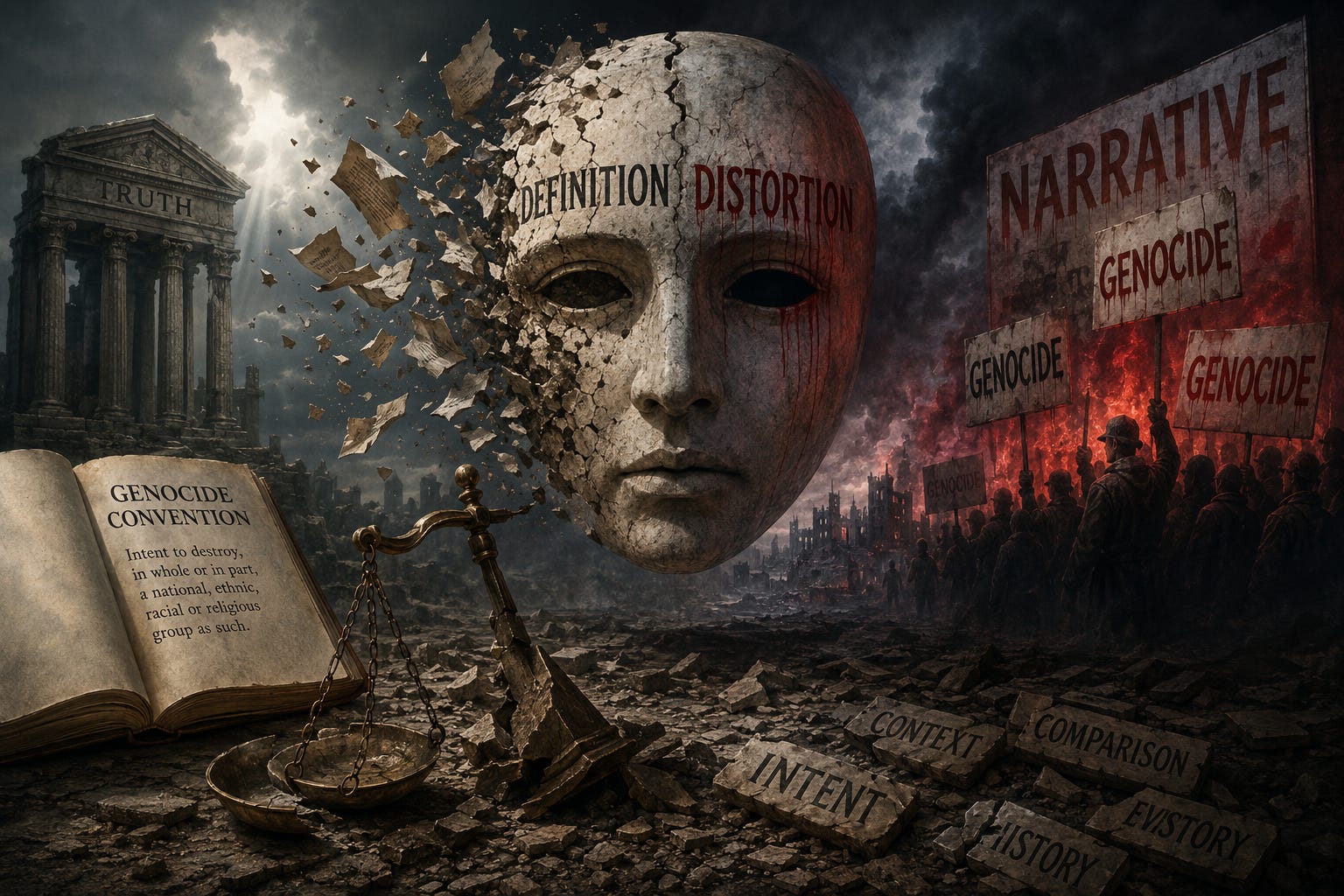
Every civilization eventually reaches the point where words stop describing reality and start serving politics.
The first casualty is precision.
The second is truth.
No word illustrates this collapse better than genocide.
Before discussing Gaza, before debating casualty figures, before arguing over proportionality, there is an intellectually prior question that every serious person must answer.
What do we mean by genocide?
That question is almost never asked.
Instead, the accusation is simply asserted, repeated, hashtagged, and treated as though repetition were evidence.
Yet genocide is not a slogan.
It is perhaps the gravest accusation recognized in international law.
The Genocide Convention was drafted in the shadow of the Holocaust to describe something extraordinarily specific: the intentional destruction of a national, ethnic, racial, or religious group as such. The distinguishing feature is not merely death, suffering, or destruction. It is specific intent to destroy the group itself.
That demanding standard is precisely what gives the word its moral authority.
Remove the requirement of intent, and genocide ceases to be a legal concept. It becomes a political adjective.
Today, however, the word is increasingly stretched far beyond its original meaning. People invoke it in contexts involving structural injustice, cultural destruction, historical grievance, or devastating wars. People are free to argue for broader philosophical definitions if they wish. But they are not free to quietly substitute those broader definitions for the legal one while pretending nothing has changed.
That is not reasoning.
It is changing the rules of the game after it has begun.
And once words become infinitely elastic, evidence becomes optional.
Which brings us to Israel.
On October 7, Hamas carried out the largest massacre of Jews since the Holocaust. Entire families were murdered. Civilians were tortured, raped, kidnapped and executed. Communities were overrun. More than two hundred hostages were dragged into Gaza.
Adjusted for population, the attack was roughly equivalent to 40,000 Americans being murdered in a single morning.
Imagine, for a moment, that the victims had not been Israelis.
Imagine that armed Canadian militias crossed into Michigan, massacred forty thousand Americans, abducted hundreds more, and retreated into southern Ontario under the protection of a government that promised to repeat the attack “again and again.”
What would the United States have done?
The answer is so obvious that the question almost seems childish.
America would have gone to war.
Every government worthy of the name would have attempted to destroy the military organization responsible while recovering its hostages and preventing another massacre.
Anyone who believes otherwise is entitled to say so.
But that is the argument that must be made.
Not the accusation of genocide.
One cannot honestly evaluate Israel’s response without first answering the question critics routinely avoid:
What should Israel have done instead?
Not ideally.Not rhetorically. Not in a university seminar.
In reality.
Should Hamas have remained intact?
Should the hostages have remained underground?
Should the organization that publicly promised to repeat October 7 have been left capable of doing precisely that? Should Israel have said “bad Hamas, don’t do it again?
These are not peripheral questions. They begin the discussion.
Only after answering them does the word genocide become relevant.
Yet remarkably, the public debate usually proceeds in the opposite direction.
The accusation comes first. The evidence, if it arrives at all, comes later.
That is backwards.
A charge as grave as genocide cannot survive on moral outrage alone.
It must survive legal analysis. It must survive military history.
And above all, it must survive comparison.
Compared to what? Compared with Berlin. Compared with Hue. Compared with Fallujah. Compared with Mosul. Compared with Raqqa. Compared with Mariupol.
Wars are not judged against imaginary conflicts in which terrorists emerge from hospitals wearing uniforms and politely surrender.
They are judged against history.
Modern urban warfare is among the most destructive forms of combat ever experienced. The battles for Mosul and Raqqa against ISIS left vast areas destroyed after months of fighting. Military analysts note that Gaza presents an even more complex environment: far greater population density in key combat areas, an extensive tunnel system developed over many years, widespread booby-trapping, hostages held underground, and an adversary embedded throughout civilian infrastructure.
That does not answer every moral or legal question.
It does not prove that every Israeli operation was justified.
It does not immunize any army from scrutiny.
But it does establish something essential.
If one is going to accuse Israel of committing the worst crime known to international law, one has an obligation to compare like with like.
One must ask how other democratic militaries fought similar battles.
One must ask what happened in Mosul, Raqqa, Fallujah, and other cities where entrenched fighters used urban terrain to their advantage.
One must ask whether any modern army has faced an opponent that spent years constructing an underground military city beneath one of the world’s most densely populated territories while embedding command centres, weapons, and fighters among civilian infrastructure.
Those questions are not distractions. They are the beginning of serious inquiry.
Too often, however, they are dismissed as irrelevant.
That should trouble anyone who still believes evidence matters.
For if the accusation cannot withstand comparison with history, military practice, and the legal definition from which it derives its force, then perhaps it survives for another reason altogether.
Part II: Holocaust Inversion and the Politics of Comparison
The accusation of genocide cannot survive on emotion alone.
It must survive comparison.
That is the test that is almost never applied.
Wars are not judged against perfection. They are judged against history.
Every major urban battle of the last century has produced catastrophic civilian suffering. Berlin. Hue. Grozny. Fallujah. Mosul. Raqqa. Mariupol. Different wars. Different armies. Different political causes. The common denominator is brutally simple: once armies fight block by block through densely populated cities, civilians die in horrifying numbers.
That is not a justification.
It is a historical observation.
The relevant question is therefore not whether civilians died in Gaza. Tragically, they did.
The relevant question is whether Gaza resembles other urban wars—or whether it represents something historically unique.
Here the comparison becomes more complicated.
Hamas did not fight as a conventional army. Its fighters generally did not distinguish themselves from the civilian population by regular uniforms. It built its military infrastructure throughout one of the world’s most densely populated territories.
Years before October 7, it constructed an extensive underground tunnel network measured in hundreds of kilometres by many analysts. Israeli forces and independent observers have documented tunnels and military facilities beneath or adjacent to civilian infrastructure in numerous locations, although the extent and significance of individual sites remain subjects of investigation and debate.
That matters.
The law of armed conflict does not disappear because an enemy violates it.
Nor does it permit indiscriminate attacks.
But any honest military assessment must recognize that an adversary deliberately embedded among civilians presents challenges fundamentally different from those faced in conventional warfare.
Military historians continue to debate the civilian-to-combatant ratios in battles such as Mosul and Raqqa. The figures vary because urban warfare rarely produces precise casualty accounting. Records are incomplete, definitions of combatants differ, and governments, militaries, and armed groups often report numbers serving their own narratives.
Gaza presents an even greater evidentiary challenge. Hamas, which controls the territory’s health ministry, has generally not distinguished between civilians and militants in the headline casualty figures it releases. Independent analysts have also identified inconsistencies, subsequent revisions, and disputed classifications within those data. As a result, determining the true civilian-to-combatant ratio remains extraordinarily difficult and continues to be the subject of active analysis and debate.
That uncertainty should produce intellectual humility. Instead, it has too often produced intellectual certainty. Casualty totals are frequently presented as though they automatically establish genocide. They do not. Even if every reported death were accepted at face value, casualty numbers alone cannot establish genocide. International law requires evidence of specific intent to destroy a protected group as such. Without that evidence, the argument has skipped over the single most important element of the crime it claims to prove.
That uncertainty should produce intellectual humility.
Instead, it has often produced absolute certainty.
The word genocide is pronounced with remarkable confidence while many of the underlying factual questions remain disputed.
That is not how serious inquiry works.
One may conclude that Israel committed war crimes in particular operations.
One may conclude that Israeli decision-making was reckless or disproportionate in specific circumstances.
One may conclude that humanitarian obligations were inadequately fulfilled.
Those are arguments capable of legal examination.
Genocide is different.
It requires proof not merely that civilians died in large numbers, but that the objective was the destruction of the Palestinian people as such.
That is an extraordinarily high legal threshold for good reason.
The Holocaust established why.
Between 1941 and 1945, Nazi Germany systematically organized the destruction of European Jewry. The objective was not defeating an army. It was eliminating a people. Men, women, children, infants, the elderly, the healthy and the disabled were all marked for extermination because they were Jews.
That remains the defining example of genocide.
It is therefore impossible to ignore the rhetorical significance of accusing the Jewish state of committing that very crime.
Scholars of antisemitism have long described this phenomenon as Holocaust inversion: the reversal by which the descendants of history’s most famous victims of genocide are recast as its symbolic perpetrators.
That observation does not answer every criticism of Israeli policy.
Nor should it.
Governments, including Israel’s, remain subject to criticism.
Military decisions deserve scrutiny.
Civilian deaths deserve scrutiny.
No democratic society should fear difficult questions.
But difficult questions require equally serious standards of evidence.
Too often, the contemporary genocide accusation functions less as a carefully reasoned legal conclusion than as a political slogan. Once uttered, it renders every subsequent fact secondary. Casualty statistics become proof. Military context becomes excuse. Historical comparison becomes deflection. Legal definitions become inconvenient technicalities.
The accusation itself becomes the argument.
That is propaganda’s oldest technique.
Not to persuade through evidence.
To redefine the terms of debate so completely that evidence no longer matters.
Perhaps that explains why the charge of genocide continues to flourish despite fierce disagreement among international lawyers, military historians, and specialists in the law of armed conflict.
For many activists, the accusation is no longer the conclusion of an investigation.
It is the starting premise.
Everything else is interpreted through it.
That is not scholarship.
It is ideology.
A genuine search for truth asks uncomfortable questions of every side. Propaganda asks uncomfortable questions only of its enemies.
History deserves better.
The Palestinians deserve better.
The Israelis deserve better.
And the memory of those who perished in actual genocides deserves better still.
The Holocaust permanently altered humanity’s moral vocabulary by giving the world a word for one of its darkest crimes.
If that word is detached from its legal meaning and transformed into a universal political epithet, it will not strengthen our moral language.
It will empty it.
For when every tragedy becomes genocide, genocide itself ceases to mean anything.
And when the gravest accusation known to international law no longer survives serious historical comparison, careful legal analysis, or disciplined intellectual inquiry, it ceases to function as law.
It becomes something else.
It becomes propaganda.
After hamas slaughtered 1200 Israelis in one day they pledged to make everyday October 7th for Israel. Had they succeeded there would have been well over 1 million dead Israelis, and that would have been genocide. They announced their genocidal intent, but Israel stopped them. hamas failed, but not for lack of trying.
Contrast that to Israel who with far greater military might and weaponry could easily kill 1200 gazans in one day, but in almost 3 years of war there is not one day they have killed that many, nor even half that many. Why is that? I've posed that question to folk who accuse Israel of genocide and never received an intelligent or coherent response.
I've had those spreading the genocide falsehood accuse Israel of attacking without restraint. When I pose the question they've then said Israel knew the world would soundly condemn them, that is why they haven't met the one day death count achieved by hamas. I point out they just said Israel attacks without restraint, and in the next sentence they say Israel restrains itself to avoid world condemnation. Point out the inconsistency in their contention and they babble meaninglessly or end the conversation.
Much of this genocide falsehood lodged against Israel by many moronic nations is done to expiate guilt they may feel over the actual genocide of Jews during WWII, which they did nothing to stop or complain about, or to gaslight Jews who faced actual genocide and to this day, in Israel, fight against genocidal enemies.