


If you believe in free speech, subscribe to support uncensored, fearless writing. The more readers who chip in, the more time I can devote to it. I’m not yelling from the sidelines—I’m a university professor fired for criticizing Hamas.
Subscribers get at least three essays a week, plus open comments. It’s $6/month (less than $4 USD). People say, “It’s just a cup of coffee,”—so when you’re at the Substack café, pick mine. Cheers.

Now, a confession fit for the times: my books on digital communication have sold fewer than 500 copies. Combined. They’re digital, not hand-bound by monks—but still. Behold the towering monument to my obscurity.
And what do I teach? Marketing. Naturally. There’s a poetic symmetry in that—like a vegan butcher or a sober Irishman.
But don’t mistake me for some embittered, rotund luddite clutching a Nokia 3310 and snarling at Wi-Fi routers. I am not anti-digital. I do not yearn for a cave, candles, or a quill. What I am is anti-delusion—and nowhere is the collective delusion more pungent than in our love affair with digital communication.
It is a faith, complete with rituals (Slack emojis, “circling back”), clergy (Zoom coaches, LinkedIn influencers), and sacred texts (emails that begin with “per my last message…”). And like all bad religions, it demands human sacrifice: namely, the soul of real communication.
Digital technology, with its soulless conveniences and masturbatory illusions of connection, has become the burka of the modern world—only this time, we put it on ourselves and call it liberation.
With work-from-home (WFH) as its dutiful midwife, the screen has swaddled us in a veil of pixels, stripping away not modesty but humanity. Our faces vanish, our voices are compressed into glitchy modulations, our gestures amputated at the shoulder by webcam frames.
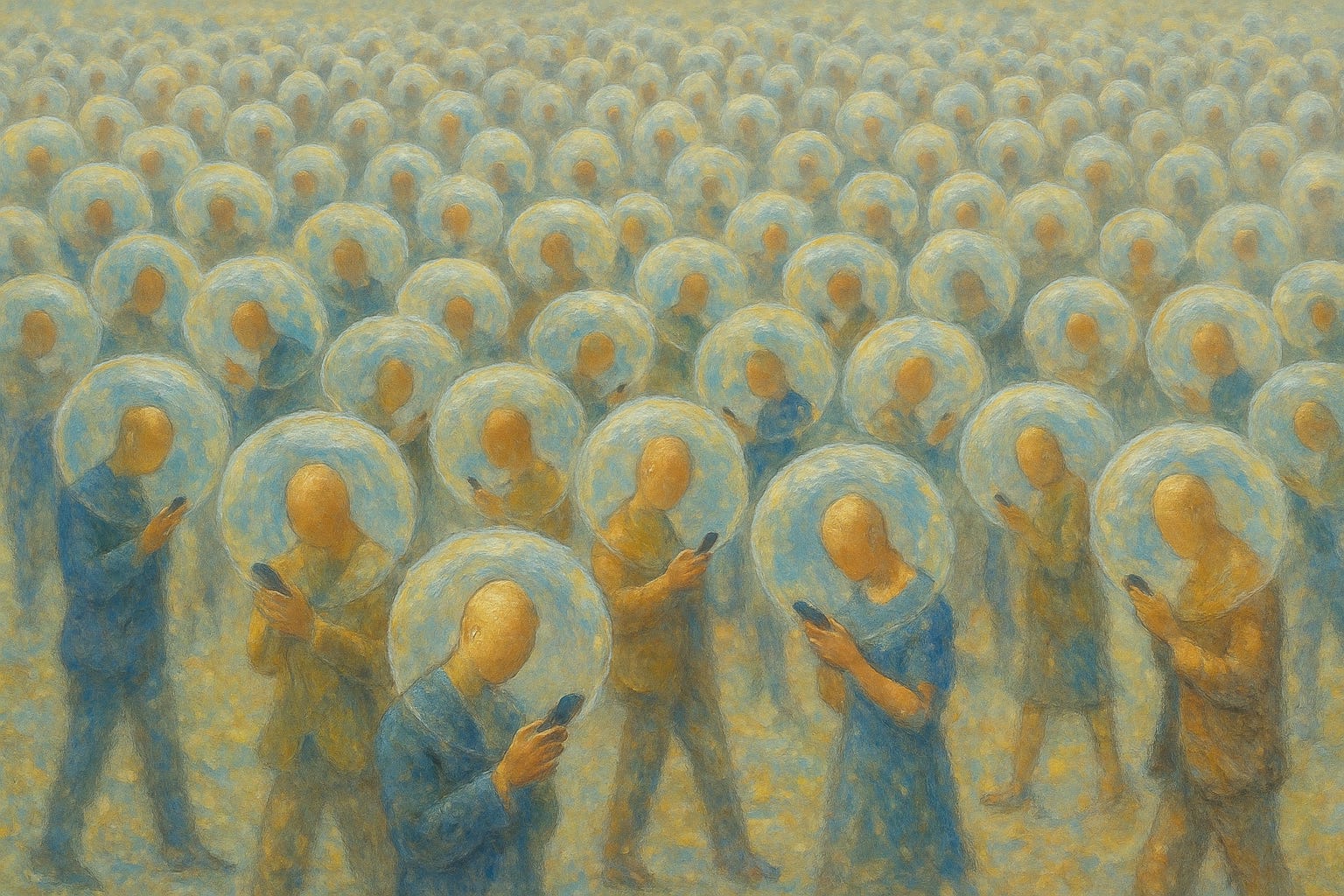
Digital communication’s sterile embrace doesn’t just fracture discourse; it’s the jet fuel for the work-from-home delusion, promising liberation but chaining us to gilded isolation. A 2021 Nature study reveals WFH, propped up by Zoom and email, cripples productivity by 8–19%, as collaboration drowns in pixelated purgatory.
Workers, siloed in their sweatpants, grow lonely—70% report disconnection, per Cigna’s 2020 survey—while morale festers like an open wound. A 2023 ScienceDirect study notes trust in bosses erodes without the alchemy of shared glances or impromptu chats.
Workplaces become ghost towns of avatars, where colleagues are strangers and Zoom’s mute button buries camaraderie. Digital’s umbilical cord tethers us to tasks but severs human bonds, leaving us “productive” only as hamsters on a wheel are “athletic.” WFH, sold as freedom, is a swindle—exiling us from the messy, vital pulse of human work.
This is not freedom—it is seclusion, fetishized. A world of digital burka-wearers, peeking at one another through the mesh slit of Zoom windows, mouthing platitudes into the void while forgetting how to make eye contact. We call this progress, just as a prison might call itself secure housing. But in reality, it’s the atomization of the soul. In our flight from discomfort, we’ve mistaken insulation for intimacy and become a civilization of ghostly avatars too fragile to be real.
Digital communication is a simulacrum.
It is to conversation what Velveeta is to cheese.
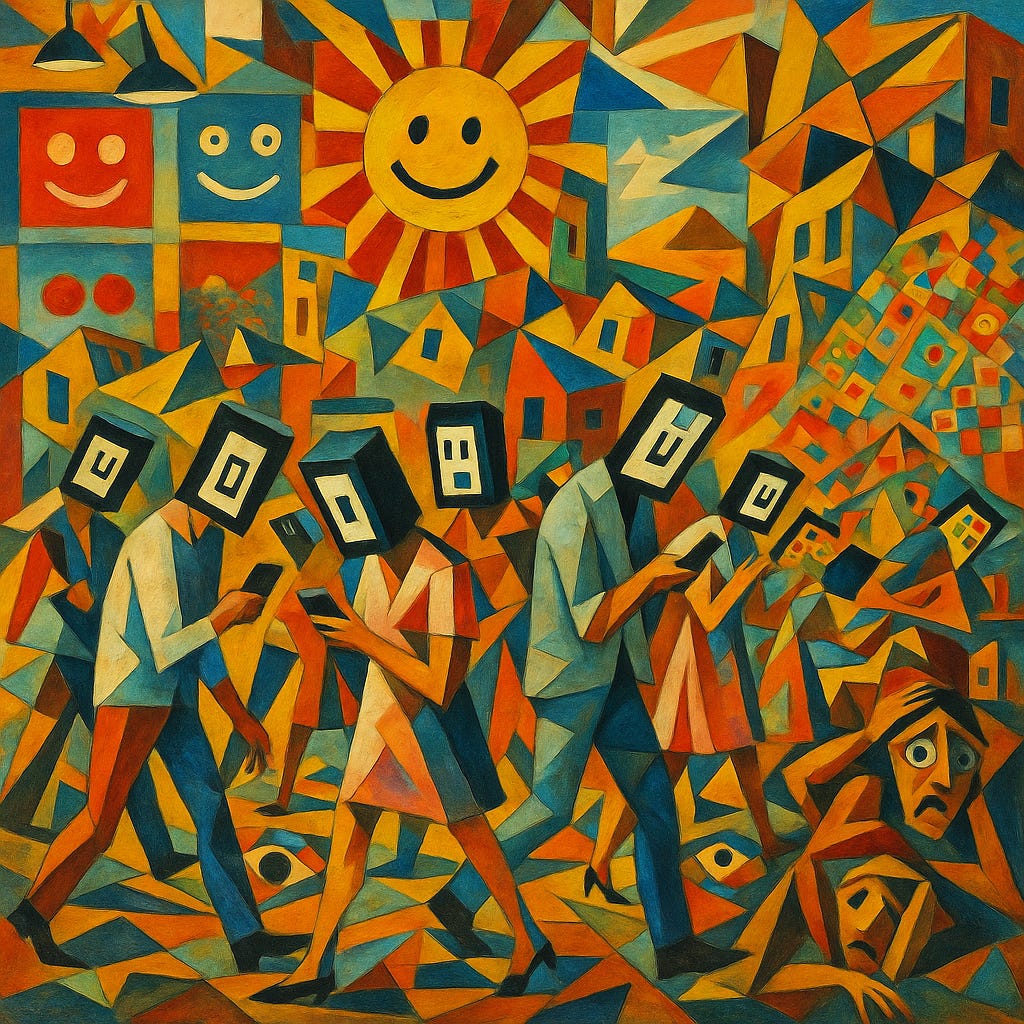
It strips from us the nuance, the nonverbal richness—tone, gesture, glance, scent, posture—that makes interaction genuinely human. And we’ve convinced ourselves that this pale, skeletal thing is progress. It’s not. It’s a lobotomy in HTML.
A 2024 systematic review in Frontiers in Psychology dared to state the obvious:
“Digital platforms…can facilitate the development of cognitive and affective empathy…However, specific limitations of digital communication, including the absence of nonverbal cues, emotional superficiality, and the dominance of algorithmically shaped ‘echo chambers,’ may substantially reduce the authenticity of empathic responses.”
Translated into plain English: it’s hard to care about someone when all you get is their emoji. Our connections are algorithmically kneecapped, their empathy pre-sorted by AI and stripped of depth. Digital interaction doesn’t build bonds; it manufactures cardboard cutouts of them.
But it gets worse. In the same year, a study published in the International Journal of Psychology examined phubbing—ignoring your partner to fondle your phone—and declared it a slow-motion relationship guillotine:
“Phubbing…leads to feelings of resentment, jealousy, and decreased intimacy in romantic relationships. It also fosters social isolation and loneliness, and can result in anxiety, depression, and diminished face-to-face communication.”
So, while the phone in your hand connects you to millions, it simultaneously estranges you from the only soul sitting across the dinner table.
And yet this is our brave new world. In universities, government cubicles, and the sad open-plan panopticons of modern corporations, digital communication has become not merely the norm but the orthodoxy. We “circle back” instead of confront. We “flag” rather than challenge. We write passive-aggressive prose worthy of an Austen villain, signing off with “Best” while secretly imagining our colleague eaten alive by otters.
Emails are for cowards. I should know. I’ve fired off many a written tirade that I’d have choked on if made to speak aloud. But now I just throw them into ChatGPT and say “talk nice.” If people only knew.
There’s a reason brave men avoid duels by choosing the keyboard. Behind a screen, every man is Achilles; face-to-face, most are interns.
But email does more than unleash cowardice—it institutionalizes evasion. In the analog world, walking away mid-conversation is rude. Walking past someone greeting you in the street is unthinkable.
In the digital, it’s standard. Ghosting is the new eloquence. Don’t like a question? Pretend you’re “away from keyboard.” Or, better yet, reply with an email full of misdirection, CC’d to enough bureaucrats to rival a NATO summit.
The latest chic atrocity in the corporate world isn’t even active cruelty—it’s the radiant cowardice of silence. Ghosting. Electronic shunning. The new gospel of HR departments and risk-averse middle managers too tepid to fire a person outright, but quite content to let them rot in a vacuum. Problem employee? Difficult customer?
Simple—never respond. Not once. You can’t be accused of misconduct if you haven’t technically done a thing. It’s the bureaucrat’s dream: plausible deniability wrapped in Wi-Fi.
And make no mistake—this is not harmless. It is psychological torture by omission, a modern form of exile. No confrontation, no explanation—just the quiet, methodical erosion of someone’s professional worth until they doubt their own existence.
It’s gaslighting at scale. And when, after five unanswered emails and the thousand-yard stare of institutional neglect, the poor bastard finally cracks and writes something human, indignant, or—God forbid—honest?
Congratulations! Now they are the problem. Now the HR Stepford mannequins can roll in, clutching their pearls, muttering about tone, “safety,” and “professionalism,” with the dead-eyed zeal of people who’ve never had a thought that wasn’t pre-approved by policy.
Digital makes monsters of the mediocre. Give a dull mind a keyboard and the narcotic of moral vanity, and behold: the age of the righteous tattletale dawns. Picture the sanctimonious employee, eyes aglow with grievance, typing furiously into some secretive HR oubliette: “I’ve filed a formal complaint. You said my curry peeled the paint off a Febreze can. That’s racist. I’m not white. You should be fired.”
Not argued with. Not debated. Fired. Because irony and hyperbole—those hallmarks of real conversation—now trigger witch trials. We no longer correct or discuss; we denounce.
This is not sensitivity. This is sanctimony weaponized. A culture so allergic to discomfort it can’t distinguish between a joke about spices and a call to arms. In saner times, this kind of whimpering would earn a raised eyebrow or a rolled eye. Now it earns you a pink slip—and your accuser, a promotion in the Ministry of Hurt Feelings.

They’re not joking. In the Kafkaesque world of Human Rights Tribunals, hate is no longer a matter of intent or evidence, but of bruised feelings and esoteric intersectional math.
Renowned HR expert Tova O’Shitte swears they factor in your sock color and tanning ability. My friend Hamish once suggested, “Why not just talk it out?”—he was promptly sacked for importing 1965 ethics into a 2025 hellscape.
Even academia is worse. There’s always some tenured gerbil who spams the entire faculty with a question like, “Can Turnitin detect AI?” (Answer: no, but we pretend it can so we feel competent.) Senior administrators spend more time deleting email than doing actual work, except for the rare meeting where the highlight is beating Fat Ted to the last Timbit.
Digital also fosters superficiality. Dunbar’s 2020 research shows face-to-face communication has dropped 40% since the 1970s, replaced by weak ties and shallow likes. We get just enough social stimulus to remain alone. TikTok rewires cognition and persuades children that slogans from terrorist groups are a vibe.
When TikTok amplifies Gaza content through algorithmic sleight of hand, it creates a generational hallucination. One cohort now believes the lie at double the speed of the informed.
If TikTok is your news source, congratulations—you’ve vacated the informed class. You’ve enrolled in Idiocracy with elective courses in virtue signaling.
Let me put it plainly: email and texting are not communication. They are communication’s ectoplasm. Some clever researcher—probably Mehrabian—once said 70% of communication is nonverbal. That means your average email is functioning on fumes. It’s like trading your Ferrari for a tricycle with a bent wheel.
Which brings us to the final betrayal: digital emboldens the persecutors. In the analog world, conflict required courage. Digital allows defamation from the safety of an inbox. Your enemies can snipe without risk, without confrontation, and without ever looking you in the eye. The only weapons left to the accused are sarcasm, screenshots, and resignation letters.
So here’s my modest proposal: talk. Face-to-face. Risk misinterpretation. Risk awkwardness. Risk being human. We are not routers. We are not bandwidth. We are people—messy, loud, contradictory people—with a desperate hunger for meaning beyond the cold flicker of a screen.
Until then, enjoy your Slack channels, your blind CCs, and your passive-aggressive “per my last email.” Just know that every ping, every digital sigh, and every unread message is another inch shaved from the soul of what makes us truly alive.
And if this sounds like a cry of despair—it is. But at least it’s a human one.
If you found value in this article and wish to support my ongoing work, especially during my 18-month suspension, please consider leaving a tip. Your support helps me continue producing uncensored content on critical issues.