


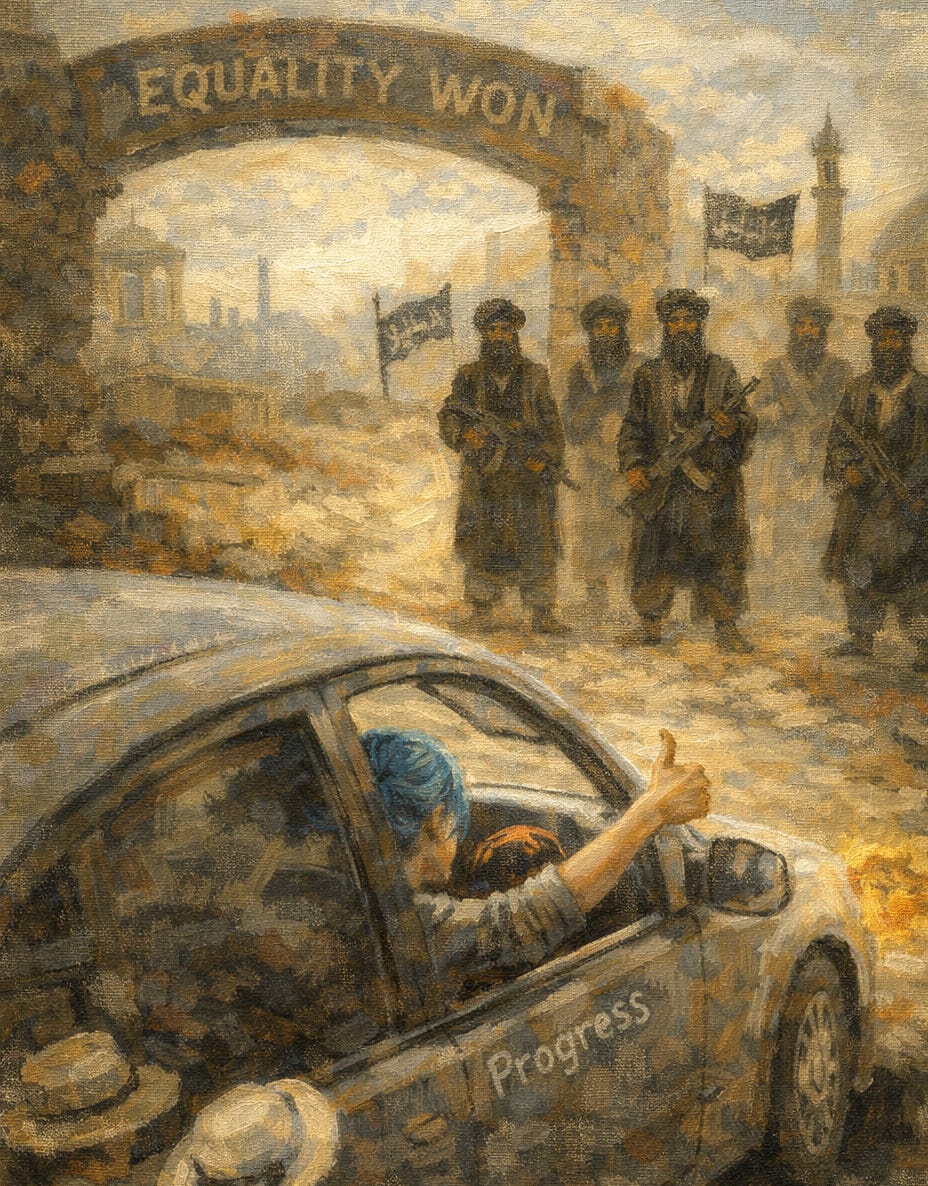
There was a time when feminism did not require qualifiers. Women could not vote. They could not own property independently in many jurisdictions. They were legally subordinate in marriage. Their earnings were absorbed into a husband’s legal identity. They were excluded from professions not by cultural inertia but by statute. The suffragettes were not policy consultants; they were dissidents. They were jailed. They were force-fed. They were mocked as hysterics and told they were destabilising society.
History sided with them.
Early feminism rested on something stubbornly empirical: biological sex. Sex mattered—not as stigma, but as fact. Biology shaped reproduction, vulnerability, economic dependence, and exposure to violence. The feminist claim was neither mystical nor metaphorical. It was juridical. Equal treatment under law despite biological differences. Equal protection. Equal standing. Equal rights.
And it worked.
In the West and in most countries, women vote. Women legislate. Women dominate university enrolment. Women inherit, litigate, divorce, govern, and command. In liberal democracies, equality before the law is not aspirational; it is embedded. Women in the West enjoy legal and economic autonomy unprecedented in recorded history.
That is not chauvinism. It is arithmetic.
To say so is not to declare perfection. Progress does not immunise the future. Rights require defence. Cultural friction persists. But arithmetic does not vanish because indignation prefers suspense. The transformation across the twentieth century is extraordinary by any honest comparative standard.
And it is precisely at this moment of achievement that modern feminism begins to unravel.
I. The Machinery of Perpetual Emergency
Movements that succeed face a dilemma: recalibrate or fossilise. Institutions rarely choose recalibration.
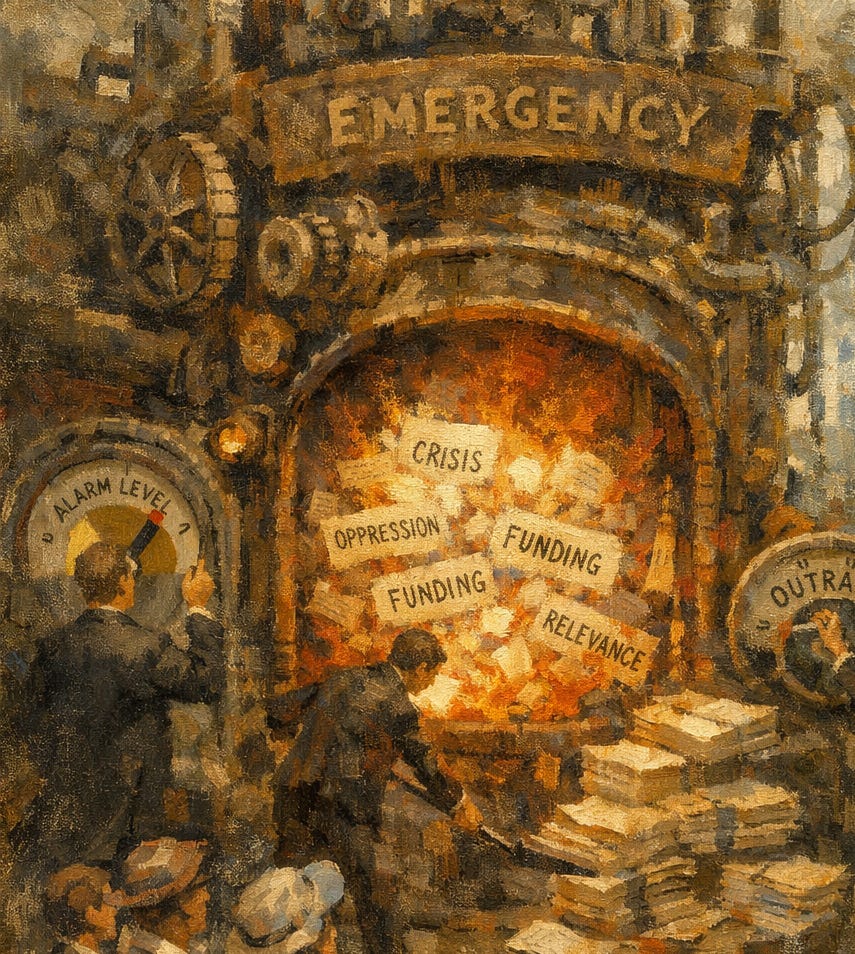
Over the past several decades, feminism has become more than a moral cause; it has become an administrative ecosystem. There are departments, advisory councils, grant streams, NGOs, diversity bureaucracies, compliance regimes, consultancies, and entire professional classes whose authority rests upon diagnosing systemic oppression. Urgency sustains funding. Alarm sustains relevance. Crisis sustains institutional expansion.
If injustice visibly recedes, budgets contract.
This does not require conspiracy; incentives suffice. Institutions built to combat injustice are rarely rewarded for declaring that injustice has diminished. It is professionally safer to discover new crises than to acknowledge old victories. If the emotional register drops from existential emergency to incremental reform, the machinery cools.
So the thermostat remains permanently set to catastrophe.
Racism in Western democracies today is not what it was in 1955. Legal inequality between men and women is not what it was in 1920. That does not mean injustice has disappeared; it means scale and form have changed. But when rhetoric remains calibrated to the worst chapters of history, proportion collapses. Improvement becomes suspect. Acknowledging progress becomes betrayal. The fire must be kept lit—even if it begins to burn the foundations it once sought to protect.
This is the first inversion: the refusal to moderate tone because moderation threatens institutional survival.
II. The Dissolution of the Category
The second inversion is conceptual — and therefore more destabilizing than any slogan.
Feminism’s victories were built upon a clear and defensible category: women as adult human females. The case for women’s shelters, women’s prisons, separate athletic categories, and sex-based legal protections rested on physical reality — on vulnerability, reproductive biology, and strength asymmetry. Sex mattered because bodies matter. The law was structured accordingly.
That coherence is now being deliberately loosened.
The rise in transgender and non-binary identification — particularly in expressive, non-medical forms — tells us something unsurprising: identity responds to cultural climate. Language shifts. Adolescents experiment. Social incentives influence declaration. That is sociology.
But sociology is not anatomy.
The trouble begins when expressive identity becomes regulatory command. If “woman” becomes a self-declared state of mind detached from biological sex, the legal architecture constructed over decades becomes elastic. Elastic categories produce an unstable law. Protections grounded in material difference collapse if material difference is declared irrelevant.
The sharpest example is not found in slogans but in prisons. A significant proportion of incarcerated women have histories of male violence. That is empirical. Housing inmates with intact male anatomy in women’s prisons based solely on identity declaration is not symbolic courtesy; it is a material decision with physical consequences. To say that biology matters in environments defined by strength asymmetry is not cruel. It is clarity.
Non-binary identification often functions as a declaration of distance from conventional gender roles rather than as a biological transition. That may be sincerely experienced. But sincerity does not alter skeletal density, muscle mass, or reproductive anatomy. Institutions built around physical reality cannot coherently operate if physical reality is treated as optional.
And then we arrive at the theatre of grievance.
In Montreal, a small private salon required clients to select “male” or “female” on an online booking form — hardly a revolutionary act, merely an administrative convenience in a business structured around different pricing categories. A complaint was filed. The salon altered the form. Apologies were offered. Complimentary services were extended.
It should have ended there.
Instead, the machinery continued. The matter proceeded to the tribunal. Money was awarded.
What is appalling is not that someone objects to a form. It is that, even after accommodation was made and gestures of good faith extended, the escalation continued — as though the point was not resolution but vindication. A small business, having adjusted its practice, was still required to endure the process, the expense, and the public scrutiny.
This is not emancipation. It is disproportionate.
It reveals a culture in which subjective offence is treated as structural oppression, and where the righteousness of one’s declared identity becomes sufficient justification to pursue maximal remedy even after correction has occurred. The goal ceases to be accommodation and becomes affirmation — not merely change, but sanction.
Feminism once fought against tangible legal barriers — property law, exclusion from suffrage, and prohibitions on employment. Now, tribunals are convened over dropdown menus.
When institutions devote themselves to adjudicating such minutiae while proclaiming moral seriousness, something has inverted. When expressive identity claims command legal penalties even after practical accommodation has been made, proportion has evaporated.
Feminism once insisted that sex mattered when it justified protection. To now insist that sex is irrelevant in the name of inclusivity is not refinement. It is a contradiction. A movement that dissolves the category upon which its victories were built begins to argue with its own premises.
That is the second inversion: abandoning biological coherence and destabilising the foundation that secured earlier gains.
III. The Factional Moral Compass
The third inversion is not merely political. It is civilizational.
At some indeterminate point, feminism ceased to be a distinct moral argument about the legal equality of women and dissolved into the broader slurry of left-wing factional politics. It became less a defence of female autonomy and more a banner carried in whatever coalition happened to be arrayed against the Right — particularly against Donald Trump.
And here the arithmetic vanishes.
Trump is vulgar. He is undisciplined. He is frequently boorish and rhetorically reckless. One may object to him on aesthetic, moral, or constitutional grounds.
But style is not structure. The United States under Trump remained a constitutional republic with contested elections, adversarial media, independent courts, and full legal rights for women. American women were not being flogged for dress violations. They were not barred from universities. They were not being jailed for removing a headscarf.
Yet the animus toward Trump metastasised into something more than policy disagreement. It became a kind of theological hatred — a moral absolute around which all other judgments were recalibrated.
And so the strangest spectacle emerged: self-described feminists who would sooner fantasise about solidarity in Gaza or Tehran than acknowledge that, however crude its leadership at times, the United States remains infinitely freer for women than any theocratic regime on earth.
We have witnessed activists declare that they would happily be “queer,” “non-binary,” or “trans” in societies that would, in fact, jail, beat, or worse for precisely that declaration. One wonders whether this is naïveté or a kind of decadent tourism — imagining oneself oppressed at a safe distance while enjoying the protections of the very liberal order one is denouncing.
This is not courage. It is cosplay.
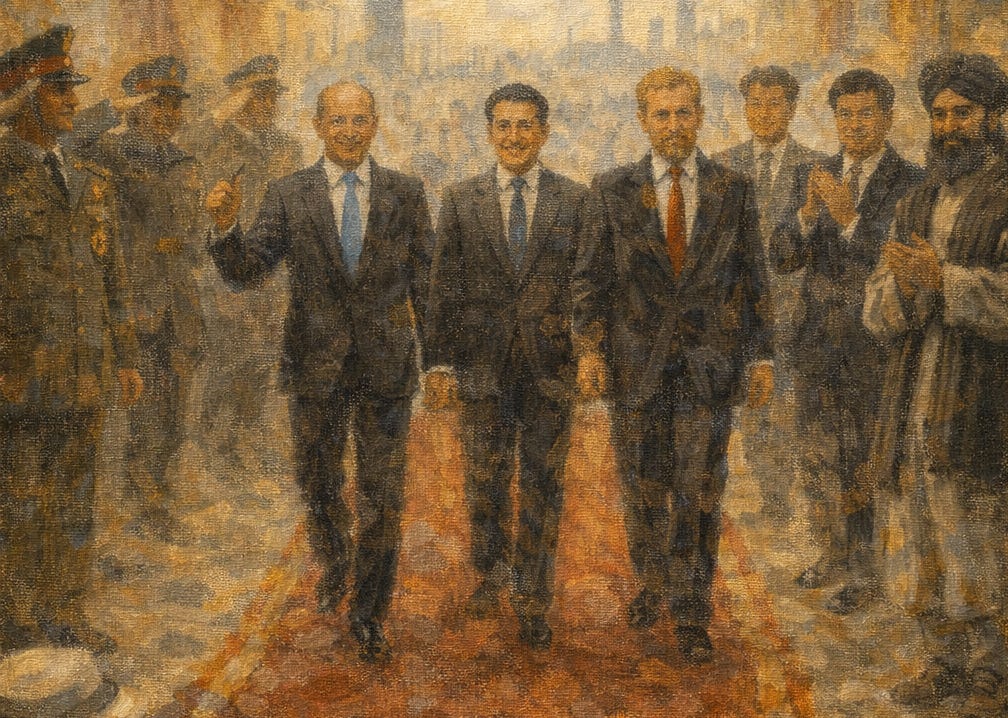
Hatred of Trump has produced a grotesque distortion of scale. Justin Trudeau once praised China’s “basic dictatorship” for its ability to “turn the economy around on a dime.” Mark Carney speaks serenely of realpolitik engagement with Beijing, as though the incarceration of dissidents and the suffocation of civil society are regrettable footnotes to trade policy. The moral engine roars when Washington is involved; it idles politely when Beijing or Tehran rolls out the red carpet.
Observe the symmetry: incandescent outrage for American populism; diplomatic indulgence for regimes that operate morality police, silence journalists, and codify inequality between men and women into law.
China is not a misunderstood cousin. It is a one-party surveillance state. Iran is not a cultural variation on liberal democracy; it is a clerical regime where women have been beaten and killed for defying compulsory veiling. Taliban Afghanistan is not an alternative governance model; it is the systematic erasure of women from public life.
These are not administrative disagreements. They are human catastrophes.
And yet the “enemy of my enemy is my friend” reflex persists. Because Trump antagonises them, the mullah becomes complicated. Because American conservatives condemn Iran, Iran becomes a geopolitical nuance. I remember after the US bombed Iran, my tone deaf union CUPE organised a pro-Mullah rally in Toronto.
As far as China, because Washington speaks bluntly, Beijing appears — absurdly — sophisticated.
This is not feminism. It is factionalism dressed in feminist language.
When a movement that once fought for sex-based legal equality finds itself soft-pedalling regimes that enforce sex-based subjugation, something has curdled. When Western liberal democracy becomes the primary villain, and actual theocracy becomes a diplomatic inconvenience, the moral compass is not merely bent — it is spinning.
If feminism is to claim universal standards, then those standards must apply universally. The right of a woman to walk unveiled in Tehran matters at least as much as the right to deploy correct pronouns in Toronto. The right of a girl to attend school in Kabul matters more than a thousand campus panels on symbolic microaggressions.
To equate Trump’s America — noisy, divided, constitutionally messy — with regimes that jail journalists and subordinate women by statute is not serious. It is anti-intellectual flattening. It collapses morally decisive distinctions.
Hatred is not a theory of politics. “The enemy of my enemy” is not a philosophy of liberation. And a feminism that subordinates its principles to partisan animus will not liberate anyone.
It will merely become another faction in the shouting match — waving its banner in the wrong direction while the real abuses continue, undisturbed.
Conclusion: The Three Inversions
Modern feminism achieved genuine victories. That is a historical fact. But success created a structural temptation.
First, institutional incentives reward permanent emergencies. The fire cannot be allowed to die because the machinery depends on flame.
Second, the abandonment of biological coherence destabilises the legal architecture that feminism built. Dissolving the category of woman into pure self-identification undermines the conceptual foundation of sex-based equality.
Third, factional politics—particularly anti-Trump animus and anti-American reflex—have distorted moral scale, leading to selective outrage and indulgence toward regimes that inflict genuine, measurable suffering.
These three inversions—perpetual crisis, conceptual instability, and factional moral asymmetry—define feminism in reverse.
Movements decay not when they lose, but when they cannot recognise what they have already won and adjust accordingly. When outrage becomes permanent, when categories dissolve into abstraction, and when moral judgment is subordinated to partisan hatred, seriousness evaporates.
Arithmetic remains stubborn. The gains achieved in the West are real. The abuses in authoritarian states are real. The distinction between them matters.
Without that distinction, moral rhetoric becomes theatre—and theatre is a poor substitute for principle.
If you found value in this article and wish to support my ongoing work, please consider leaving a tip. Your support helps me continue producing uncensored content on critical issues.
Feminism has crossed the plot line from positive to negative. In the process, feminists, and many women are that unknowingly, have created a third world order - the trans movement which now subsumes all women. Liberal feminists women have destroyed themselves and made all women targets.
Yuri Bezmenov points out that after Communism is achieved the first to be lined up and shot are the Useful Idiot revolutionaries because they are not happy with success of the initial 'cause'. The Idiots will repeatedly find another oppression to rally against, eventually rising up against the Regime they helped to power. Therefore they must be eliminated to prevent further insurgency.