


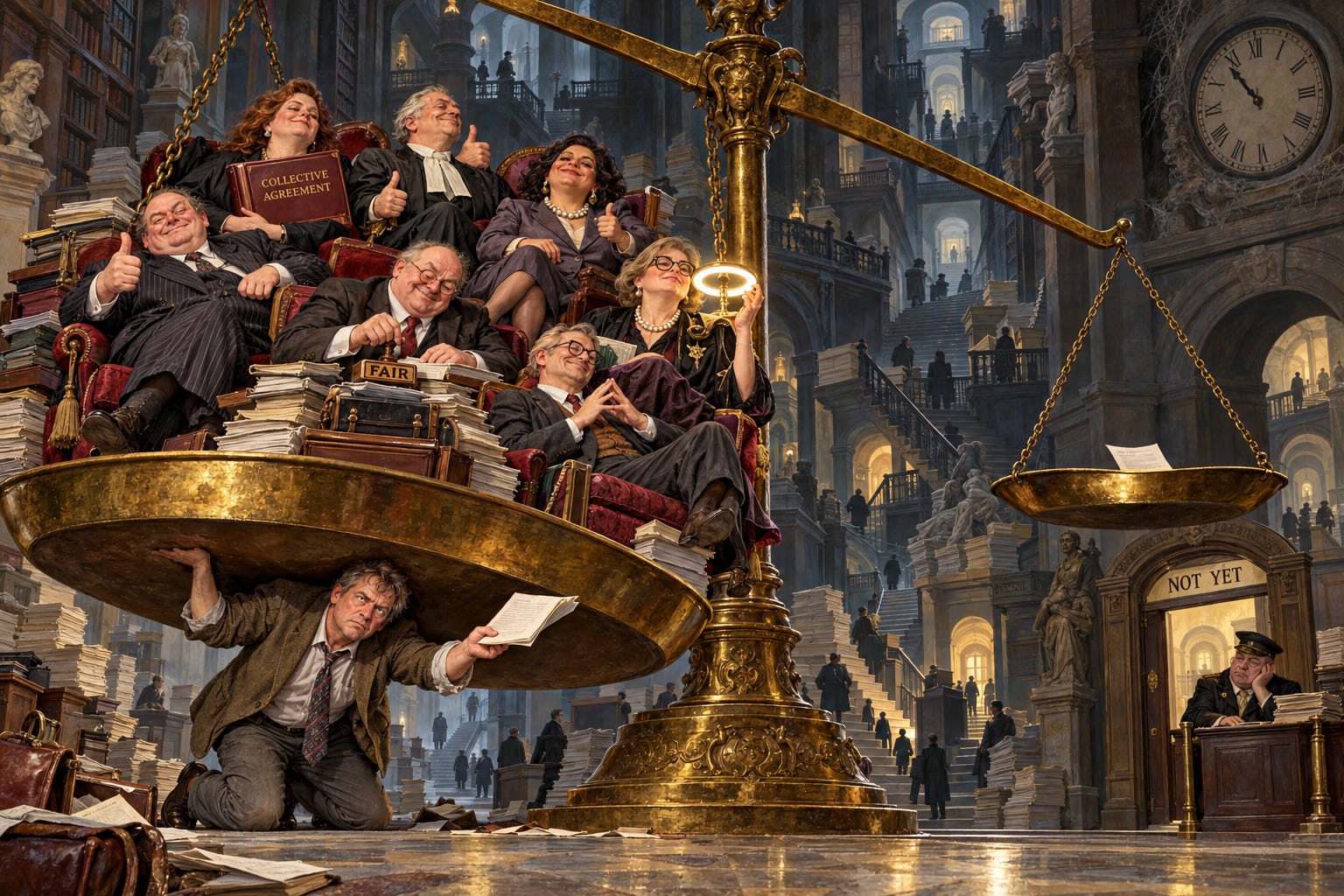
Everyone has heard of Kafka’s The Trial. Almost no one has read it, which is a pity, because it is not really about a courtroom. It is about Josef K., a man arrested one morning for a crime nobody will properly name and drawn into a legal machinery that never quite produces a charge, a trial, an appeal or an ending. Officials, procedures, doors and clerks fill the space. Everyone assures him that the process exists. What never quite appears is justice. K.’s great mistake is assuming that a system surrounded by all the vocabulary of justice must eventually behave justly.
I made much the same mistake.
For roughly fifteen years, I paid union dues. In all, about $30,000. Think of that money differently. Imagine putting money aside every payday as insurance against the possibility that one day your employer might fire you unfairly. The bargain seems straightforward: if that day comes, there will be a collective agreement protecting you and an organization with lawyers ready to enforce it. You pay now so that you will not stand alone later.
Then later arrives. You are fired. You reach for the representation you have been paying for and discover that the organization holding the exclusive right to provide it does not want to defend you. Fine, you think. I will hire somebody else. Except you cannot simply replace the union within the collective-bargaining machinery. It remains your exclusive representative even when it stopped representing you. You are not allowed to sue for wrongful dismissal. You now face two enemies: your employer and your union.
This is where collective protection begins to resemble institutional captivity. I was denied salary, benefits, pension rights, severance and basic remedies while devastating defamatory allegations were permitted to circulate and evidence concerning institutional misconduct and failures of due process remained protected from meaningful scrutiny. The organization I had spent years financing did not shield me from that machinery. It became another part of it.
Kafka would have looked at this and probably have cut the passage for being too obvious.
My objection is not to collective bargaining. Collective bargaining makes perfectly good sense. Workers combine their leverage because an individual employee confronting a large institution possesses very little. The problem begins when collective representation becomes exclusive representation, and the exclusive representative decides it does not care much for the person it represents. Collective power can then perform a remarkable inversion: what was supposed to protect the individual becomes one more source of his helplessness.
My own story began with political speech supporting Israel and condemning Hamas. Long before anything resembling a proper adjudication was even hinted at, my union local had declared me ‘guilty ‘.
Guilty of what, exactly, was considerably less clear. Only in the squirrelly, hate-filled echo chamber of a union could condemning a terrorist organization be considered a crime.
What was clear was that my political position on Israel collided almost perfectly with the politics being advanced by senior figures within the university and the union movement. The further absurdity was that one of my accusers was also my judge, the VP, Melanie Spence Ariemma, while the other was her friend and co-accuser Wael Ramadan, a perfect central-casting stereotype of the anti-Semitic professor. He had been repeatedly accused of running Jews down in the class for years, while leaving a verified trail of anti-Semitic sewage through his personal and professional social media.
Unfortunately, Ramadan’s hate-infested soul was a perfect match for my union, OPSEU.
The verdict appeared first. The evidence could apparently catch up later.
It never arrived.
My union local’s president characterized insulting Hamas to a stranger in Pakistan as a “hate crime.” That set the intellectual altitude early on. From day one, OPSEU Local 562 refused meetings and calls and eventually told me in writing not to expect representation.
The grievance officer assigned to protect my rights admitted that she had never read the collective agreement she was supposed to enforce. She asked me to keep emails under 100 words because anything longer was difficult for her to process. When I suggested that the union’s rather conspicuous political commitments concerning Israel might impair its ability to treat my case impartially, she laughed.
These were not merely ideological zealots. They were radicalized left-wing hillbillies: all the tribal certainty and suspicion of outsiders, but without the redeeming overalls, pickup trucks or ZZ Top beards. They had exchanged the shotgun rack for a stack of protest signs, and the family Bible for the approved list of oppressors, but the epistemology remained largely undisturbed.
I do not think the principle involved is particularly complicated. If the law grants an organization enormous and effectively exclusive power over another person’s livelihood, competence and impartiality should not be optional extras.
Nor was I imagining the political conflict. This was not a union whose institutional culture had remained studiously neutral about the very political issue underlying my employment dispute. The union movement around my case had embraced extraordinarily severe accusations against Israel: apartheid, ethnic cleansing and genocide. Their president, JP Hornick, was a mannish, short-haired furnace of hatred and anger. She had publicly threatened violence against the police if law enforcement moved against university encampments of pro-Palestinian militants.
These are not mild disagreements over the composition of an Israeli cabinet or the wisdom of a military operation.
I regard OPSEU’s position as vile. I am entitled to say so.
I did not form that conviction during my employment dispute. As a young man, I stood at Dachau and Auschwitz. I stood beneath Arbeit macht frei and contemplated what had happened beyond those gates. Some places make history stop being an academic subject and feel almost physical. You stand where human beings were degraded, starved, tortured and murdered because they were Jews, and Never Again ceases to be a commemorative slogan. It becomes an obligation.
I am a Christian, and the survival of the Jewish people and continued existence of Israel have long carried a particular moral weight for me.
Yet I found myself compelled to finance an organization whose political leadership advanced positions concerning Israel that I profoundly oppose and which employed a person whose publicly reported historical social-media material included admiration for Hitler and a wish that she had been alive during his era so that she might have participated in the Holocaust.
But I do not merely have to tolerate the contradiction. I have to subsidize it.
That is what makes the arrangement so extraordinary. If a political organization accuses Israel of genocide, I can reject its argument and refuse to donate. If an activist expresses admiration for Hitler, I can regard the opinion as repulsive and walk away. If a lawyer attacks me, I am not ordinarily required to help pay his bill.
My experience of unionization combined all three. I was compelled to finance an institution advancing politics I regarded as morally abhorrent; I could not simply substitute another representative when that institution abandoned me; and when I challenged the abandonment, the institution could use its accumulated resources to fight me.
The political problem therefore cannot be brushed aside as incidental. What happens when an institution possessing exclusive authority over your employment rights becomes an energetic political actor, and you find yourself on precisely the wrong side of its political commitments? You cease to be merely a member requiring representation. You become an ideological inconvenience.
And then, extraordinarily, you arrive at the institution supposedly created to protect you from precisely this kind of arbitrary union conduct.
The Ontario Labour Relations Board.
