



There is an image that will outlast the charts, the briefings, and the solemn nods of public officials. A child—my own—lying on her stomach in bed, laptop glowing, eyes fixed not with curiosity but with compliance.
A teacher speaks somewhere inside the machine. Or perhaps not. It scarcely matters. What is taking place is not education but its digital imitation—an arrangement of pixels that soothes adult anxieties while quietly unmaking the habits of attention on which learning depends. Education was turned into a thoughtless, elongated ritual.
I remember thinking, long before the data arrived, that this was not a pause. It was a transformation.
And like most transformations worth worrying about, it was done in the name of safety.
Canada did not invent lockdowns, but it embraced them with a thoroughness that would have impressed any minor functionary suddenly granted major authority.
Provinces such as Ontario and Quebec became laboratories of restriction. Schools closed. Playgrounds were taped off. Parks were declared off-limits. Tennis nets were taken down, and dye was added to swimming areas to make them less tempting to swimmers.
Citizens were instructed not merely on how to behave, but also on how to exist.
But what matters in a society is rarely the rulebook. It is the culture that sits beneath it—the unstated norms, the quiet permissions, the shared assumptions about what is acceptable, expected, and normal. Laws can be repealed. Orders can expire. Culture lingers.
The stated goal was to stop a virus.
The actual result was to reorganize a society—and more importantly, to reshape its culture.
What emerged from that period was not simply a healthier country, nor even merely a more cautious one, but a country altered in how it thinks about work, education, community, and liberty itself.
The Collapse of Education as a Living Process
The first casualty was education.
Screens replaced classrooms. Interaction gave way to transmission. The friction and sweat that defines learning—the awkward question, the spontaneous challenge, the moment of confusion that sharpens understanding—was replaced by a muted interface and the ever-present option to disengage.
A child lying in bed, staring at a screen, is not being educated. She is being trained.
Trained in distraction. Trained in passivity. Trained in the idea that participation is optional and effort negotiable. Trained in the idea that education is not learning, but putting in time on what is called educational activity.
And when those children returned, they did not return unchanged.
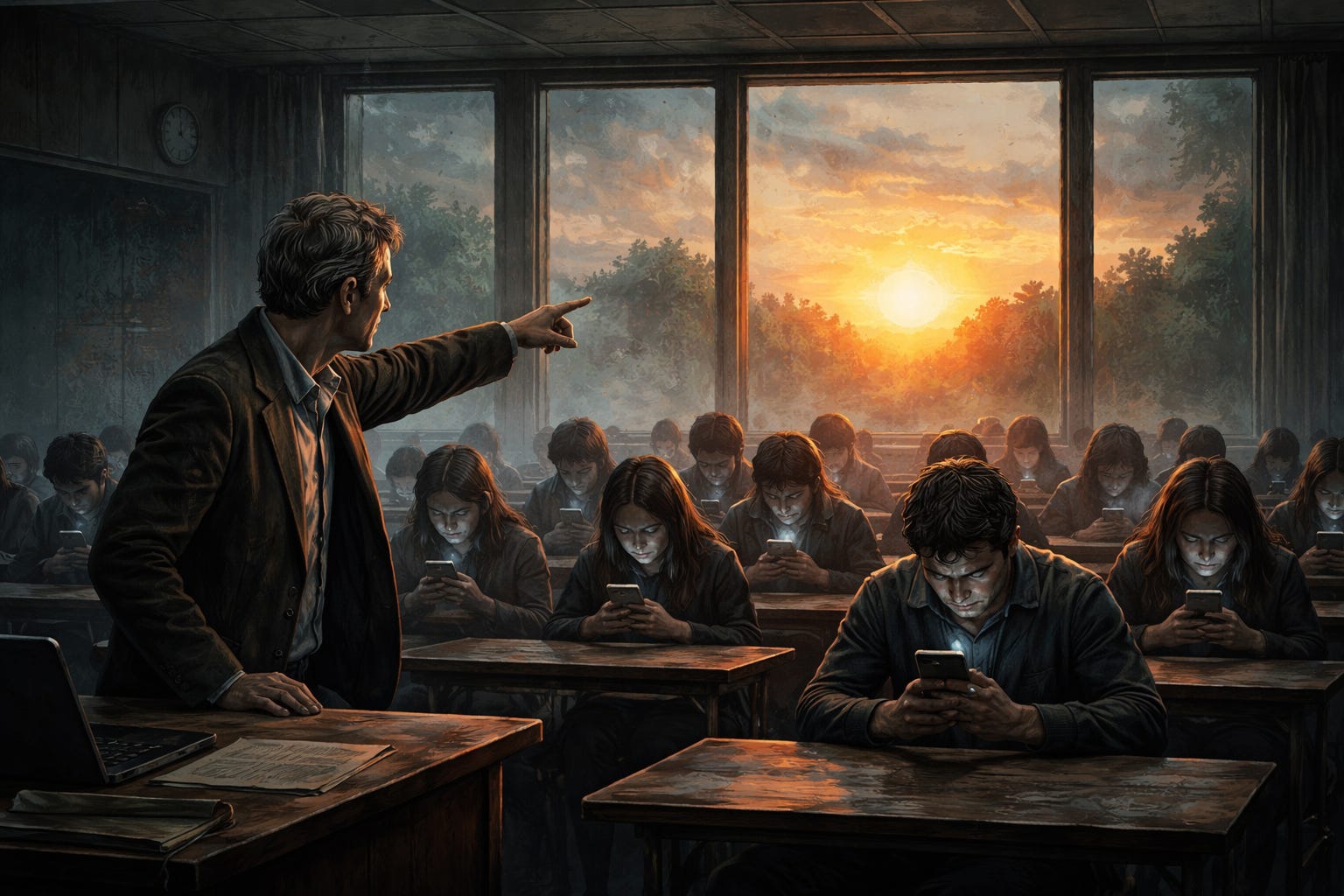
As a professor/lecturer, I saw it immediately. The room was not unruly; it was inert. Not shy—silent. Not insecure—absent. I developed a line, born less of humour than necessity: “Did the sun come up this morning?” One would wait. Eventually, a student would answer, yes, it had. The room would stir, as though speech itself required permission.
“So you are capable of speaking,” I said. “Well done.”
This was not a failure of confidence. It was a failure of attention.
Students were not engaging because they were not following. They were not following because they had lost the habit of sustained thought. AirPods in, music bleeding faintly into consciousness, eyes flicking between screen and thought, they inhabited a state of partial presence.
The classroom, which depends on exchange, has become a one-way conduit.
And a one-way conduit is not education. It is a distribution.
Education, like exercise, requires resistance. It demands effort, discomfort and even the occasional embarrassment of being wrong in public. Remove that friction, and what remains is credentialing—four years endured, a degree obtained, and little in the way of intellectual transformation.
Credentialism is not education.
And as a quick aside—because it is often raised with misplaced confidence—one hears that grades did not fall and, in some cases, rose.
Let us be serious.
When student quality declines, grading standards do not hold firm. Administrative pressure ensures otherwise. Professors, especially sessionals, understand that there is no penalty for lowering standards and every incentive to raise grades. Increase the average by ten percent, and complaints disappear. Evaluations improve. Silence follows.
The transcript survives. The learning does not.
The Inversion of Work—and the Decline of Productivity
Before 2020, working from home was marginal. Within weeks, it became dominant for a large segment of the population.
This was presented as liberation. In practice, it inverted daily life.
Work became an intrusion. Leisure became the baseline.
We are told—confidently—that productivity has not suffered. The evidence often rests on surveys asking workers whether they feel more productive at home. One might as well ask students whether they learn more when they are not paying attention.
More serious analysis is less flattering. Studies tracking actual output show productivity declines in fully remote environments—often 8–19%—driven by slower communication, weaker collaboration, and the erosion of informal learning.
Convenience is not productivity.
A Society Trained in Isolation
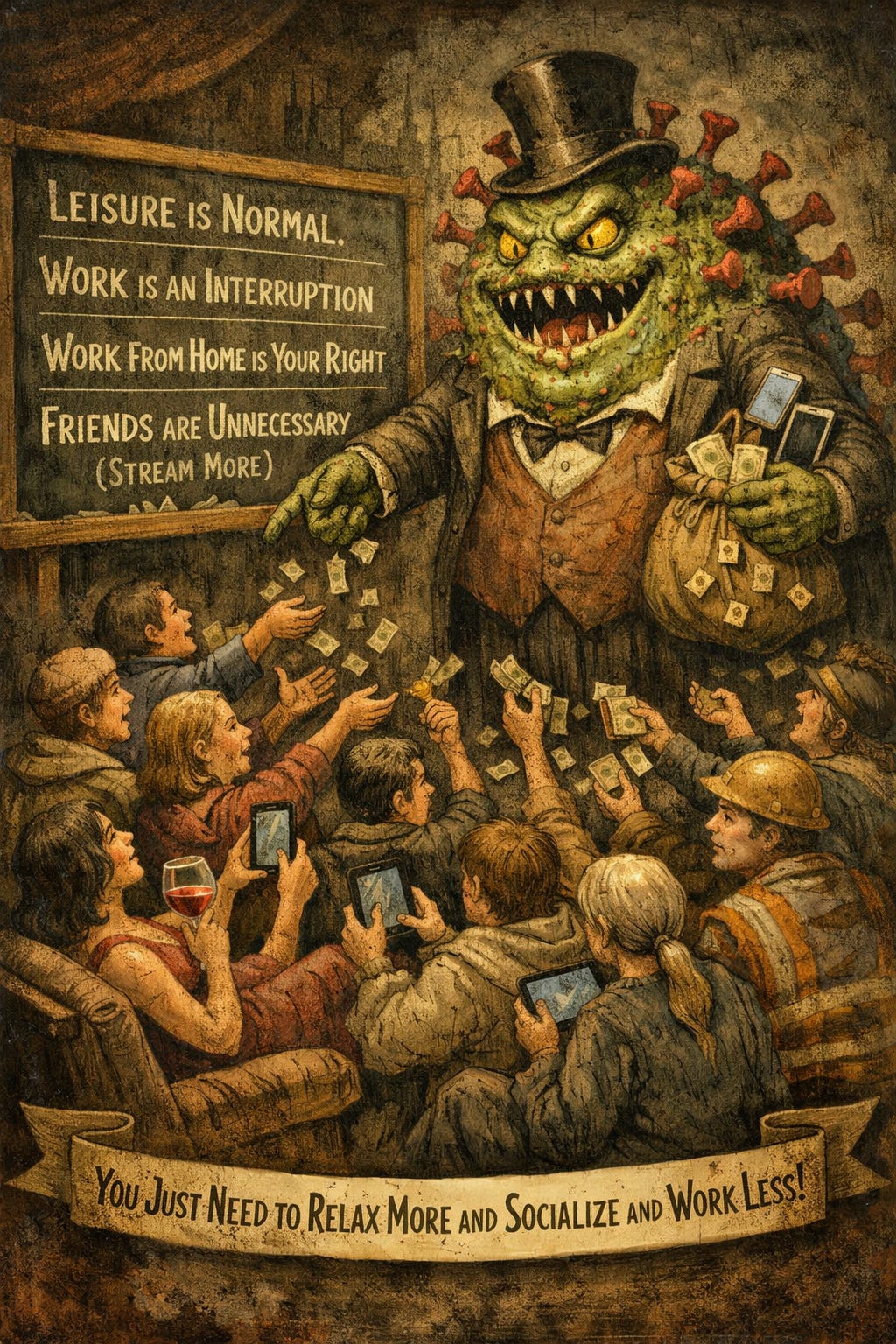
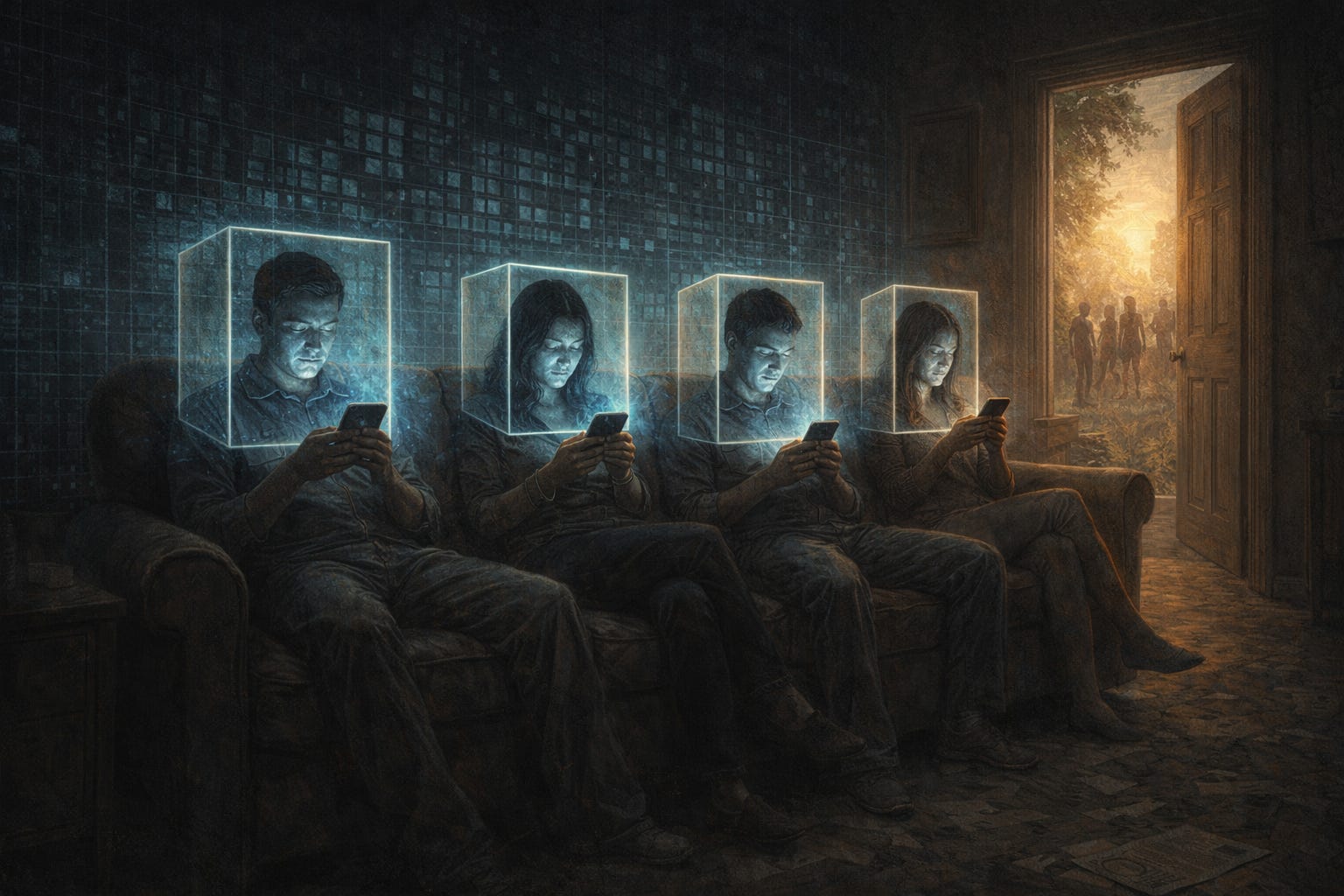
Loneliness surged. Social bonds weakened. Casual interactions vanished. Communities retreated into their devices.
Streaming replaced socializing. Netflix was easier than meeting up with someone. Messaging replaced meetings. We trained a population in solitude and expected it to reconnect as if nothing had happened.
But habits formed under pressure do not dissolve under relief.
And what changed here was not merely behaviour but expectation. It became normal to be alone, normal to disengage, normal to substitute the mediated for the real. That is culture at work—not imposed, but absorbed.
The Class Divide: Comfort for Some, Confinement for Others
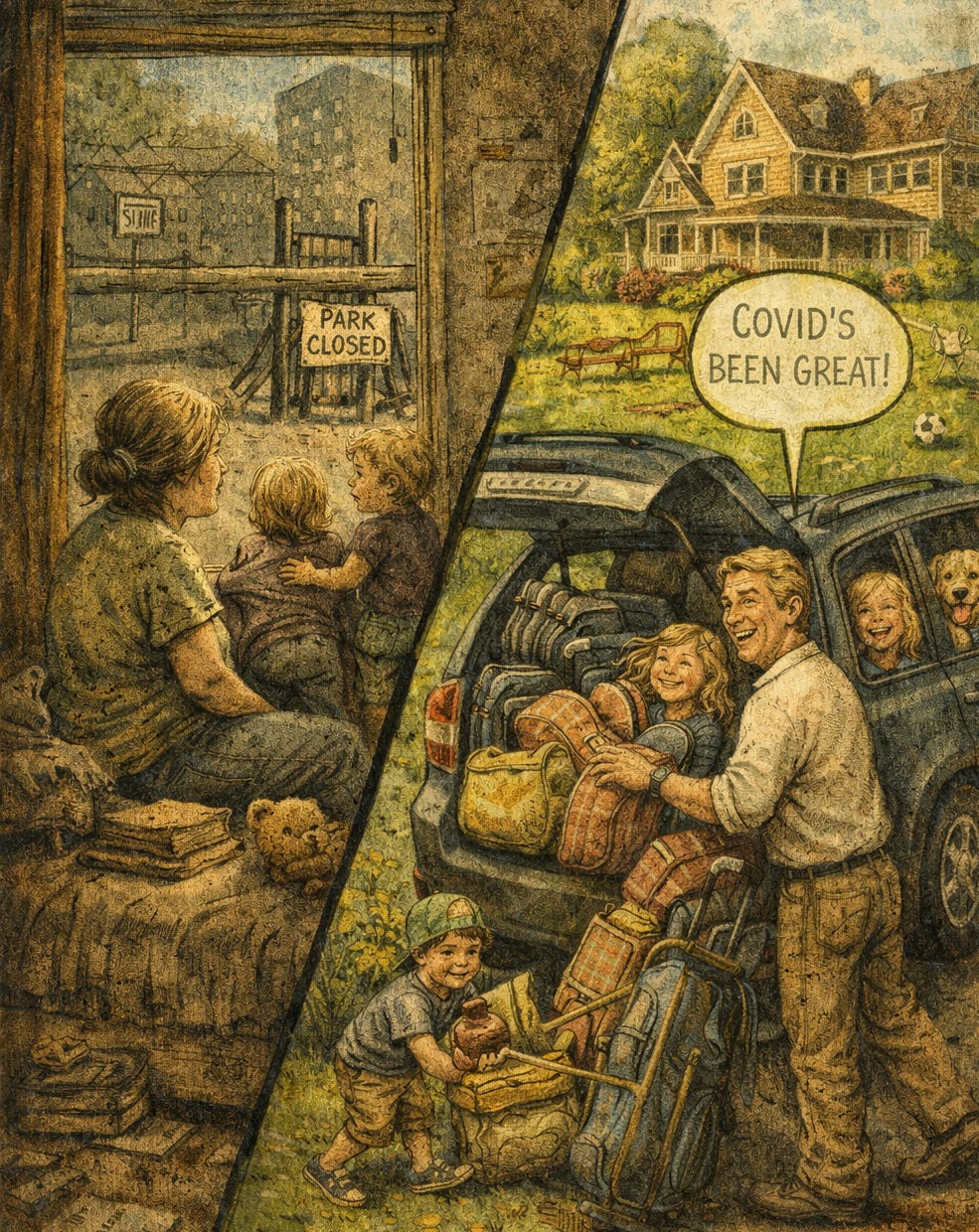
For all the rhetoric of shared sacrifice, the burdens of lockdown were not shared.
The laptop class retreated to safety. They worked remotely, often comfortably, often with space—homes, yards, cottages. For others, it was confinement.
The single mother in a small apartment did not work from home. She endured it. Essential workers did not log in; they showed up.
This was not solidarity. It was class power, expressed politely.
Policy followed the preferences of those insulated from its consequences. Culture followed power.
Civil Liberties: Tested and Found Wanting
In Ontario, Premier Doug Ford proposed that police stop vehicles at random and question occupants to determine if they were really from the same household; if not, a huge fine.
Only valiant civil liberties lawyers beat back this frightening intrusion on civil freedoms.
And the police refused. And bully for them.
When protests later converged on Ottawa, the Emergencies Act was invoked, and bank accounts were frozen.
Rights existed. Remedies did not.
And what changed here, again, was cultural. The acceptable expanded. The unthinkable became briefly thinkable—and that is often all it takes.
The Money Flood—and the Change in Mentality
Government transfers surged far beyond lost income, reaching roughly $4-$7 for every $1 in lost wages.
Billions were overpaid. Billions will never be recovered.
But the stronger effect was cultural. People learned that when something goes wrong, the government will make it right. Not partially. Not cautiously. But immediately. That expectation does not vanish when the programs end.
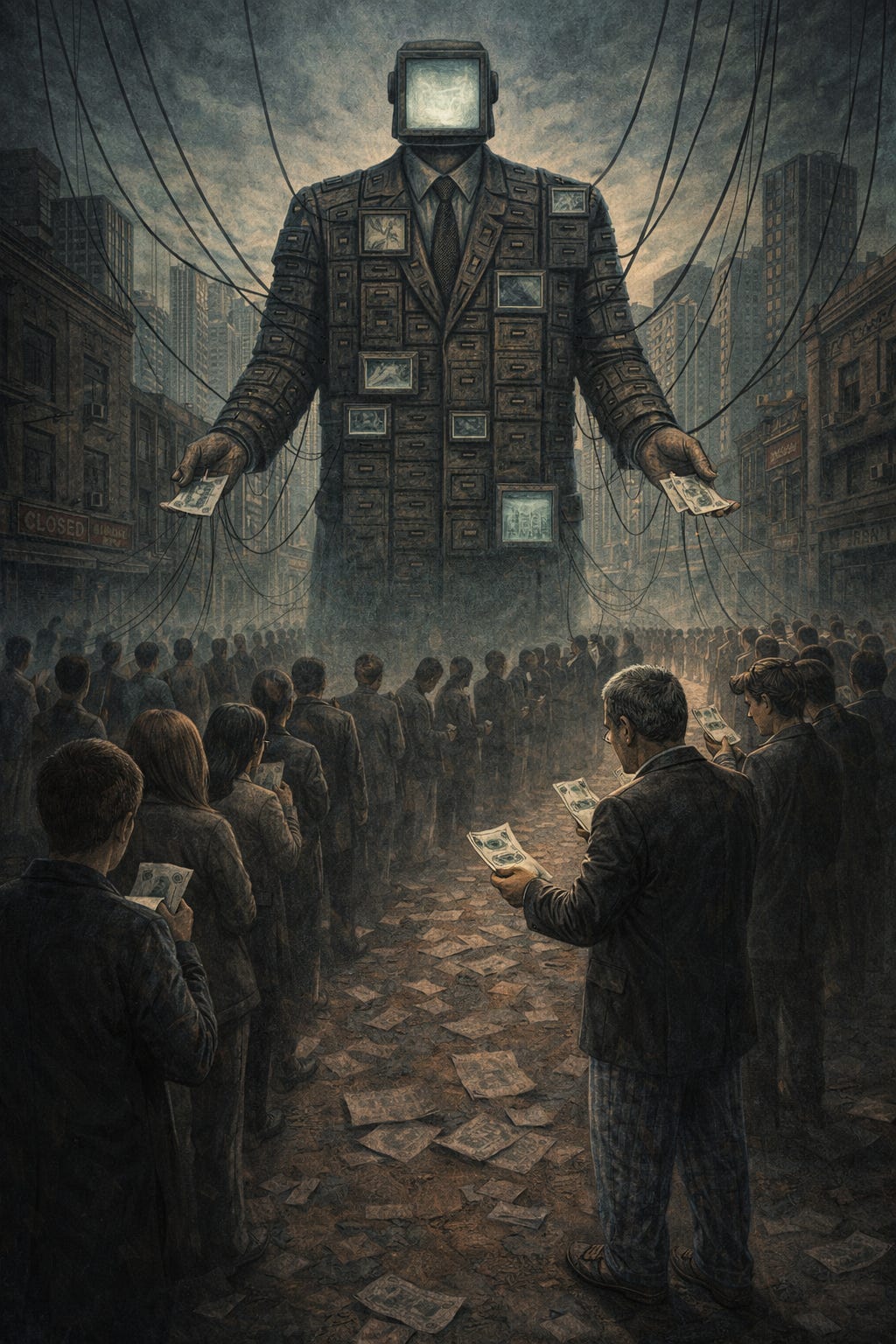
And you do not train people that way without consequence.
Entrepreneurship, once the unruly engine of Canadian ambition, has not merely slowed—it has been gently, almost tenderly, conditioned out of existence. Since the mid-1980s, business formation has fallen by nearly half—no small feat for a nation that still hosts conferences on “innovation” while quietly ensuring that as little of it as possible actually occurs.
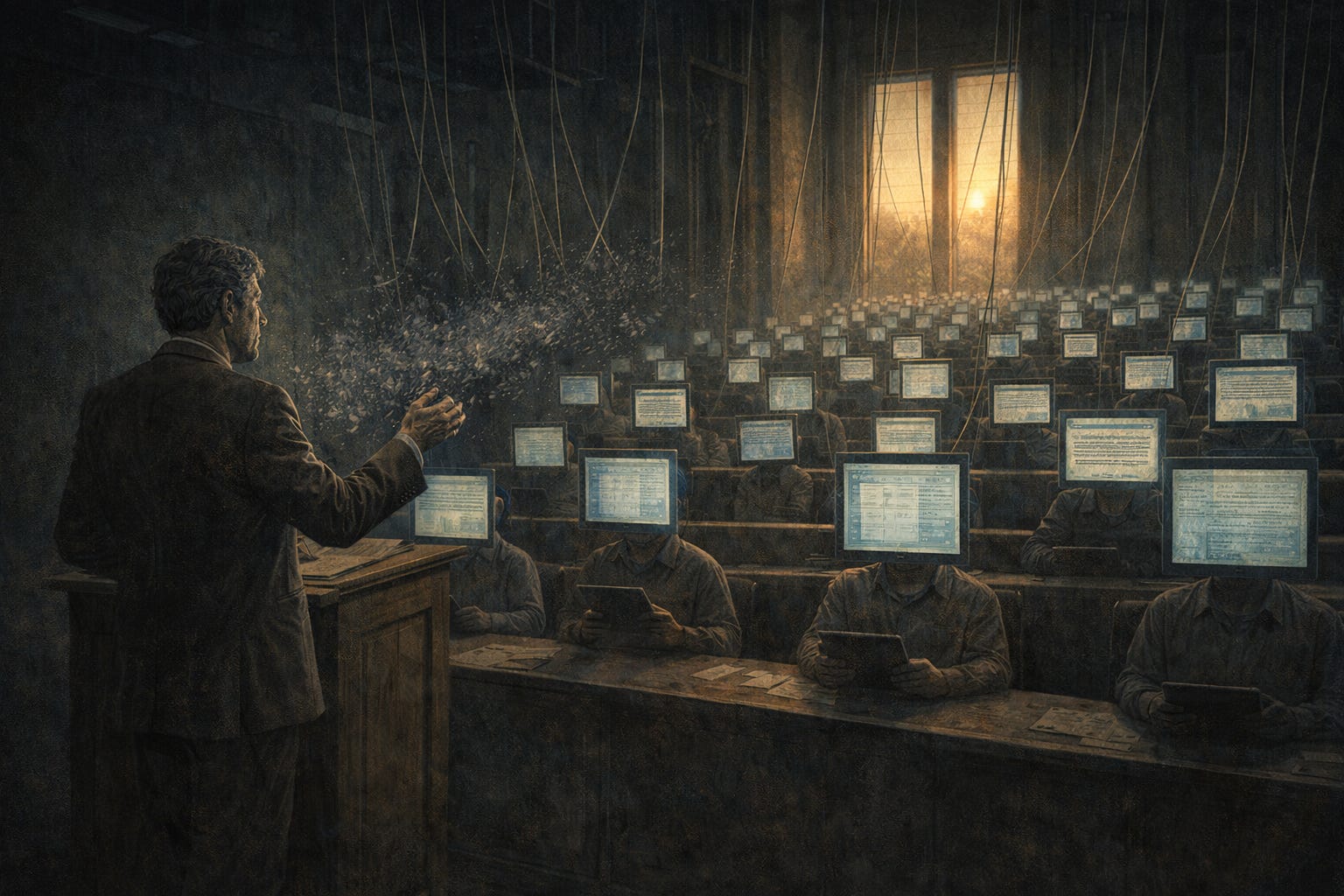
And now comes the pièce de résistance: as of 2025, more businesses are dying than being born. Exit rates are at 5.8%. Startup rates are trailing at 4.9%.
Outside of a once-in-a-century pandemic, these are among the weakest figures in a decade.
A flashing red light—if we were the sort of country still inclined to notice such things. Instead, we file it under “acceptable outcomes” and move on.
But let us dispense with the usual, comforting half-truth that this is merely about taxes or regulation. Those matters, certainly. But they are not the disease—they are the symptoms of something far more corrosive: a cultural shift away from risk itself.
Because for several years—years that now seem to have settled into the national psyche—we trained an entire population to stay home, stay safe, wait for instruction, and above all, avoid risk. We criminalized normal life, subsidized inactivity, and elevated caution into a civic virtue bordering on a moral commandment.
And now we are surprised—surprised!—that people hesitate to build, to gamble, to step into the unknown without permission.
You cannot spend years telling citizens that leaving their homes is dangerous, that interacting freely is irresponsible, that risk is antisocial—and then expect them, on cue, to become bold entrepreneurs the moment the press conference ends.
Culture, unlike policy, does not switch off. It lingers. It seeps. It instructs long after the mandates are gone.
What we have produced is not a nation suddenly lacking in intelligence or ability, but one that has been psychologically reoriented. Risk is no longer the price of opportunity; it is a behaviour to be managed, mitigated, and, if possible, avoided altogether.
And so, inevitably, a quiet piece of folk wisdom has begun to circulate—half in jest, half in resignation: why not simply get a government job? There, at least, the storms have been domesticated. The pay is typically higher than comparable private-sector roles, the pensions are not merely generous but virtually guaranteed, the benefits are expansive, and the likelihood of dismissal is—let us be charitable—remote. One does not so much work for the state as enter into a long-term arrangement with permanence.
This is not conjecture but arithmetic. In Canada, public-sector compensation, on average, exceeds that of the private sector when wages, pensions, and benefits are taken together. Add to this the near-absence of downside risk, and one begins to understand the gravitational pull.
Security, once the byproduct of achievement, has become the product itself.
And the state has obliged. The number of government employees has swelled to the point where roughly one in five Canadians now draws a paycheque, directly or indirectly, from the public purse—a remarkable expansion under the managerial benevolence of Trudeau and, now, Carney. A nation of risk-takers has been gently encouraged to become a nation of administrators.
The result is not merely economic distortion but cultural drift. When the safest path is also the most rewarded, and when the apparatus of the state grows fat on its own insulation, ambition does not disappear—it is redirected. Not toward creation, but toward inclusion in the system that guarantees protection from consequence.
In such an environment, the old virtues—initiative, resilience, the willingness to fail—begin to look less like strengths and more like eccentricities. Why hazard the uncertain when one can inherit the assured? Why build when one can administer?
And so the circle closes: a society that once rewarded risk now trains its citizens to avoid it, and then wonders, with mild confusion, why so few are willing to take any.
A society that trains its citizens to seek permission before action, to fear failure more than stagnation, and to equate safety with virtue will not produce entrepreneurs.
It will produce committees. It will produce administrators.
What began as a public-health episode has matured—like a poorly tended culture in a petri dish—into a habit of mind. We have trained ourselves, with admirable discipline, to prefer the eloquent over the effective, the declarative over the done. Big talkers are rewarded; small doers are tolerated; and somewhere in the shuffle, actual achievement has been reclassified as optional.
Which is why the present moment feels so familiar. Our leadership does not stand apart from us; it reflects us—faithfully, almost tenderly. If anything, the difference is one of scale. We have become a nation of small talkers and small doers; we have merely elevated to high office a man who embodies the same instinct with greater polish.
The end product is predictable: a class of highly articulate, impeccably credentialed managers of decline—men and women who can explain, in sentences of great beauty and slides of exquisite symmetry, why nothing new has been built… and why, given the sensitivities involved, that is probably for the best.
And one hesitates to name names—only briefly—but does this not sound uncannily like Mark Carney? A Prime Minister who has mastered the art of appearing in motion while remaining perfectly still.
Fourteen months in office, and not a single megaproject meaningfully advanced, not a trade relationship fundamentally improved, not even the quaint absurdity of interprovincial trade barriers seriously disturbed. Meanwhile, unemployment drifts upward, productivity slumps, per capita GDP politely retreats—and yet, in a triumph of modern optics, his popularity rises.
It is, one must admit, a kind of genius. Not the genius of construction, but of narration. Not the ability to build, but the ability to describe, with great authority, why building is complicated, perhaps inequitable, and therefore best postponed.
And so the circle closes. We have become a country that mistakes fluency for competence and composure for achievement—and are governed, accordingly, by its most fluent practitioner.
The Final Excuse—and the Evidence Against It
“Yes, but we had no choice.”
Even the research now suggests otherwise. Reviews have found that lockdown benefits were often overstated while costs were understated.
The certainty was misplaced.
What We Forgot
Did lockdowns ruin Canada? Not entirely. But they changed it. And the change is not primarily legal or economic.
It is cultural.
Work is weaker. Social bonds are thinner. Attention is fractured. The state is stronger. And beneath all of this lies a quieter realization. We reorganized society around avoiding harm. And we forgot something basic.
The purpose of life is not to avoid death. The purpose of life is to live.
And living requires friction. Risk. Contact. Presence. A society that elevates safety above all else will discover it has quietly demoted everything else.
And in the classroom, where the future is supposed to announce itself, one now waits for a student to confirm that the sun has risen. It has. But whether we have chosen to live under it again is another matter entirely.
If you value this work, consider leaving a tip. It’s cheaper than therapy, less pious than public broadcasting, and the only censorship here is my bad taste. On second thought, it’s bad therapy.
Freedom to Offend is a reader-supported publication. To receive new posts and support my work, consider becoming a free or paid subscriber.
Yes agree. The covid lock down changed Canadians and turned them into small cowards, pretenders and more arrogant, if that's even possible. I never thought I'd see neighbors reporting neighbors to police. The price is definitely being paid today by students, teachers, business. And the Freedom Convoy, the only time I felt pride in anything Canadian, is still being hunted for punishment by the Feds.
Canada today is a lost country that will never achieve any of its potential.