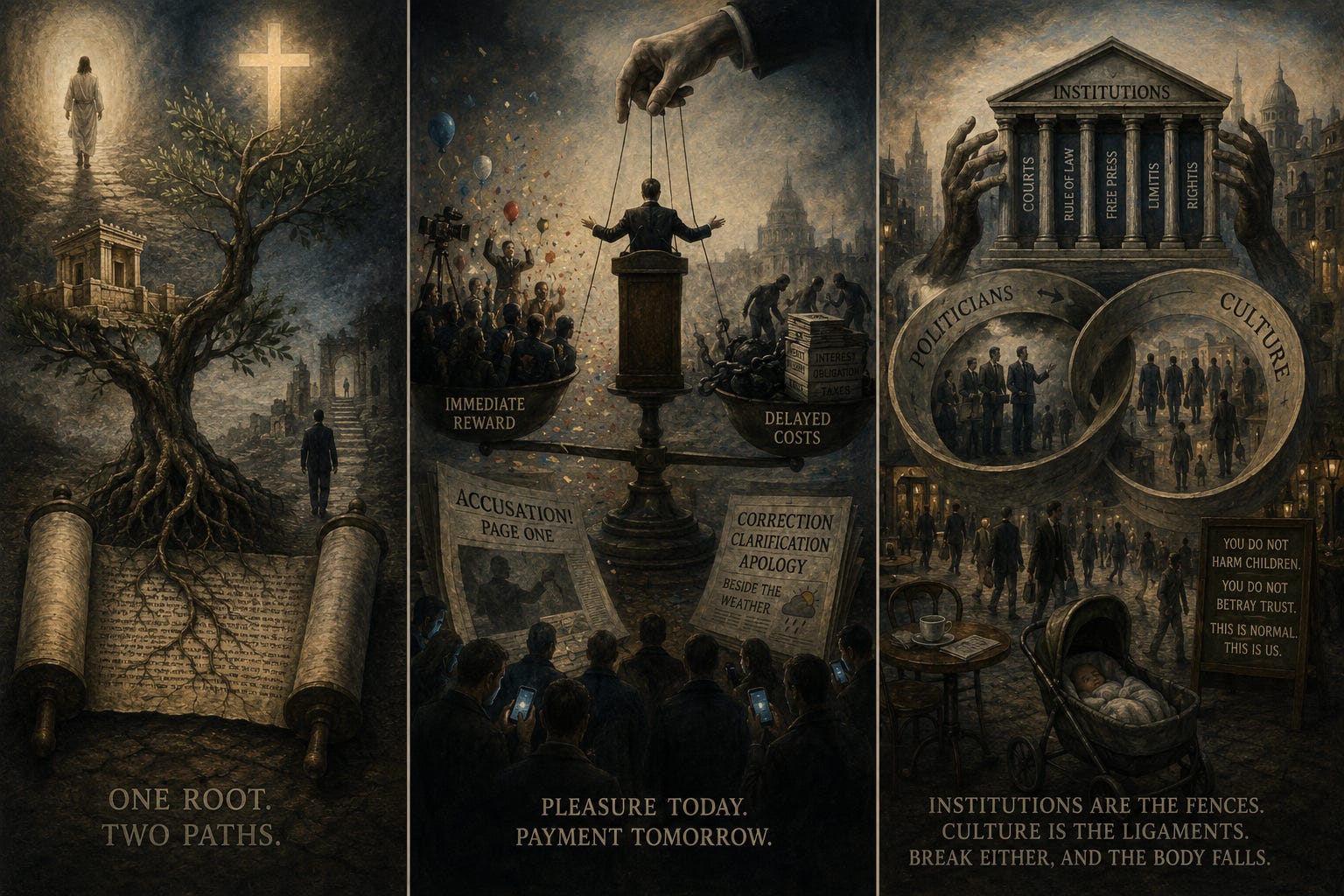
Dear Christian: Judaism Is Not Christianity 1.0
A Primer on the Jews, the Faith That Gave Birth to Christianity, and Why Christians Owe the Jewish People Far More Understanding Than They Usually Give Them
Many ‘Christians’ speak about Jews with the peculiar confidence of tourists explaining Paris after changing planes at Charles de Gaulle.
They “know Judaism.”
After all, they have read Isaiah. They know Moses. They know David, Solomon, Jeremiah and the Psalms. They know Abraham, Joseph, Pharaoh, Sinai and the Exodus. They know the Ten Commandments. They know the stories.
And above all, they believe they know how the story ends.
Jesus arrives.
The veil tears.
The old covenant is fulfilled.
Christianity emerges like a butterfly from the cocoon of Judaism.
Case closed.
Except it isn’t.
Because Judaism is not Christianity 1.0.
It is not a beta release awaiting a software update from Galilee.
It is not “Christianity without the final chapter.”
And one of the strangest realities in modern religious life is that millions of Christians devote enormous amounts of time to studying the Hebrew Bible while understanding almost nothing about the civilization that preserved it, argued over it, suffered for it, and built an entire world around it.
Many Christians know the Old Testament. Far fewer know the Jews.
Those are not remotely the same thing.
Christianity and Judaism emerge from the same ancient soil, but they are now two radically different interpretive civilizations.
Christianity asks:
“How is mankind saved?”
Judaism more often asks:
“How shall we live?”
That distinction changes almost everything.
Christianity became intensely focused on salvation, eternity, grace, redemption, heaven, hell, sin, and the cosmic rescue of humanity through Christ.
Judaism remained focused far more on covenant, law, ritual, discipline, memory, justice, obedience, survival, community, and the sanctification of ordinary life.
The observant Jew is not primarily asking:
“How do I escape damnation?”
He is asking:
“How do I live faithfully before God?”
That difference is not cosmetic.
It is civilizational.
And it explains why Jews often find Christian theology bewildering.
Christians frequently imagine Judaism as incomplete Christianity — a story awaiting its final chapter.
Jews generally do not see themselves as unfinished Christians.
They see Christianity as a dramatic theological departure from Judaism.
To many Jews, the Trinity appears incompatible with strict monotheism. The incarnation of God into human flesh appears impossible. The worship of Jesus appears not as fulfillment, but as a break from the uncompromising unity of God proclaimed in the Shema:
“Hear, O Israel: the Lord our God, the Lord is One.”
And here we arrive at the central fracture point that polite interfaith dialogue perpetually tiptoes around.
The Jews did not accept Jesus as the Messiah.
Or more precisely: some Jews did — the first Christians were themselves Jews — but the Jewish religious mainstream ultimately did not.
Christianity emerged from Judaism and then separated from it in one of the most consequential civilizational schisms in human history.
And for Christians, this creates a permanent theological tension because Christianity simultaneously proclaims two things.
First:
Jesus is the Jewish Messiah foretold in the Hebrew Scriptures.
Second:
The covenant with Israel still matters.
That tension runs directly through Romans 11, one of the most emotionally complicated and morally sobering chapters in the New Testament.
Paul — himself a Jew and former Pharisee — warns Gentile Christians not to become arrogant toward the Jewish people.
He uses the image of an olive tree.
The Jewish covenant is the original cultivated tree.
Gentile Christians are “wild branches” grafted into it.
And then comes the warning:
Do not boast against the natural branches.
In other words, Christianity does not emerge from nowhere. It emerges from Jewish scripture, Jewish prophecy, Jewish ethics, Jewish apostles, Jewish monotheism, and a Jewish Messiah.
A Christian who despises Jews is therefore sawing at the very branch upon which Christianity itself sits.
Historically, many Christians ignored this warning with consequences ranging from disgraceful to monstrous.
For centuries, Europe produced one of history’s great moral absurdities: civilizations worshipping a Jewish Messiah while frequently despising the Jewish people from whom that Messiah came.
Expulsions.
Pogroms.
Forced conversions.
Blood libels.
Ghettoization.
Humiliation.
Periodic massacres sanctified with enough theological jargon to soothe the consciences of cowards. One need not indict Christianity itself to acknowledge the historical record of Christian societies.
And yet the Jews survived all of it with a level of civilizational continuity that is frankly astonishing.
Empires vanished.
Languages disappeared.
Borders dissolved.
Dynasties collapsed into dust.
The Jews remained.
There are only about fifteen or sixteen million Jews on Earth today — fewer people than many metropolitan regions — and yet they have exerted an influence on philosophy, economics, ethics, literature, science, law, psychology, music, medicine, and intellectual life wildly disproportionate to their numbers.
And perhaps this contributes to another misunderstanding.
Many Christians imagine Judaism as frozen in biblical amber — ancient Hebrews wandering deserts in sepia tones.
But Judaism evolved.
Modern Judaism is not simply “Old Testament religion.”
Rabbinic Judaism — the Judaism most Jews recognize today — emerged largely after the destruction of the Second Temple in 70 AD. It became a civilization of scholarship, legal reasoning, commentary, adaptation, textual analysis, debate, and memory.
To study Judaism seriously is not merely to encounter a religion.
It is to encounter a four-thousand-year-old argument.
And then there is the question many Christians quietly wonder but often hesitate to ask directly:
What do Jews think about Christian salvation?
The answer surprises many Christians.
Traditional Judaism is usually far less exclusivist regarding salvation than Christianity or Islam.
Judaism historically does not teach that all non-Jews are damned.
Indeed, Judaism has generally not sought converts aggressively. In many periods, rabbis actively discouraged conversion unless sincerity was demonstrated over time.
A righteous non-Jew could still stand rightly before God.
Again: different assumptions.
Judaism focuses less on extracting precise doctrinal assent and more on righteous conduct, repentance, justice, obedience, and covenantal faithfulness.
Christianity, however, makes universal truth claims.
It does not say:
“Jesus is one spiritual option among many.”
It says:
Christ is Lord.
Which means Christians cannot entirely avoid the uncomfortable theological issue:
What happens to Jews who reject Jesus?
Christian traditions differ sharply here.
Some Christians — particularly exclusivist evangelical traditions — believe explicit faith in Christ is necessary for salvation. Under that framework, Jews stand spiritually in the same position as any other non-Christian.
Other Christians take a softer or more mysterious approach. They point to Romans 11 itself, where Paul insists that “the gifts and calling of God are irrevocable,” and speaks of a future reconciliation involving Israel.
Some Catholics and theologians argue that the Jewish covenant retains a unique place within salvation history.
But no serious Christian theology can simply pretend the disagreement is minor.
Christianity says the Messiah came.
Judaism says He did not.
That is not a footnote.
That is the divide.
And then comes another profound difference many Christians instinctively sense but rarely articulate clearly.
Judaism can survive partial unbelief in ways Christianity fundamentally cannot.
A secular Jew who has not entered a synagogue in twenty years may still remain deeply Jewish in identity, humour, memory, family structure, cuisine, tribal attachment, historical consciousness, and emotional connection to Jewish history.
Because Judaism is not merely a set of propositions.
It is also a people.
Christianity, however, was never intended to function primarily as an ethno-religion.
Christianity was radically universal from the beginning.
There is neither Jew nor Greek.
Neither slave nor free.
Neither Roman nor barbarian.
The faith explodes outward from tribe, bloodline, ethnicity, geography, and nation.
One does not become Christian by ancestry.
One becomes Christian through belief, repentance, baptism, discipleship, worship, and faith in Christ.
At least in theory.
And yet modern Christianity often functions as a kind of pseudo-ethnicity anyway.
Millions identify as Christian while almost never praying, never attending church, never reading Scripture, never shaping their lives around Christian teaching, and often barely thinking about God at all except perhaps at funerals or Christmas.
The cross becomes jewelry.
Christianity becomes the atmosphere.
Aesthetic.
Inheritance.
Sentiment.
A family brand name retained from grandparents who actually believed.
One hears phrases like:
“I’m Catholic.”
“I’m Anglican.”
“I’m Christian.”
But often this means something closer to:
“My grandparents were.”
And this creates an odd irony.
Modern secular Christians increasingly resemble secular Jews sociologically, while differing from Judaism theologically.
The secular Jew may remain Jewish because Jewishness itself includes ancestry, peoplehood, covenantal identity, historical continuity, and tribal memory.
But Christianity, doctrinally speaking, does not really permit an equivalent category of “ethnic Christian.”
Christianity is not supposed to be inherited tribal affiliation alone.
It is supposed to be a living conviction.
The New Testament is relentlessly existential in its demands.
Pick up your cross.
Repent.
Follow me.
Be transformed.
Be born again.
Not:
“Wear a cross necklace twice a year and vaguely admire the Sermon on the Mount.”
And this perhaps explains why secular Jews often remain intelligibly Jewish, while secular Christianity frequently dissolves into little more than cultural residue.
Judaism was built to survive exile, dispersion, catastrophe, statelessness, and minority existence across millennia.
Christianity was built to evangelize the world.
Different architectures.
Different purposes.
Different understandings of the covenant itself.
And modern Judaism itself contains worlds within worlds.
Orthodox Judaism is the most traditional and law-centred form, regarding Jewish law — halakha — as binding and divinely rooted.
Within Orthodoxy itself exist multiple traditions:
Modern Orthodox,
ultra-Orthodox,
Hasidic traditions,
Lithuanian traditions,
Sephardic traditions,
and others.
Then comes Conservative Judaism, which attempts to preserve tradition while adapting to modernity.
Then, Reform Judaism, which emerged largely in Germany, treats many traditional practices more symbolically or ethically than literally.
Then Reconstructionist Judaism and entirely secular Jewish identities beyond religion altogether.
So yes: one can absolutely be religiously Jewish without being Orthodox.
And then there are Israeli Jews, Russian Jews, Persian Jews, Ethiopian Jews, secular Tel Aviv Jews, Brooklyn Hasidim, French Jews, Argentine Jews, and Jews who have not entered a synagogue in twenty years but still feel bound to Jewish history with fierce emotional intensity.
Judaism survived because it became more than a belief.
It became a memory.
And perhaps this is where Christians — especially those who fancy themselves defenders of Christianity — ought to pause and perform a small but painful act of self-examination.
Because one of the most disgraceful habits in Christian history has been the use of Jewish rejection of Jesus as a license for contempt.
As though the proper response to a people from whom came the patriarchs, the prophets, the apostles, the scriptures, and Christ Himself was sneering resentment.
As though the command to “love thy neighbour” somehow contained a hidden footnote exempting Jews.
As though Christians, of all people, were appointed celestial immigration officers for heaven.
The irony is almost unbearable.
Christians claim to worship a Jewish carpenter from Judea, read Jewish scriptures, quote Jewish prophets, revere Jewish apostles, and await the return of a Jewish Messiah — while some somehow still manage to cultivate hostility toward Jews themselves.
One suspects this would come as news to Jesus.
And if Romans 11 means anything at all, it means Christians are forbidden from arrogance toward the Jewish people.
Forbidden from contempt.
Forbidden from triumphal sneering.
Forbidden from the nauseating historical habit of treating Jews as spiritually defective supporting characters in somebody else’s story.
A Christian may believe Jesus is the Messiah.
Christianity itself requires that belief.
But if that belief produces hatred, mockery, arrogance, cruelty, or tribal contempt toward Jews, then something has gone catastrophically wrong in the soul of the believer.
Because before Christianity was a cathedral, an empire, a denomination, a televangelist franchise, or a suburban cultural aesthetic, it emerged from Jewish soil.
And Christians who wish to understand Jews must first understand this:
Judaism is not Christianity without Jesus.
It is Judaism.
An ancient civilization.
A wounded civilization.
A stubborn civilization.
A civilization that survived Babylon, Rome, exile, dispersion, pogroms, inquisitions, expulsions, and history’s repeated attempts to erase it.
And before one attempts to fulfill, supersede, theologize, or explain another civilization, one should first attempt the far more difficult task:
Understanding it.
If you found value in this article and wish to support my ongoing work, please consider leaving a tip. Your support helps me continue producing uncensored content on critical issues.


Dear Paul,
You are a brave, noble, uncompromising intellectual and a born teacher with a Jewish soul.