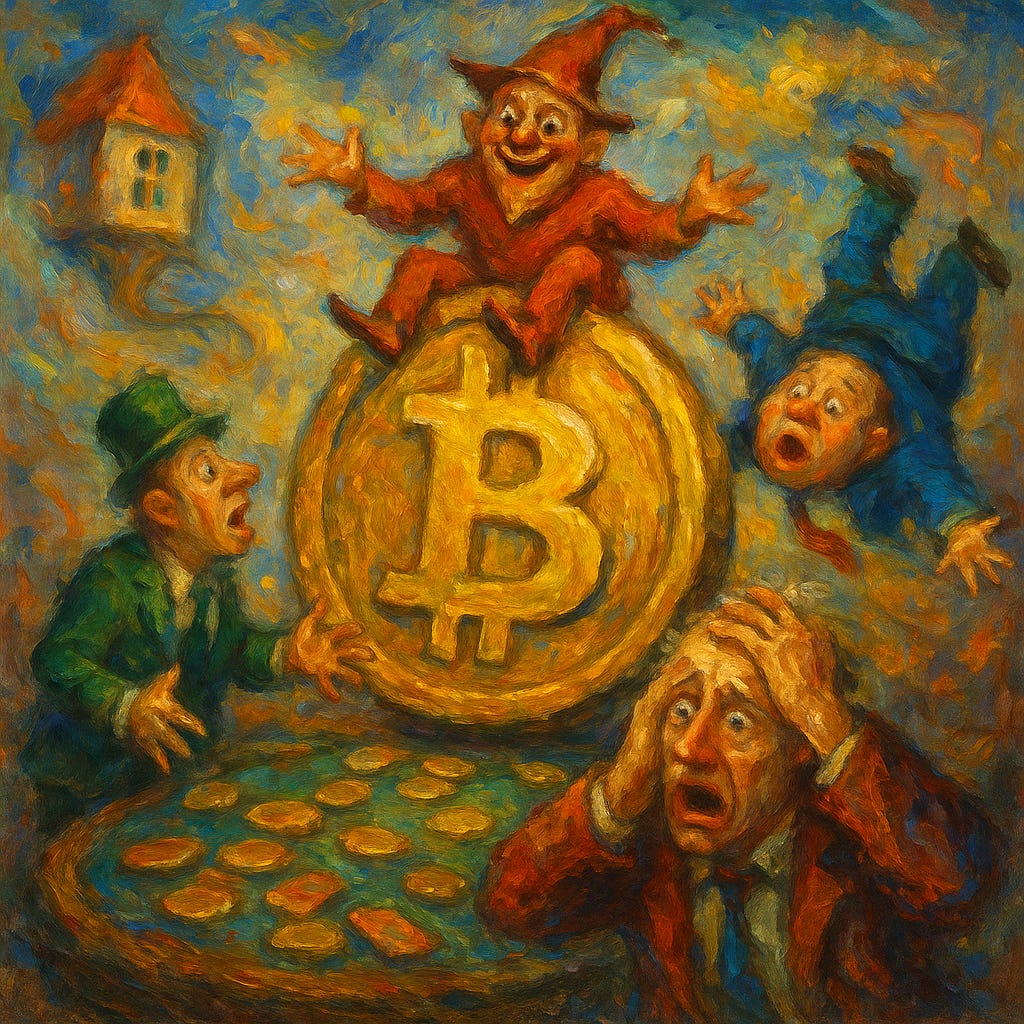
Crypto’s Carnival of Fools: Why the Digital Gold Rush Is a Loser’s Bet
From shoeshine boys to keyboard evangelists, the siren song of cryptocurrency lures the greedy and gullible into a speculative swamp where bravado trumps reason and most drown in their own delusions.
If you believe in the importance of free speech, subscribe to support uncensored, fearless writing—the more people who pay, the more time I can devote to this. Free speech matters. I am a university professor who was suspended due to a free speech issue, so I am not speaking from the bleachers.
You know you’re in deep trouble when the fellow polishing your shoes starts handing out stock tips. Legend has it that in the roaring Twenties, Wall Street’s fate was sealed the moment a shoeshine boy began offering investment advice—because if innocence can’t distinguish between insider genius and fool’s gold, the game is up. Today, that hapless urchin has been replaced by an army of keyboard evangelists hawking crypto “tips” in every comment thread, each insisting they’ve unearthed the next Bitcoin, or Dogecoin, or Shiba Inu, or whatever fad promises a fortune.
I’m certainly not proposing day-trading as a safer harbour than crypto, far from it. After all, even the most sober studies show that roughly 80–90 percent of retail day traders end up poorer, with only about 10 percent breaking even and a pitiful one percent finding long-term success.
That’s almost as grim as the crypto roller-coaster, which, let’s face it, is even less suited to “buy and hold” retirement planning—most registered pension plans won’t let you stuff Bitcoin into your RRSP, and the few token crypto-ETFs that slip through carry jaw-dropping fees and volatility.
Both arenas peddle the same siren song—“There’s a free lunch here, and it’s yours for the clicking”—and while they’re not quite as delusional as scheming one’s golden years on lottery jackpots (yes, some surveys still find a worrying number of would-be retirees banking on a windfall ticket), they are only marginally less absurd.
In short: swapping one form of speculative delusion for another doesn’t make you a contrarian genius—it merely trades one sucker’s bet for another. Still acting like a loser. No offence.
How often have you woken to a DM from a stranger peddling “inside information,” “can’t miss” moonshots, or the reassuring patter that this token is destined to eclipse the sun? Sure, it can—and just as surely, it won’t. I may not be a Wall Street savant, nor will I ever sip champagne on the penthouse balcony, but I have one modest ambition: to avoid retiring into a fluorescent Walmart vest.
And I’m not talking about folks who work for the camaraderie—I loathe most people, and I prefer dogs. If there were a Walmart that was only patronised by dogs, and assuming no crazy pit bulls, I would work there, and the yellow vest would be fine.
Against this chorus of digital snake oil salesmen, we must draw a line in the sand. Crypto is not a revolution; it’s a carnival for the credulous, built on bravado, buoyed by bubbles, and destined to deflate. If you must dabble, fine—just know you’re gambling with wild odds, where 86 per cent of believers will choke on the dust of their illusions. So before you click “buy,” remember: if the shoeshine boy is your broker, you’re already upstream without a paddle.
Crypto is for losers.
In the fevered swamps of modern finance, where the credulous and the cunning converge, cryptocurrency has emerged as the latest totem of speculative delirium. It is not a scam, nor is it a guarantee of ruin—indeed, some have ridden its volatile waves to riches—but it is a monument to human folly, a testament to the enduring power of self-deception, and a savage indictment of those who mistake luck for genius.
The fatal flaw of cryptocurrency is that it possesses no intrinsic value whatsoever—it’s nothing more than a casino wager on collective delusion. Buying a share of stock, by contrast, grants you a literal sliver of a company’s future cash flows, underwritten by real revenues, profit margins, and a thousand quantifiable metrics—from P/E ratios to balance-sheet health—augmented by qualitative judgments about management, market niches, and competitive moats. Crypto’s devotees, however, trade these sober appraisals for the fever dream of momentum and memes, mistaking sheer crowd hysteria for sound investment.
If we examine the digital gold rush and expose the psychology, statistics, and stark reality that crypto is for losers, not because everyone loses, but because it is a game rigged against the average person who dares to play.
The Allure: A Siren Song for the Greedy and Gullible
Cryptocurrency arrives cloaked in the garb of revolution, a shimmering promise of wealth unshackled from the dreary constraints of banks and governments. It is the stuff of late-night infomercials, only sexier: a get-rich-quick scheme for the tech-savvy, the crypto bros who swagger through Twitter with their “HODL” mantras and “moon” prophecies, as if the future of finance could be conjured with the vocabulary of a stoned teenager. They are the new conquistadors of a digital El Dorado, chasing a mirage of riches that only exists as long as someone else is willing to buy the dream.
This is the greater fool theory distilled to its essence. In this financial pyramid, value is not rooted in utility or production, but in the desperate hope that a bigger idiot will pay more tomorrow. History offers grim parallels: the tulip mania of 1637, where bulbs fetched the price of houses before collapsing into worthlessness; the dot-com bubble, where billions evaporated when the hype outran the reality. Crypto’s apostles insist this time is different, but the only difference is the blockchain jargon they wield like a talisman against reason.
The Psychology: Hubris for Winners, Silence for Losers
Step into the crypto casino, and the psychology reveals itself in garish neon. Those who strike it rich—yes, they exist, and they have the Lamborghinis to prove it—cannot shut up about it.
They crow from the rooftops, their success a glittering badge of their supposed brilliance. “I saw the future,” they proclaim, “I understood the tech, I timed the market.” Never mind that the market’s whims are as predictable as a drunkard’s stagger; they have made their pile, and they will be damned if they credit it to dumb luck. How many admit that their windfall was a fluke, a roll of the dice that landed on black? Precisely none.
Contrast this with the losers—and there are legions of them, a silent army of the shamed and shattered. They do not post screenshots of their emptied wallets or their margin calls.
The same psychology holds at the craps table in Vegas: you never hear someone bellowing, “I gambled away my house on the dope bet!” The winners parade their jackpots like peacocks, flashing neon smiles and fist-pumps, while the vanquished slip away in the night, nursing their losses in private shame. Crypto is no different. For every boastful tweet of a 10× return, there are countless silent pockets emptied by a pump-and-dump, yet you’ll never see those stories in the highlight reel.
According to a 2025 Security.org report, forty per cent of crypto owners now admit they don’t trust the platforms they use, and nearly one in five have suffered access failures on custodial exchanges—lost passwords, frozen accounts, “maintenance” outages that coincide with price crashes. Do these confessions make the rounds? Of course not. The winners preen, the losers slink into the shadows, and the resulting asymmetry leaves us with a market fueled by bravado, propped up by denial, and as honest as a back-room poker game where the house always takes its cut.
This is not how it works with equities. The stock market has its share of braggarts, but most investors are not day-trading degenerates or high-risk speculators. They are plodding along with index funds, betting on the slow grind of economic growth, rather than the manic swings of a cryptocurrency chart. The average equity investor does not live or die by a single ticker’s hourly gyrations; the crypto bro, by contrast, is glued to his screen, praying for a spike before the inevitable crash. Crypto is not investing—it is gambling with extra steps.
The Stats: Volatility and Ruin in Numbers
If crypto were a currency, it would be the laughingstock of commerce. Bitcoin, the granddaddy of them all, has soared past $60,000 only to nosedive by half in a matter of weeks. Imagine buying a coffee with a coin that is worth ten dollars today and five tomorrow—or twenty if Elon Musk tweets something cryptic. This is not stability; it is a roller coaster for masochists. A 2025 Chainalysis report might tout the blockchain’s resilience. Still, it cannot hide the chaos: prices that lurch like a heart monitor in cardiac arrest, driven by hype, FOMO, and the occasional exit scam.
Compare that to the S&P 500, where annualised volatility hovers around fifteen to twenty per cent, a gentle ripple next to Bitcoin’s eighty-per-cent-plus swings. The crypto market is not a store of value—it is a house of cards built on the breath of speculators. And when it collapses, as it often does, the bagholders are not the hedge funds or the whales; they are the little guys who thought they could outsmart the sharks.
The Dirty Secret: Energy Guzzling and Empty Promises
Then there is the environmental carnage. Bitcoin mining gulps energy like a frat boy at a kegger—Digiconomist pegs its annual consumption on par with nations like Argentina or Norway. Each transaction generates electronic waste and carbon emissions, leaving a dirty footprint for a technology that claims to be the future of sustainability. Crypto’s defenders might point to green tech parallels—solar panels take years to offset their production energy—but that is no defence; it is an admission of hypocrisy. Both are sold as salvation, yet both leave the planet gasping for air.
Security: A Playground for Thieves and Thugs
Do not be fooled by the blockchain’s vaunted security. The tech might be ironclad, but the ecosystem is a sieve. High-profile hacks—such as the Colonial Pipeline ransomware heist—prove that even Bitcoin is not immune to sticky fingers. Chainalysis notes the rise of professionalised crypto crime, including laundering, fraud, and extortion. And the anonymity? A joke—governments have tracked and clawed back assets with ease. It is not a fortress; it is a sandcastle, and the tide of reality keeps rolling in.
The Losers: A Taxonomy of Fools
Who are the losers here? Not just the ones who lose money, though they are plentiful. It is the dreamers who buy the decentralised utopia spiel, only to drown in speculation. It is the naive who think they will outwit the market, only to be fleeced by insiders. It is the idealists who see crypto as a means of justice, only to watch it widen the gap between the haves and have-nots. And it is the braggarts who think their gains prove their genius, not the caprice of chance.
Your cousin Elmo made fifty thousand dollars in a week? Bully for him. That is not an argument—it is an anecdote, a shiny bauble dangled to distract from the wreckage. For every Elmo, there are a dozen Joes who lost their shirts and will not say a word. The stats do not lie, but the losers do—mostly to themselves.
Conclusion: A Hitchensian Verdict
Cryptocurrency is not a scam, but it is a folly of biblical proportions. It is a glittering trap for the uninformed, the overoptimistic, the desperate—a game where the house always wins, even if there is no house to speak of. As Hitchens might have put it, “What can be asserted without evidence can be dismissed without evidence.” The evidence for crypto as a currency or a sane investment is thinner than a pauper’s gruel, and the burden falls on its evangelists to prove otherwise. They have not, and they won’t.
So let the crypto bros chase their moonshots, clutching their digital trinkets as the market bucks and heaves. The rest of us will watch from solid ground, armed with reason and a healthy scorn for fairy tales. Crypto is for losers—not because it always ends in tears, but because it is a sucker’s bet in a world that eats suckers alive.
Before any keyboard warrior floods the comments to call me an idiot or regale me with tales of crypto-fueled yachts, let me be clear: I’m not claiming to be some market savant, nor am I peddling my riches as proof of genius. I’m no day-trader (studies show roughly 80 percent of them end up underwater), I don’t dabble in options or leverage (too stupid, too lazy), and I certainly won’t be retiring on cryptocurrency dividends. I am the picture of average.
I simply refuse to believe I’m a complete moron—and in that refusal, I stand by one indisputable truth: crypto is still for losers.
If you found value in this article and wish to support my ongoing work, especially during my 18-month suspension, please consider leaving a tip. Your support helps me continue producing uncensored content on critical issues.