If you believe in free speech—not the slogan, but the dangerous, untamed variety—then subscribe to support uncensored, heretical writing. Every paid subscription buys more time to write without asking permission from the sort of people who think “problematic” is an argument.
Please subscribe to receive at least 2 pieces/essays per week with open comments. It’s $7 per month, less than USD 5.
Everyone says, “Hey, it’s just a cup of coffee,” but please choose my coffee when you come to the Substack counter. Cheers.

There is nothing new about electorates being seduced by polish over substance.
History is crowded with societies that mistook fluency for wisdom and charm for competence. The Roman crowd preferred the theatrical demagogue to the dull administrator; the Republic did not fall because ideas vanished, but because spectacle replaced argument.
Cicero warned about this explicitly—and was ignored, then murdered.
A more modern example is Weimar Germany, where exhaustion, inflation, and civic impatience produced an electorate that no longer wished to think, only to feel reassured. Policy complexity was reframed as weakness; seriousness as elitism. The winners were not those with workable solutions, but those who could compress grievance and hope into slogans short enough to chant. The collapse that followed was not sudden. It was applauded on the way down.
Sounds familar doesn’t it?
What is new today is the speed and shallowness of the seduction. The twentieth century’s discovery of mass persuasion—advertising, branding, narrative control—did not merely sell products; it reprogrammed politics. Once leaders learned to market themselves as consumables, citizens were reclassified as customers: impulsive, distractible, and easily nudged. Governance became a branch of public relations.
The present decline is driven by attention. We no longer read; we skim. We no longer reason; we react. Persuasion is now expected to arrive in fifty words or fewer, preferably with a slogan and a soothing tone. The idea that serious policies might require explanation—context, trade-offs, even boredom—is dismissed as elitism.
Did it ever occur to us that the best ideas cannot be explained in 280 characters?
What is most astonishing is how many columnists and Twitterati cannot tell the difference between words and action. They treat rhetoric as governance and branding as leadership. Thus, Mark Carney is endlessly praised not for what he has done—because he has done very little—but for how fluently he speaks.
He is not a leader. He is a prime-ministerial brand.
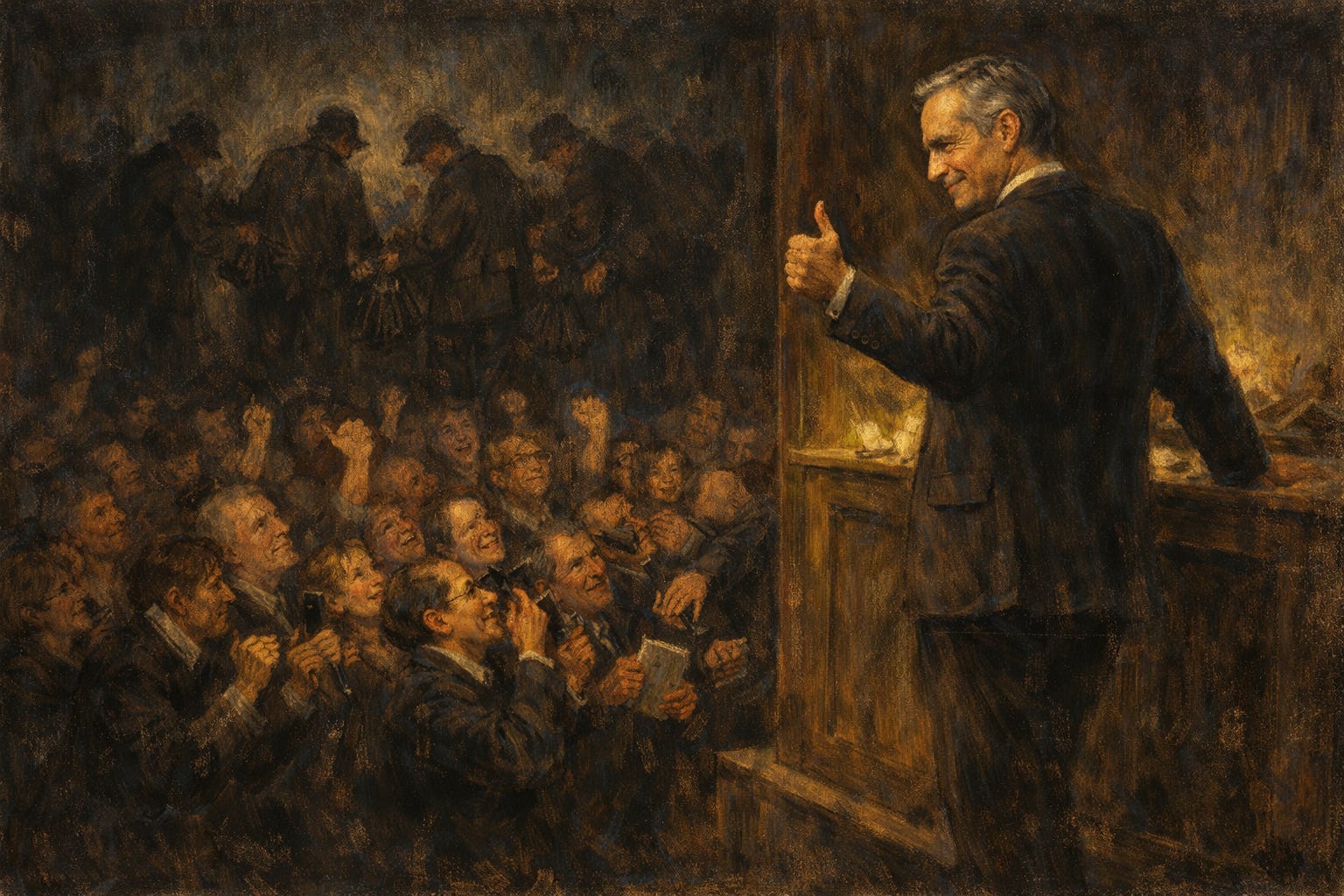
Smooth, camera-ready, and exquisitely managed. In modern Canada, that apparently suffices.
Look past the slogans, and the conflict yawns wide. Opening up energy? Spare us. Carney is a climate absolutist who has spent years signalling hostility to hydrocarbons. Expecting him to revive Canada’s energy sector is like expecting a teetotaler to reopen the pub. What we will get instead is what we already saw during his time at the Bank of England: torrents of verbiage, endless frameworks, ambitious plans that substitute motion for movement.
He has elevated glibness into a governing philosophy.
Canadians, alas, confuse fluency with authority. We think leadership sounds like a well-turned sentence. It does not. Leadership delivers results.
Here, the ignorance becomes fatal. Canada remains a commodity economy, whether urban elites like it or not. We rank near the top globally in agriculture, minerals, forestry, and oil and gas—top five or six in most categories. These are not legacy sectors; they are the pillars of national income.
Yet much of the country, particularly east of the Shield, barely understands what actually pays the bills. There is a widespread fantasy that physical production can be replaced by app development, consulting decks, and innovation jargon. This ignorance breeds a casual disdain for the very sectors that sustain the country.
We speak blithely about “transitioning away” from the golden goose, as if no other serious energy economy on earth had learned—often painfully—that you do not impoverish yourself on purpose.
Carney insists he does not wish to kill that goose. But the proof is in the pudding. Everything he has said and done over the years points in the opposite direction. This is not speculation; it is record. He was, after all, the chief economic adviser to Justin Trudeau, presiding over precisely the policy mix that produced capital flight, stalled productivity, and an energy sector treated as a moral embarrassment rather than a strategic asset. Words may change. The worldview has not.
If one were to draw a simple graph of Canada’s decline, it would not require ideological interpretation—only arithmetic. On one axis: time. On the other: productivity, capital investment, and per-capita GDP are measured in U.S. dollars. Since roughly 2015, Canadian business investment per worker has flatlined while the United States has surged ahead. Capital flows south; machinery ages here. Our productivity gap widens year after year, not cyclically but structurally.