


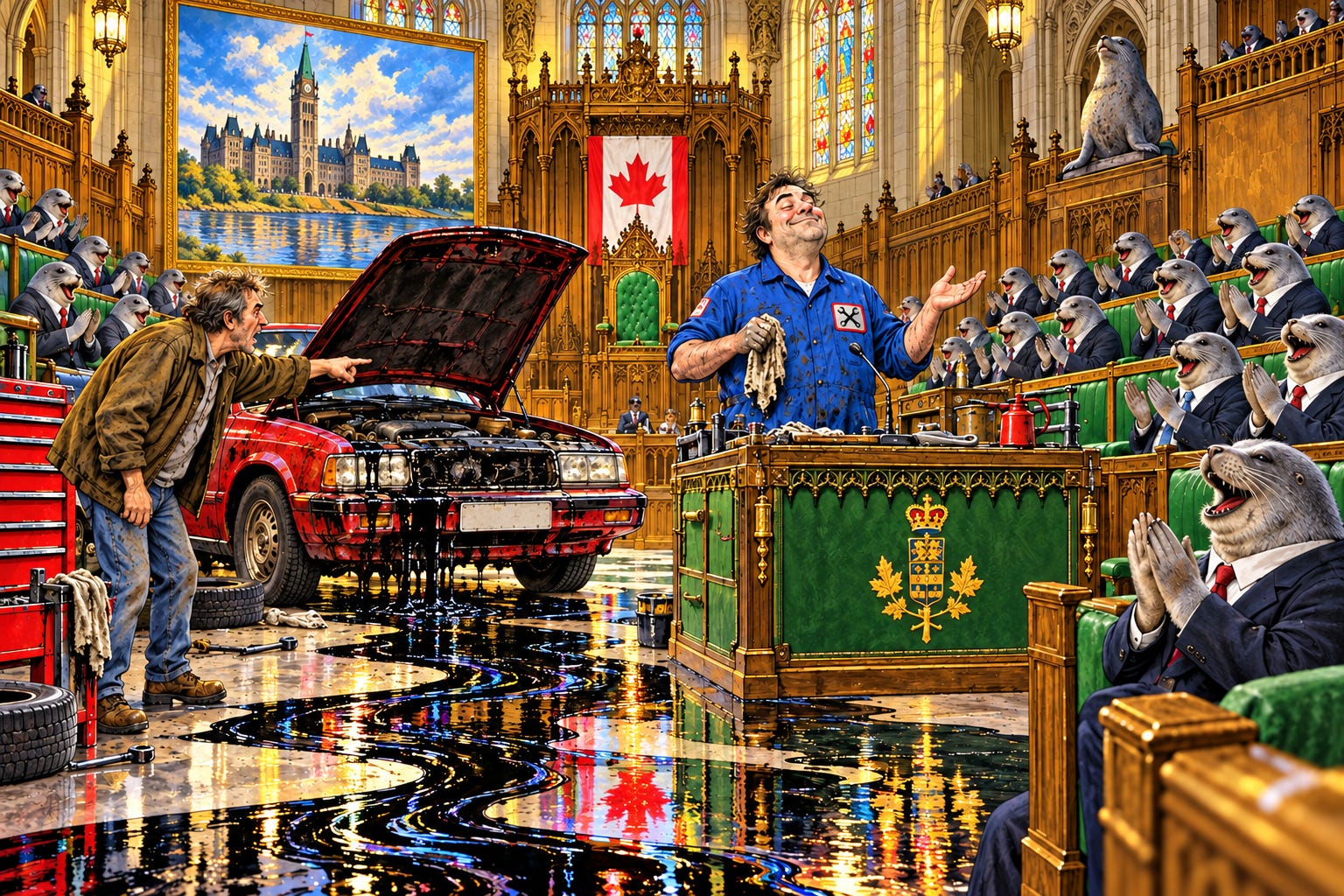
Imagine walking into a mechanic’s shop to ask why your car, after being repaired, still leaves oil slicks on your driveway. Your neighbours call it the Exxon Valdez.
The manager smiles pleasantly and begins explaining how much their auto repair centre cares about the community and how committed they are to customer satisfaction. They talk about happy customers and why Steve’s Auto Repair across the street is so much worse. You repeat your question. He explains that they always triple-check their work and they have won awards for service. He tells you that their mechanics shop is committed to affordability, opportunity, and building a stronger future for everyone.
At some point, you would reasonably conclude that the manager was either incompetent, a complete ass, or deliberately avoiding your question. You would probably leave. Yet this is approximately what Canadians are expected to suffer through every afternoon in the House of Commons, where Mark Carney and his Liberal government are subjected to something rather inaccurately described as Question Period.
Perhaps this is why Carney’s attendance record at Parliament is 26%.
The routine has become tediously predictable. An opposition member asks a question about government policy. A minister delivers a prepared recital of unrelated accomplishments, announces how much the government cares about Canadians, or attacks the opposition. Liberal MPs applaud. The opposition repeats the question. Another non-answer follows. More applause. Apparently everyone considers this a satisfactory day’s work.
It would be comic if it were not such an extraordinary waste of a democratic institution.
Consider an exchange from April 15, 2026. Pierre Poilievre repeatedly asked Prime Minister Mark Carney why his government would not eliminate all federal gasoline taxes for the remainder of the year. The government had already agreed to suspend the excise tax temporarily, but Poilievre wanted a broader reduction.
Carney initially discussed his government’s affordability programs. He subsequently referred to provincial gasoline taxes, wage growth, and inflation. At one point, instead of explaining his position on the proposed tax reductions, he began discussing his record as governor of the Bank of Canada and the Bank of England. In a later answer, he celebrated rising wages and falling rents before announcing that he had run out of time. He had no intention of answering the question; he responded to a question with self-promotion that was only tangentially related.
Why should Canadians have to suffer through a succession of economic advertisements, personal boasting, and partisan insults and still not extract a single relevant explanation of government policy?
Here is a rather more straightforward hypothetical example. Suppose an opposition member asks why grocery prices in Canada are rising faster than in other G7 countries. The minister responds by declaring that the Liberal government has always cared about working families, that Canadians deserve opportunity, and that Conservative policies would be disastrous.
For all the information conveyed, the minister might just as usefully have announced that he loves chocolate pudding.
At least that would have had the merit of brevity.
What is Question Period actually for?
The purpose of Question Period is basic. It exists to hold the government accountable to the people's elected representatives. The opposition asks questions precisely because they do not control the executive branch. They are not, as some dim-witted boomers think, “being unduly negative”; they are doing their jobs.
Ministers exercise enormous powers, spend vast sums of public money, administer laws, and make decisions affecting millions of citizens. Question Period is supposed to compel them to explain those decisions in public.
That is not an interpretation of parliamentary democracy. The Canadian House of Commons’ own procedural manual identifies Question Period as an essential instrument of government accountability.
But accountability requires something that our parliamentary rules have made effectively optional.
An answer.
But according to the House of Commons’ 2025 procedural manual, ministers may answer a question, defer their answer, explain why they cannot answer, or simply say nothing. The Speaker is not responsible for the quality or substance of their replies.
Read that again. Parliament conducts a daily ceremony supposedly devoted to extracting answers from the government, yet its rules explicitly permit ministers to provide no answer whatsoever. Without being hyperbolic, one needs to ask: what is the point of Question Period then?