



We will continue to sleepwalk. Societies do not hover at moral equilibrium like a physics experiment left undisturbed. They drift, they decay, or they are corrected—never neutral, never static. What we call “stability” usually just means momentum carrying us downhill, with our eyes politely closed.
Social and moral trends do not pause for reflection. They do not wait for committees, task forces, or the issuance of another well-meaning communiqué. They slide. They erode. They diminish. And when they collapse, we are always surprised—despite having ignored every warning sign on the way down.
As Alexis de Tocqueville observed with unnerving precision:
“The health of a democratic society may be measured by the quality of functions performed by private citizens.”
When citizens cease to think, speak, and judge for themselves—when they outsource moral reasoning to institutions, slogans, and fashionable indignations—the decline is already well advanced. What follows is not a catastrophe by coup, but tyranny by negligence.
We flatter ourselves that things cannot get worse because we imagine ourselves morally superior to the past. This is the most dangerous illusion of all. The same self-assurance has accompanied every civilizational failure in history: surely we are wiser than those who fell before us. The graveyards of history are filled with cultures that believed exactly that.
Our sleepwalking is not derived from innocence. It is abdication. And abdication, in politics and morality alike, is never a victimless act.
Here are 12 predictions, some societal assessments, and some political forecasts that our team (me and my two dogs) see as we look ahead to 2026.
1. The Law Without Measure
When a society abandons fixed principles, it does not grow humane; it grows arbitrary. Law becomes discretion, discretion becomes power, and power—unmoored—learns to enjoy itself. In 2026, Bill C-9 will reveal its true function: not to protect the vulnerable, but to license selective enforcement. The chaos in England over policing free speech on social media may visit their commonwealth cousins in Canada.
This is the capricious law warned about—applied unevenly, justified emotionally, and enforced under pressure rather than proof. It will blow back like bear spray in a closed room. Those who applauded its release will cough first. Jews and Christians will feel it most because when law becomes mood, visibility becomes guilt.
2. The Cry That Cannot Be Answered
The charge of Islamophobia will continue to rise like incense—sweet-smelling, suffocating, and designed to sanctify rather than illuminate. It is no longer an argument but an invocation. No statistic can puncture it. No testimony can trouble it. It exists precisely because it cannot be falsified, and therefore cannot be debated. One does not answer it; one submits to it.
Speech, in this climate, is not formally prohibited. That would require honesty. Instead, it is rendered unsayable. Silence is enforced not by statute but by dread—by reputational threat, professional extinction, and the ritual humiliation reserved for those who decline to genuflect. The censor’s genius lies in persuading you that no censor exists.
Islamophobia, in this usage, has nothing to do with irrational fear, phobia, or unwarranted hostility. It is a tool—blunt, effective, and endlessly reusable—whose sole purpose is to end discussion. It functions as a conversational kill switch, terminating inquiry at the precise moment it becomes uncomfortable.
What makes this manoeuvre particularly obscene is its timing and its asymmetry. As antisemitic hate incidents skyrocket across Western societies—not anecdotally, but empirically—the rhetoric of victimhood grows ever more theatrical. While Jews face harassment, vandalism, intimidation, and violence at rates unseen in generations, the aggressor class learns to cloak itself in moral insulation.
Statistically—not rhetorically—Muslims are four times more likely than other non-Jewish groups to hold antisemitic views. Yet, this fact is treated as unspeakable, even as Jewish vulnerability is dismissed as inconvenient noise.
The aggressor, having mastered the grammar of grievance, drapes himself in the blinding garments of victimhood and declares immunity. Criticism becomes persecution. Evidence becomes “harm.” And the very communities experiencing the most persistent, historically resonant hatred are instructed to be silent—for their own safety, of course.
What is being smuggled into the secular world under this arrangement is not tolerance but theology. Specifically, the demand—rooted in the most rigid strands of Islamist doctrine—that the Quran is infallible, uncreated, and beyond interpretation or criticism. This is at the root of the concept of “Islamophobia.”
This claim, already dubious within faith, becomes grotesque when imposed upon a pluralist society. To institutionalise it is to grant a single religious text immunity from the scrutiny to which every other ideology, scripture, and philosophy is rightly subjected.
This is not multiculturalism. It is clerical privilege by another name.
That this strategy succeeds owes much to a disciplined minority of Islamist political actors who understand Western moral psychology better than Western elites understand themselves.
But it relies even more heavily on a vast supporting class of academics, administrators, and cultural tastemakers—people so intoxicated by their own moral exhibitionism that they mistake performative solidarity for ethical seriousness.
Unable—or unwilling—to distinguish concern for Muslim individuals from the enforcement of Islamist dogma, they applaud censorship as compassion and intimidation as sensitivity. In the process, they abandon Muslim reformers, liberal dissenters, and Jews alike—while congratulating themselves on their courage.
The result is not tolerance but submission; not coexistence but exemption. And a civilisation that cannot criticise ideas for fear of offending them has already surrendered the very freedoms it claims to defend.
3. Capricious Law
This is not a retreat to pre-Enlightenment faith. That would at least have the dignity of coherence. What we have instead is something far worse: the demolition of moral architecture altogether, replaced by subjectivity enthroned as virtue and enforced as dogma.
Truth is no longer something to be discovered through evidence, argument, or reason. It is assigned—distributed by institutional fiat, affirmed by applause, and insulated from challenge. Justice no longer weighs facts; it weighs feelings. The law, once imagined as blind, has been fitted with a mood ring. It swivels obediently toward the loudest outrage of the moment.
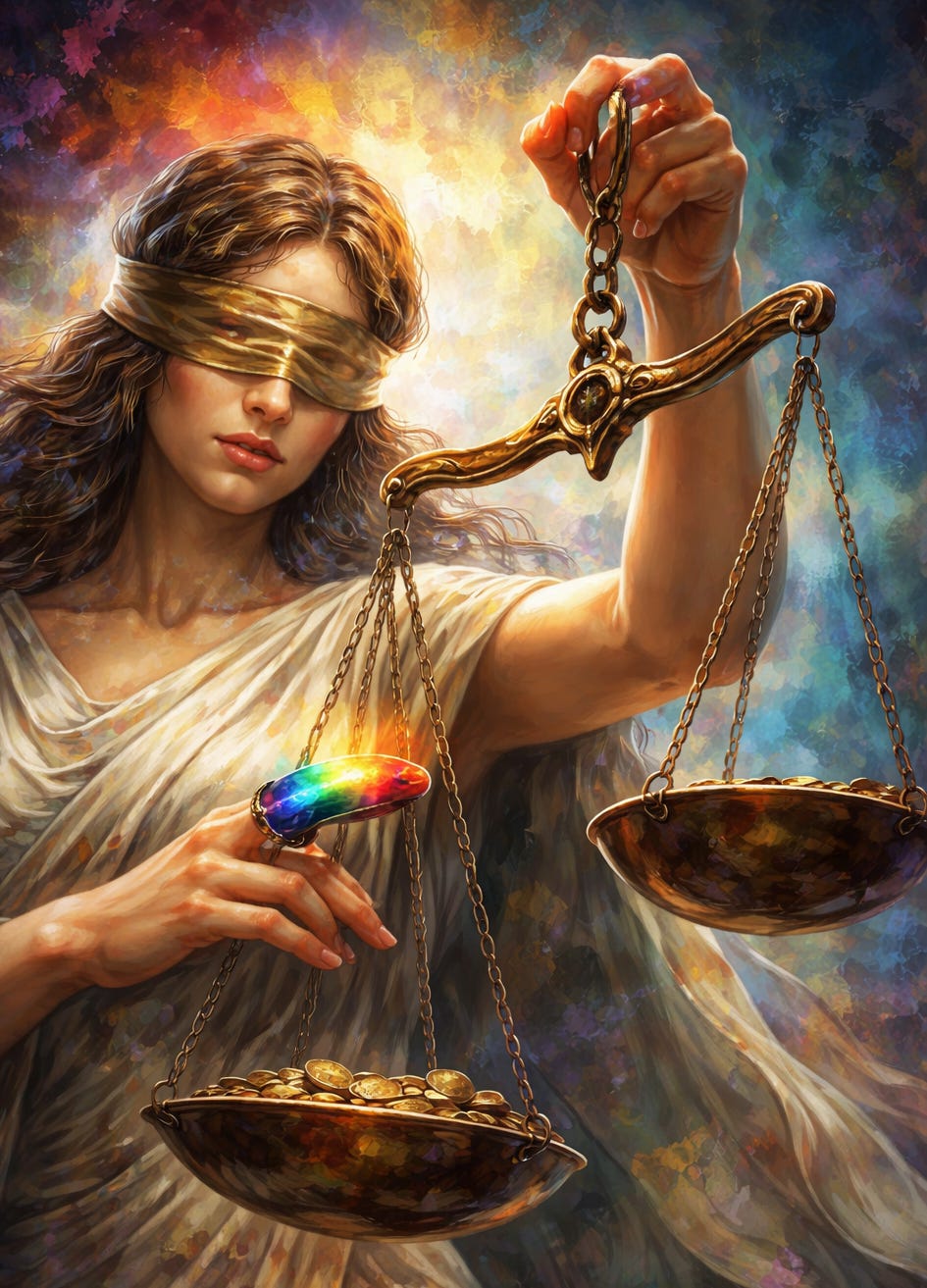
In this regime, the most dangerous people are not the malicious but the morally vain. Those most intoxicated by their own righteousness are invariably the least capable of seeing the damage they inflict. Convinced of their virtue, they feel licensed to abandon restraint, scepticism, and even basic standards of proof.
Consider the grotesque national farce surrounding the alleged discovery of 215 buried bodies at the Kamloops residential school. A claim announced without excavation, without forensic evidence, without proof—and now, as even reluctant officials concede, almost certainly untrue.
On this phantom foundation, Parliament lowered the national flag for six months, staging a prolonged orgy of performative guilt. This was not commemoration but self-congratulation: a society congratulating itself for its sensitivity while abandoning the most elementary standards of evidence.
We did not honour the dead. We invented them—because a comforting lie delivered a greater moral thrill than the austere, unfashionable discipline of truth.
Reason is sacrificed on the altar of moral display.
And having abandoned evidence, we then proceed to criminalise doubt.
In Parliament, the NDP has proposed legislation that would punish those who deny the existence of graves for which no proof has been produced. Not falsification—denial. Not fraud—scepticism. The offence is not being wrong, but refusing to assent. It is a law not against falsehood, but against disbelief.
This is not progress. It is regression dressed up as compassion. It is the substitution of inquiry with intimidation, of justice with sentimentality, of law with ritual denunciation. If much of this essay now constitutes a potential criminal offence, that fact does not indict the essay. It indicts the civilisation that would punish thought to preserve a comforting fiction.
I have earned the right to say this. I was, so far as I can determine, the first professor in North America—and likely in the English-speaking world—to be dismissed for stating a historical fact: that Hamas are Nazis in ideology, in method, and by their own explicit declaration. This was not a metaphor or a hyperbole. It was description—grounded in doctrine, practice, and the open celebration of genocide.
For this, the University of Guelph and Humber College did not rebut the claim. They did not dispute the history. They did not test the evidence. At a university—an institution allegedly devoted to inquiry—they declined even the pretence of argument.
Instead, they surrendered to offence. They punished truth not because it was wrong, but because it was intolerable to those whose moral imaginations have collapsed into reflexive resentment, and who confuse emotional discomfort with ethical injury.
This was not the community's defence. It was institutional abasement: the spectacle of an academic body disciplining a fact because it bruised a feeling, and censoring history to spare the vanity of those who believe their indignation outranks reality itself.
That is not scholarship. It is cowardice, dressed in policy.
The Enlightenment was not a mood; it was a discipline. And once a society abandons that discipline, it does not ascend to greater moral heights—it descends into superstition with better branding.
4. The Universities
Real education must involve learning, and it, like wrestling, cannot be acquired without engagement. No one acquires balance, strength, or technique from the sidelines, let alone from slides. Wrestling is learned through strain, repetition, failure, sweat, and pain. Thinking is no different.
To imagine that one can train wrestlers with PowerPoint is laughable. Yet this is precisely how universities now imagine they educate minds. Inquiry has been replaced by exposure. Struggle with attendance. Challenge by “content delivery.” Slides are uploaded, objectives announced, rubrics posted—and the absence of learning is declared a success.
Physical presence is mistaken for intellectual engagement. A student may attend only 60% of classes, arrive late, leave early, spend hours staring into a phone, and still be credited with participation. If they remain in the room, it counts. If they submit something—anything—it passes. Grade inflation is endemic.
This is not education. It is supervised inertia.
Real learning requires friction. It demands attention, endurance, and the humiliation of being corrected by reality. Remove resistance, and you do not make learning accessible; you make it impossible.
A university that abolishes intellectual strain does not produce enlightened students—it produces credentialed spectators, trained only to confuse comfort with competence.
5. Disorder Left Untended - The Muslim Brotherhood’s Agenda Marches On
Within hours of the pogrom at Bondi Beach, before the blood had even cooled, the familiar machinery whirred back to life. The story was no longer the slaughter itself, nor the ideology that produced it, but the supposed ingratitude of the Jews.
Had they sufficiently thanked the brave man—Christian Maronite, Muslim, the details already blurred by haste—who threw himself at one of the attackers? Had they performed the required ritual of gratitude loudly enough, humbly enough, photogenically enough?
And there it was, right on cue, but this is not all Muslims. The infantile incantation, delivered as though anyone had suggested otherwise, was deployed not to clarify but to silence. Thus, within hours of murder, Jews were once again placed in the dock—this time for insufficient thankfulness—and the circle closed.
Their alleged moral failure now became fresh fuel for the charge for the Muslim Brotherhood’s most successful marketing program: “Islamophobia,” which in this moral economy is both the accusation and the verdict.
Observe the elegance of the loop. Islamic fundamentalist violence erupts. The response is not to interrogate the ideology, the networks, the tolerated rhetoric, or the long parade of threats—“globalise the intifada,” “gas the Jews”—that preceded it. No, the response is to scold the targets for their tone, their timing, their manners. The arsonists are excused; the homeowners are lectured on fire safety.
Then enter the officials. The same politicians and administrators who allowed the flames to burn—who treated threats as speech, chants as culture, intimidation as “context”—now appear solemn and stricken, like the morning drunk presiding over a temperance meeting. Their faces register surprise, even shock. How could this have happened? One might as well ask how gravity works.
If there were widespread revulsion within the Islamic community, one might expect the streets to be filled with “Not in my name” marches. But they are not.
The streets are quiet—for now. They will fill again soon enough, not with repudiations of violence, but with keffiyehs, slogans, and the same mindless bleating of “Free Palestine,” untroubled by the bodies that made the chant possible.
The rules against violent threats and hate propaganda already exist. They are simply not enforced—at least not when Jews are the targets. Across Canada, Australia, the UK, and much of the West, the same quiet calculation is made: there are more Muslims than Jews; they vote; enforcing the law might provoke anger; anger might provoke violence. And so the law is asked, once again, to look the other way.
Public order becomes conditional. Trespass, intimidation, and the illegal seizure of civic space are waved through under an unspoken exception—Islamic protest receives indulgence. In contrast, elsewhere the same indulgence is extended, with equal recklessness, to drug encampments and lawlessness dressed up as compassion. Equality before the law is not abolished; it is selectively suspended.
Authority, therefore, waits for blood before acting, even as intelligence services quietly intercept plots far larger than the atrocities we are later instructed to mourn. Prevention, being invisible, earns no applause. Failure, when it finally arrives, is ritualised, aestheticised, and carefully explained away.
This is not a restraint. It is cowardice with a briefing note.
And it guarantees repetition.
Of course, there will be more Bondi Beaches—worse ones, too—not because the danger is unknown, but because acknowledging it would require the courage to act early, decisively, and without the narcotic of moral theatre.
The public, trained in indifference and schooled in deferral, will shrug until the river turns red and reaches its own driveway. Only then will urgency be rediscovered, too late to matter. This is not prudence. It is civic superstition—the belief that naming a danger summons it, and that silence is a form of protection.
But silence is not neutral. It is permission.
A society that insists on catastrophe as a prerequisite for enforcement has already made its choice. It has chosen disorder, outsourced responsibility to fate, and confused restraint with wisdom. And when the bodies appear, no amount of mourning will conceal the truth: the warning signs were not missed. They were ignored.
6. The Sign of the Jew
A new generation is now emerging from a feminised and radicalised secondary and post-secondary system that has quietly abandoned the moral grammar of effort, risk, and consequence. They have not been taught that freedom of speech is costly, abrasive, or earned.
They have been taught, instead, that it is therapeutic, conditional, and, above all, subordinate to feeling. The great civilisational insight—that free speech is nothing more and nothing less than the freedom to offend—has been buried beneath layers of grievance management and institutional cowardice. What once required sweat, discipline, and intellectual courage has been replaced with posture, performance, and accusation.
Into this vacuum has rushed something darker. Antisemitism, once rare and socially radioactive in the West, has been rebranded, laundered, and re-imported under the guise of moral critique. We are told that naming this reality is discriminatory, that acknowledging imported hatreds is itself a form of bigotry.
The result is not tolerance but selective blindness. Hate propaganda—defined plainly as the public promotion of hatred against a people in ways that legitimise exclusion, intimidation, or violence—is permitted to flourish so long as it wears the correct ideological costume. It is dangerous precisely. It normalises dehumanisation, preparing the ground long before the first blow is struck.
We now inhabit an Animal Farm version of free speech, where all speech is equal, but some speech is more equal than others. Attacks on Jews are indulged as a political expression. Antisemitism is excused as “context.” Anti-Zionism—a fixation on the illegitimacy of one Jewish nation among dozens formed through blood, conquest, religion, and partition—is treated as sophisticated dissent. Yet this critique is pursued with a fanaticism that will wade through oceans of Jewish suffering to catalogue Israeli paper cuts. This is not principled opposition. It is antisemitism 2.0, updated for the sensibilities of the educated coward. It always has been.
Jews respond as they always have: with reason, ethics, memory, and law. And they are met, as they always have been, with rage. This is not incidental. It is diagnostic. The condition of the Jew has always been the civilisational litmus test.
When Jewish presence is treated as provocation, when Jewish symbols are reclassified as “incitement,” when Jews are told that their visibility is the problem, the verdict is already rendered. The sickness is advanced.
As MLK understood, injustice does not announce itself with clarity; it cloaks itself in procedure, patience, and false moderation. The most dangerous posture is not hatred shouted, but hatred rationalised. And a society that teaches its young that moral virtue lies in silence, conformity, and selective outrage is not drifting—it is choosing.
7. Cowardice by Another Name
Cowardice is a word we have almost banished from polite discourse, and its absence has not been accidental. We prefer euphemisms: “prudence,” “de-escalation,” “process,” “community relations.” We reserve the term cowardice for caricature—for soldiers fleeing a battlefield, for moments of visible panic. This is a profound misunderstanding. Cowardice, properly understood, has very little to do with fear in the animal sense. It has everything to do with selfishness in the moral sense.
The Greeks understood this clearly. Cowardice was not the absence of bravery under fire; it was the preference for personal comfort over the demands of the good. It was the refusal to endure inconvenience, risk, or social cost for the sake of justice. It was the decision to remain seated when standing would require a sacrifice. Aristotle did not define courage merely as boldness, but as the capacity to act rightly despite fear, and cowardice as the failure of that capacity, not because fear exists, but because ease is chosen instead.
Modern cowardice rarely announces itself as such. It dresses well. It speaks in procedural bromides and mindless catchphrases. It substitutes “context” for clarity and “dialogue” for judgment. It avoids moral absolutes in favour of managerial language, because absolutes demand commitment, and commitment demands cost. In this way, cowardice becomes socially respectable. It is well-packaged selfishness masquerading as sophistication.
This is why authorities will continue to prioritise “community relations” over the law. Not because the law is unclear, but because enforcing it would provoke discomfort, criticism, or unrest. This is cowardice, precisely defined: the preference for immediate ease over enduring justice. It is the refusal to bear temporary disorder to prevent permanent decay. And it always disguises itself as wisdom.
There is a famous observation, often attributed to Kierkegaard, that people follow herds collectively but learn truth only individually. Cowardice thrives in herds. It feeds on the diffusion of responsibility. When everyone is responsible, no one is accountable. Each administrator waits for the other; each academic hides behind consensus; each institution claims its hands are tied. Meanwhile, the moral ground beneath them erodes.
This is the bitter fruit of a secularised moral order stripped of transcendence but not of sanctimony. We have discarded the old architecture of moral courage—rooted in duty, sacrifice, and truth—and replaced it with ethics courses taught by people who have never once risked anything for an ethical principle. Academics lecture endlessly on courage, justice, and resistance, yet recoil at the first hint of professional or social cost. They catalogue the bravery of historical figures without ever noticing the small, daily cowardice of their own grovelling existence.
And this is how societies fail—not with a scream, but with a shrug. Cowardice is not loud. It is quiet, administrative, and polite. It insists it is being “reasonable.” It assures itself that it is being careful. But in truth, it is abandoning civic duty while congratulating itself on its sensitivity.
The Greeks warned us of this long ago. Cowardice is not fear; it is the love of comfort over the good. It is the refusal to stand when standing costs something. And it always, without exception, calls itself wisdom.
8. The Road Paved With Good Intentions Will Grow Brighter
The road to hell will grow smoother, brighter, and more decorative. It will glitter with slogans, ceremonies, and hashtags. Its architects will insist they mean well. Their policies will be driven not by evidence but by craving—the dopamine hit of moral superiority. Like addicts, they will ignore the wreckage behind them, preaching louder as consequences mount. Their hearts will deceive them. They will build higher and higher, convinced they are ascending—raising a tower of vanity.
Like Babel, it will be toppled, not by malice, but by reality.
9. The Murmur of the Ordinary
We are now in a race in the West, and it is not between parties but between moral temperaments. On one side stand those draped in the new vestments of woke revolutionary consciousness—clerics of grievance who believe censorship is compassion, silence is safety, and coercion is care. On the other hand, the ordinary citizens who still assume, quaintly, that democracy means consent, that free speech means risk, and that laws apply before feelings.
The question is simple and brutal: which side will prevail?
If the first faction wins, censorship will harden into custom. It will be sold as anti-racism, as protection for children, and as harm reduction. It always is. Every authoritarian project in history has arrived wrapped in benevolence. The banners change; the bones beneath them do not. The whitewashed tombs of these schemes are always full of liberties surrendered, of truths buried, of citizens trained to whisper. What begins as sensitivity ends as surveillance.
In this version of events, politicians like Mark Carney or Keir Starmer will continue to gaslight their publics, insisting that restrictions are temporary, that opposition is dangerous, and that dissent is indistinguishable from malice. Imported populations who openly scorn the societies that sustain them—while living off their protections and revenues—will be indulged so long as they chant the approved slogans. Theocratic aspirations will be waved away as a misunderstanding. Violence will be contextualised. And the remarkable cognitive dissonance will persist: movements that despise free speech will insist they are its truest defenders—so long as only they are speaking.
But there is another possibility.
In Western Europe especially, the ground may finally shift—not because of elites, but because of ordinary people. Not activists, not theorists, not professional moralists, but those who rise early, work honestly, pay bills, and hope—modestly—that their children will do better than they did. These people are not ideological. They are arithmetical. They understand that a society cannot import unlimited numbers of people who reject its values, criminalise its speech, and demand its submission without eventually breaking. They understand that assimilation is not cruelty, that borders are not hatred, and that arithmetic is not racism.
History offers a warning when such people lose heart.
In late Weimar Germany, the republic did not collapse because everyone suddenly became a fanatic. It collapsed because the decent majority retreated into silence. Each individual feared standing alone. Each assumed someone else would speak. The extremists were loud, organised, and shameless; the moderates were isolated, cautious, and polite. Fear became contagious. Silence became normal. And the best-dressed authoritarians in Europe walked calmly into power while the ordinary people told themselves it was safer not to be noticed.
That is always how it happens.
The test, then, is whether the ordinary will see through the glossy public relations of their own leaders and finally say: enough. This is a democracy. You govern by consent, not by manipulation. You will honour the will of the people, or you will be dismissed.
If that moment comes, it will not be polite. NGOs will not choreograph it. Universities or editorial boards will not approve it.
It will be overdue.
And it will mark the difference between a civilisation that corrects itself and one that quietly abdicates—while congratulating itself on its manners.
10. Bread Before Virtue
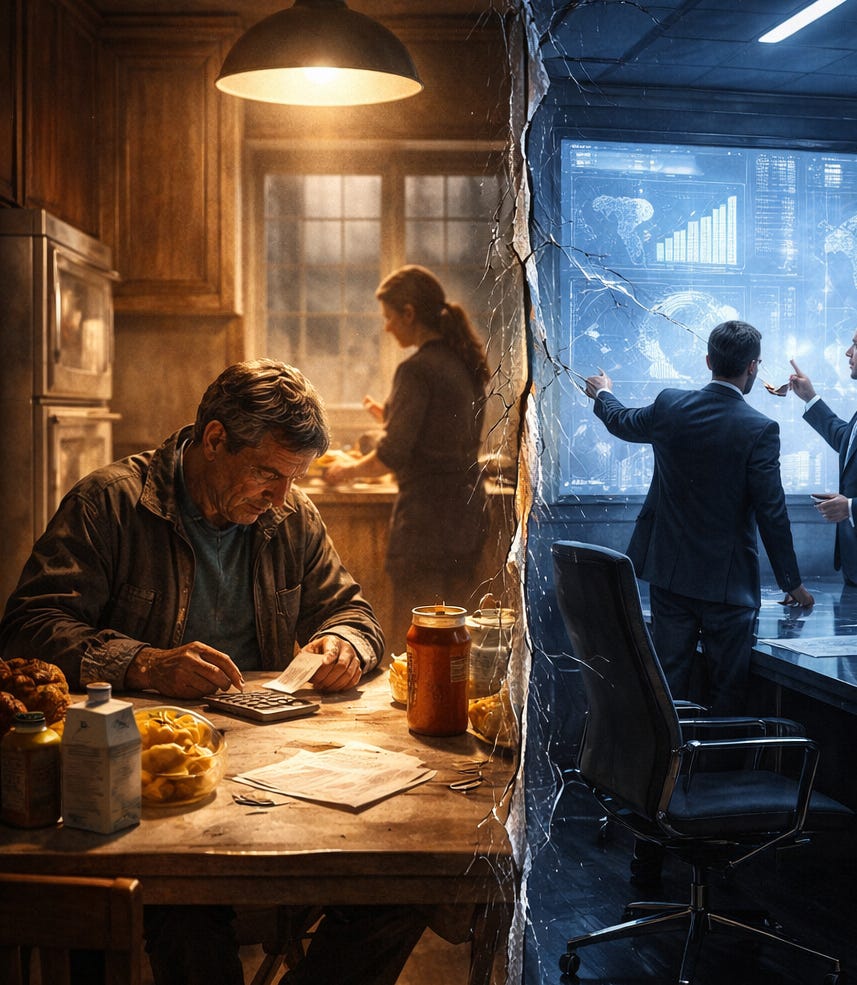
When food banks lengthen and mortgages tighten, virtue signalling does not survive. Plastic straws matter less than meat prices. Net-zero sermons ring hollow to people counting coins at checkout. The technocratic class—well insulated, chauffeured between conferences, cocooned in gated communities and business-class cabins—eventually discovers a truth as old as politics itself: moral exhibitionism collapses when it collides with hunger.
History is merciless on this point.
The French Revolution was not ignited by abstract theories of equality, still less by fashionable moral rhetoric from Versailles salons. Bread prices drove it. When the price of a loaf consumed most of a worker’s wage, enlightenment ideals suddenly became combustible. Philosophers supplied the language, but empty stomachs supplied the force. Marie Antoinette’s alleged indifference—apocryphal or not—captured something real: a ruling class insulated from scarcity is always baffled when the governed stop applauding.
The same pattern reappeared in Weimar Germany. Hyperinflation did not merely impoverish the middle class; it annihilated trust. Moral lectures about civic responsibility and democratic restraint sounded grotesque when a wheelbarrow of banknotes could not buy dinner. The result was not moderation, but radicalisation. When governments lose control of prices, they soon lose control of narratives.
More recently, the Arab Spring did not spring from seminar rooms. It followed spikes in global food prices. Bread, fuel, and unemployment—not abstract injustice—pushed millions into the streets. Western commentators romanticised the uprisings as democratic awakenings; the participants knew better. They were reacting to the simplest of realities: life had become unaffordable.
Even in stable democracies, the rule holds. Britain’s Winter of Discontent in the late 1970s was not a revolt against insufficient virtue, but against economic paralysis. Rubbish piled up, wages lagged, and power cuts spread. Moral posturing collapsed under the weight of daily inconvenience. A complacent political class was swept aside by voters who no longer cared for excuses.
France’s Yellow Vest movement followed the same script. A fuel tax, preached as an environmental virtue from Parisian offices, collided with rural workers who depended on cars to survive. The lecture on planetary salvation evaporated the moment it met the petrol pump. Emmanuel Macron learned, briefly, that technocratic righteousness has limits once it demands sacrifice from people already stretched thin.
This is the unchanging law of politics: basic needs outrank moral theatre. Always.
Today’s managerial elites appear determined to relearn this lesson the hard way. They fly to climate summits on private jets to scold commuters. They lecture about consumption from homes protected by rising asset values. They moralise from abundance. And they seem genuinely shocked when those outside the bubble stop listening.
The poor do not resent morality. They resent hypocrisy. They resent being told that their inability to pay rent is a pedagogical opportunity, that their anxiety is a character flaw, that their hunger is a teachable moment about sustainability. They resent sermons delivered by people who will never feel the cost of the policies they promote.
When economic pressure mounts, the spell breaks. Moral vanity—so intoxicating in comfort—loses its audience. The electorate does not become more enlightened; it becomes more honest. Questions sharpen. Tolerance for nonsense shrinks. The politics of symbolism gives way to the politics of survival.
The correction will not be elegant. It never is. History shows that it arrives with resentment, anger, and often cruelty. But it is inevitable. Governments can ignore arithmetic only for so long. When daily life becomes a struggle, people stop caring about their rulers' moral self-image.
They start caring about bread.
And when that happens, no amount of well-phrased concern, no invocation of virtue, no accusation of insufficient compassion will hold the line. The technocrats will discover what every ruling class eventually learns: you cannot eat slogans, you cannot heat homes with intentions, and you cannot govern indefinitely on moral vanity alone.
11. Israel
Israel will endure. It always does. It will act in its own interest—clear-eyed, unapologetic—while international bodies drown in their own sewage of resolutions and moral vanity. Western leftist parties will sermonise. And slowly, grudgingly, some may realise that their condemnations were never about peace, but about self-adoration. Each good intention laid another stone on the old road.
12. America and the Market
It may seem comforting for a president to capture resentments, to transform grievance into political currency. But that cypher dissolves when the economy tightens and the food bank beckons. When grocery prices climb, and paycheques shrink, the applause for grievance harvesting fades quickly. Voters do not live by symbolism; they live by sustenance. And Americans are not immune to this rule.
Donald Trump was born into advantage. From an early age, he benefited from his father’s real estate success — reportedly a millionaire in inflation-adjusted terms by age eight and raised in an affluent Queens neighbourhood with resources far beyond ordinary families. His own narrative of a “small loan” belies the reality that he received significant financial backing and opportunities from family capital that most Americans can scarcely imagine. This is not a personal judgment, but a reminder that vanity projects rooted in self-image do not withstand the harsh arithmetic of daily life.
Foreign-policy legacies, Nobel aspirations, and self-appointed roles in history are luxuries that depend on a stable economic base at home. When tariffs act like inefficient taxes, mercantilism reveals itself as a mirage, and grocery bills climb, the political mood changes. Thoughtful observers know that tariffs and trade wars tend to act like regressive levies on ordinary consumers — a lesson economists like Milton Friedman cautioned against decades ago.
The electorate may tolerate theatrical grievance as long as parking costs and petrol prices remain manageable. But when inflation hits the supermarket aisle, resentment ceases to be an asset and becomes a liability.
History teaches the same truth: leaders who distract with culture wars soon find themselves disciplined by arithmetic. Bread riots have toppled governments when everything else failed. Levelling grievances against outgroups might win attention in comfortable times, but when fields lie bare and checkout lines grow long, voters return to fundamentals.
When food banks fill, and meat prices bite, the politics of resentment loses its purchase. Electorates will not fall for grand narratives of legacy while their own household budgets fracture. The economy will speak plainly — and in that language, hubris is poorly translated.
What Cannot Be Predicted?
What cannot be known is what finally matters. Who will still be here?
In a single twenty-four-hour span—from the 21st to the 22nd—I received word that two men my wife and I knew, old friends, unknown to each other, both devoted husbands and fathers, had died suddenly of heart attacks. The news shook me. Not abstractly. Physically. It cracked whatever illusion of distance I was still clinging to.
So when we ask about 2026, the questions that are always closest are not the loud ones. They are not all about trends, or politics, or noise.
They are the quieter questions: whose children will be healthy; which friendships will survive silence and strain; whether mercy will still be extended when it costs something.
These questions do not trend. They endure—like seed beneath frozen ground.
But Robert Frost, late in life, stripped it all down to three words: it goes on. Not because it is easy. Not because it is just. But because it must.
May 2026 be a year of ascent rather than noise; of repair rather than rage; of windows mended instead of shattered.
To my readers, thank you for your presence, your seriousness, and your willingness to read.
May the coming year bring you steadiness, kindness, growth, and peace. And may God guard you and those you love as you walk onward, toward 2027.

If you value this work, consider leaving a tip. It’s cheaper than therapy, less pious than public broadcasting, and the only censorship here is my bad taste. On second thought, it’s bad therapy.