


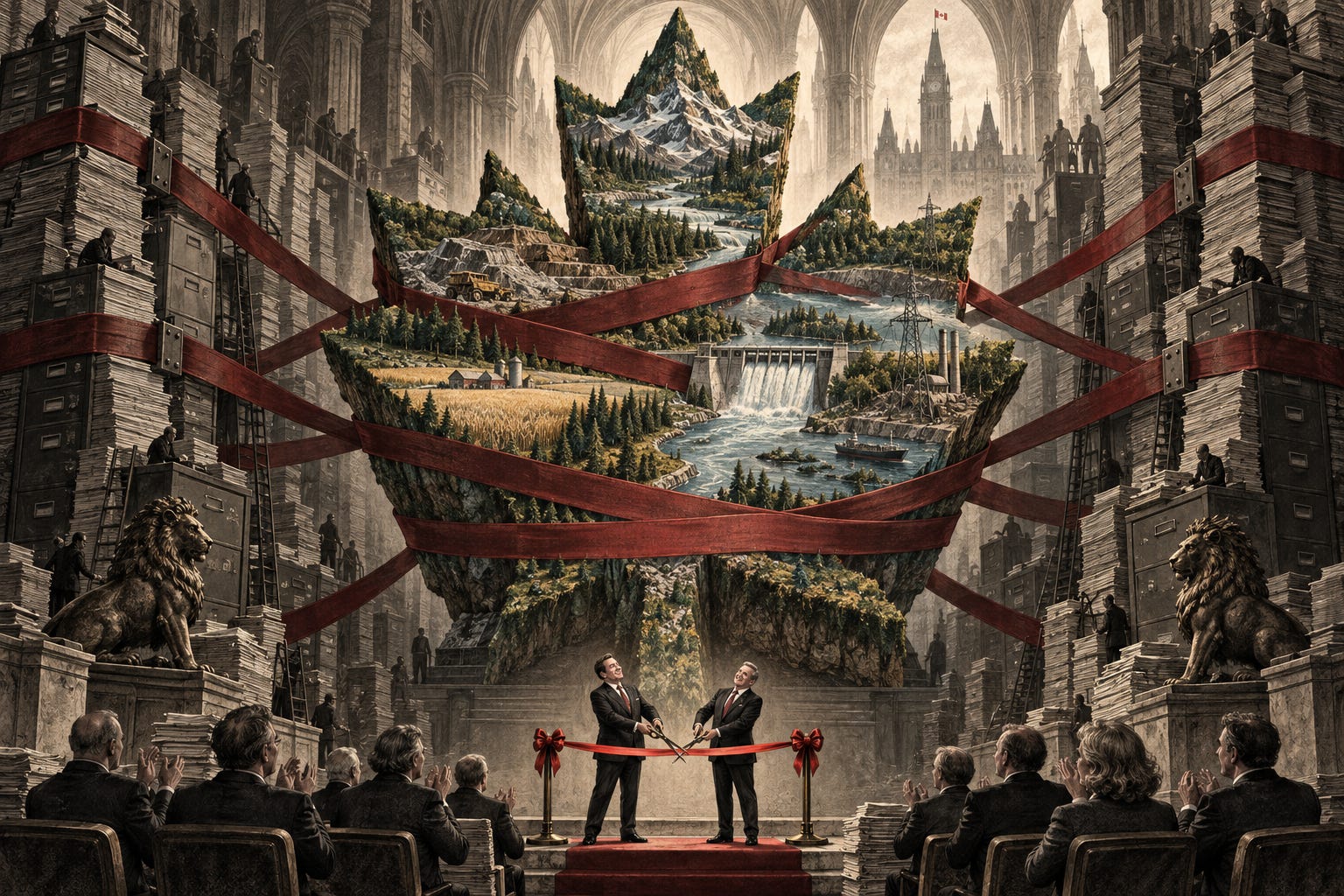
Canada is rich in energy, minerals, food, timber, water, talent and geography. What it lacks is a political class willing to dismantle what no longer works, and an electorate willing to reward anyone who tries. Nations with voters and politicians that lack political courage, where the state continues to ladle out a thin gruel of statism, are trapped in a mediocrity defined by their own complacency.
I am told I spend too much time criticizing Mark Carney. Citizens, it seems, are now expected not merely to elect governments but to applaud them. The opposition should be agreeable, the press supportive, and the rest of us should admire the leader’s vision and clap at the appropriate intervals.
We have gone from a mindless parliament, the famous cast of clapping seals, in which MPs vote with their party 97% of the time, a frequency unparalleled in the Western world, to an encaptured and besmitten media, where just under half of their salaries are paid by the state ot Google, to an electorate dominated by self-centred boomers, with an astonishing 70% of female boomers swooning before Mark Carney.
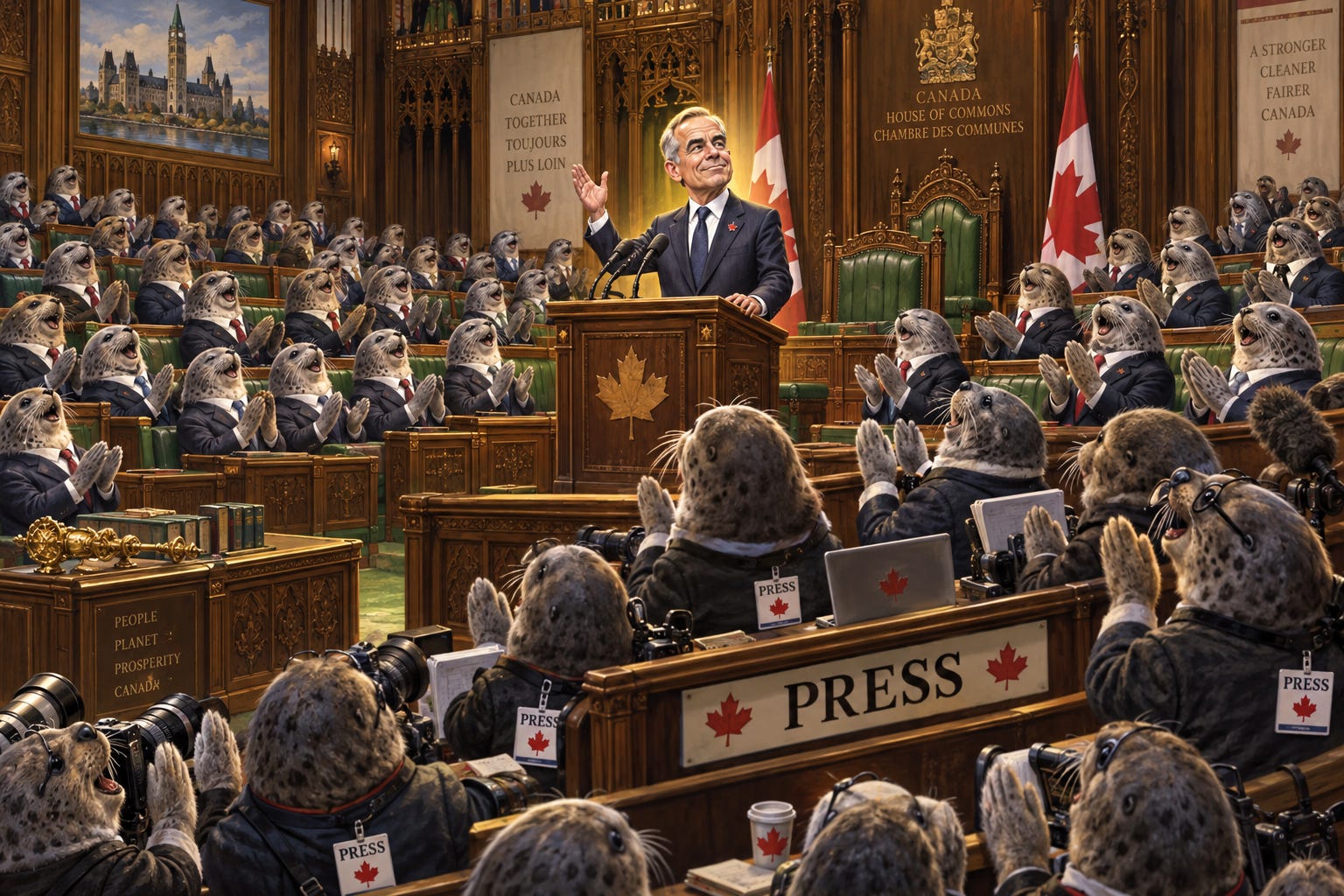
We have enough cheerleaders. The job of an opposition is to oppose. The job of a free press is to interrogate power. The citizen is under no obligation to become a fan of whoever occupies the Prime Minister’s Office. We are not like North Korea, where if the house burns, the people have been trained to run out but not before ensuring their framed portrait of the dear leader is kept away from the conflagration.
But there is a fair version of the complaint: fine, then what would you do instead?
Here it is. Ten proposals, whose first letters spell out something this country ought to aspire to. Yes, it is branding. Ideas need names if people are to remember them and demand that politicians take them seriously. The name is the packaging.
What follows is the substance.
A word first on what this is not. It is not hard-right, and nobody should pretend otherwise. “Hard right” has become a synonym for any politics right of socialism and a convenient muzzle - the phrase that says, “heel, sit, shut up.”
The plan keeps universal healthcare. It raises the basic exemption to protect lower-income Canadians. It welcomes the immigrants Canada needs and protects genuine refugees. It is ordinary conservatism: low taxes, open markets, limited government, the rule of law, and a well-earned suspicion of anyone who spends other people’s money and calls it “investment.” That this now passes for radical says more about the country than about the plan.
Nor is it uniquely anti-Carney. Neither major party shows much appetite for reforms this disruptive. Politicians adore policies whose benefits arrive before tomorrow evening’s news and shun those that hurt now and pay off in five years. Difficult policy is slow cooking. Modern politics is intellectual candy, and the electorate has an appetite for sugar.
We hold a better hand than almost any country on Earth: oil, gas, potash, uranium, farmland, forests, hydroelectric power, fresh water, three oceans, and the largest consumer economy on the planet next door.
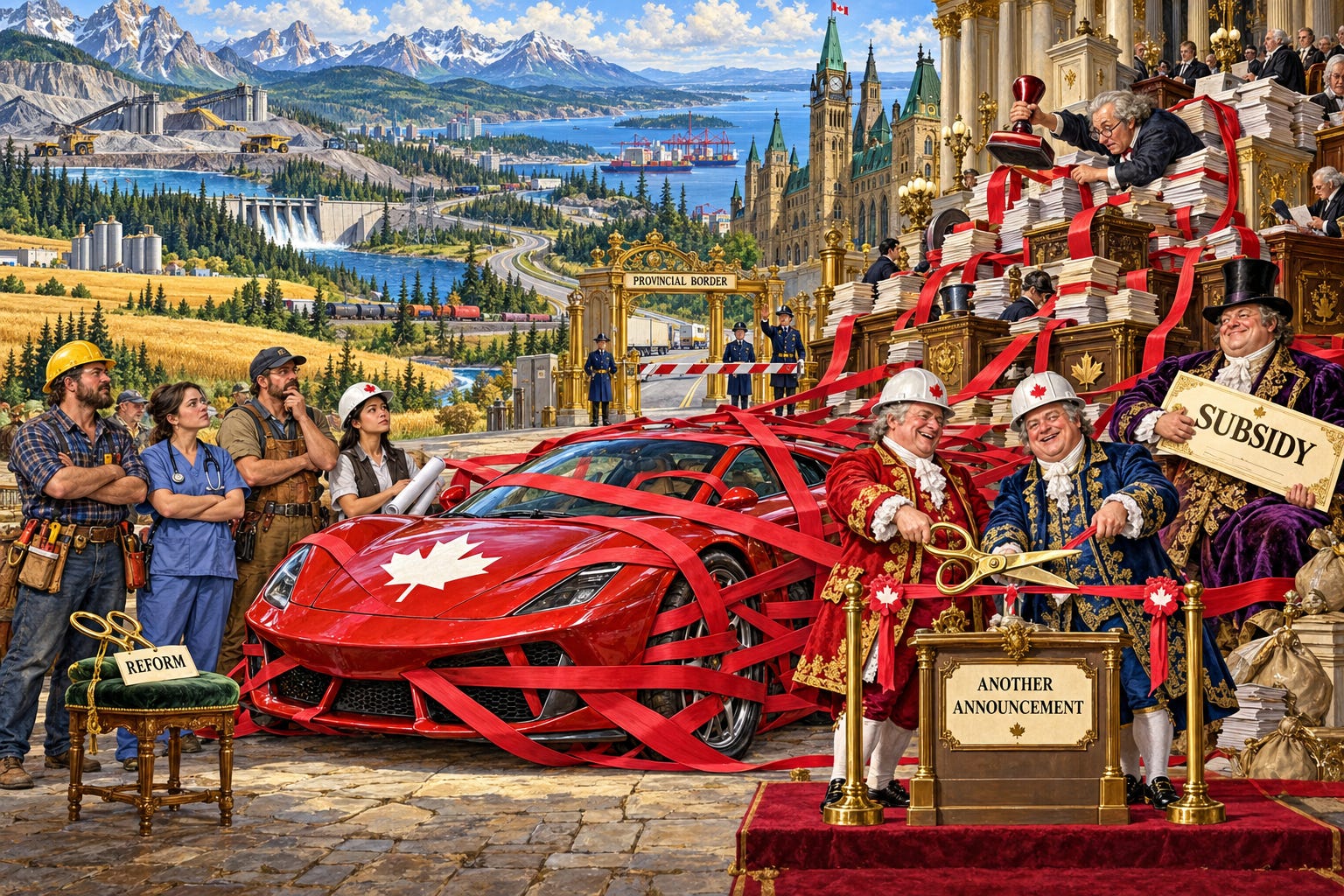
Canada, unfortunately though, has the body of a Ferrari and the brains of a Mattel toy.
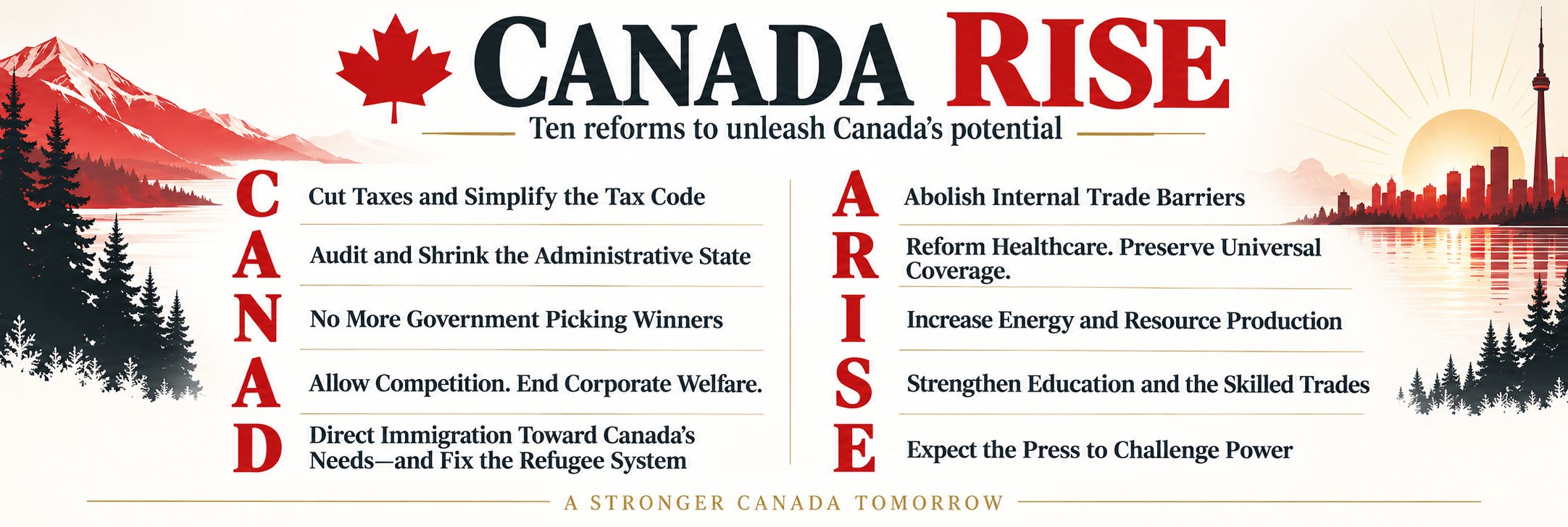
C: Cut Taxes and Simplify the Tax Code
Lower the rates. Broaden the base. Raise the basic exemption so the poorest are shielded. Then clear out the thicket of credits, deductions, boutique incentives and political favours. The tax code is not a Christmas tree.
Governments love tax credits because each one permits another announcement. It caters to their endless compulsion to market themselves to the electorate in the next election, but it disrupts both labour and capital markets and wounds the economy as a whole.
A low, simple rate is inconsiderate that way: there is nothing to unveil. And consider the Laffer curve: lower taxes will likely revive the economy to the point where gross tax revenue increases, not falls.
I would also shift the burden toward broad consumption taxes and away from income, work and investment. There is a substantial economic literature showing that taxing productive activity carries higher long-run costs than taxing consumption.
Ireland grasped decades ago that if you want capital, you make yourself attractive to it. My own ancestors left Ireland for Canada in 1904 because this was the land of opportunity. It is worth contemplating how that has reversed.
A: Audit and Shrink the Administrative State
Roughly one Canadian worker in five is employed in the public sector across all levels of government and public institutions. In August 2026, Statistics Canada said we have 4.52 million public-sector employees out of 21.17 million employed Canadians. That does not mean one in five works for Ottawa, but it is an enormous footprint.
Every department, agency and program should be forced, periodically, to answer a question so simple that parts of Ottawa will take it as an act of violence: what measurable value do you produce? Not how many people you employ, how many stakeholders depend on you, or how many lobby groups will issue a press release if you vanish. What do you accomplish?
Bureaucracies never conclude that their work is done. Programs do not commit suicide. Departments discover new missions with the same enthusiasm universities show in discovering new vice-presidents.
Government needs the institutional capacity to say: this failed, this agency is unnecessary, this regulation costs more than it achieves. Value for money audits must happen for all government spending, and right now it barely happens. Audits that produce only another report, another committee and another request for funding have missed the point.
Canadians are being charged Porsche prices and handed the keys to a battered, second-hand pickup: the question is what our substantial public workforce and spending actually deliver.
Denmark spends slightly less per person on healthcare yet reports far higher satisfaction and guarantees access to subsidized childcare; its public universities generally charge domestic students no tuition, while barely half of Canada’s high-volume federal services meet their own service standards.
Canada needs an independent, nonpartisan public accountability website, operated outside government, that tracks every government promise and every discretionary spending commitment against actual expenditure and measurable results. We are living in the AI/digital age and still have a startling lack of transparency, contrasted with an abundance of fax machines.
What was promised? What was paid? Who received it? What happened? The public should be able to look behind the curtain, long after the cast has left the public stage. A battery subsidy should remain visible long after the minister’s hard hat has returned to storage. Link the contracts, deadlines, employment targets, audits and outcomes. Flag missing information as prominently as missed targets. Citizens should not need a research team to follow their own money. We cannot make everyone investigate government, but we can make investigation dramatically easier—and political amnesia considerably harder.
N: No More Picking Winners
Here I part company with Mr. Carney’s economic philosophy. His government has openly embraced industrial policy and built mechanisms to put public capital alongside private capital in selected sectors. Politicians' kryptonite is always hubris - they fancy themselves cleverer at picking winners than the outcome of millions of micro decisions made by consumers.
In April 2026, it announced the Canada Strong Fund, with an initial federal contribution of $25 billion to invest in chosen projects and companies.
A savings account funded by debt? If an eight-year-old asked their parents to fund their savings based on a loan, that kid would lose some screen time. But our PhD in Economics PM has no issue.
Call it what it is: industrial policy. Its defenders say governments can identify strategic sectors and accelerate investment that markets under-provide. Its weakness is that governments make poor venture capitalists.
Canadians have seen this film. Battery plants. Auto plants. Bombardier. Bombardier again. Algoma Steel over and over. Regional development funds, green funds, transformation funds, innovation funds, funds for funds. Each comes with a politician in a hard hat, a giant number on the backdrop, and the verbal trick by which spending taxpayers’ money ceases to be spending once somebody calls it an “investment.” Change the noun and the books balance. Debt goes through political alchemy to become investment; subsidy becomes partnership, corporate welfare becomes strategy.
The Fraser Institute documents the substitution effect: subsidies can move jobs and investment between businesses and jurisdictions while politicians announce them as economic gains—including a $2.2-million subsidy for a Quebec fish plant whose promised jobs were offset by losses at a neighbouring plant. Research cited by Fraser also models how subsidizing automobile production can reduce national income by drawing labour and capital away from more productive uses: the favoured factory grows while the economy pays the price.
Government-backed projects rarely succeed - politicians have neither foresight nor their own money at stake; businesspeople have no mystical wisdom either. The case for markets is more modest and more durable: millions of investors, lenders, entrepreneurs and consumers collectively hold more information than any ministry. Hayek’s point about dispersed knowledge remains devastating1. Prices carry information. Bad decisions lose money. Industrial policy replaces that discipline with political judgment, which arrives, as it always does, accompanied by lobbyists.
Soon every company is strategic, every industry essential, every subsidy an investment, every failure unforeseeable. And every minister owns a hard hat.
Government should provide stable law, infrastructure, education, competitive taxation and sensible regulation. Then it should show some humility.
A: Allow Competition. End Corporate Welfare.
Canada has spent decades protecting its industries and then wondering why its consumers complain about lousy service: banking, airlines, telecommunications, agriculture, broadcasting. It is a remarkable coincidence how often the national interest turns out to resemble the commercial interest of whoever already dominates the market.
Open them up. Reduce unnecessary foreign-investment barriers. Phase out supply management. End routine corporate subsidies. Let foreign firms compete wherever genuine national-security concerns do not forbid it.
The previous reform concerns who allocates capital. This one concerns whether established businesses must keep earning their customers once they have it. A country needs both disciplines.
New Zealand stripped away its agricultural supports, farmers adjusted, and the sector became one of the world’s most competitive exporters. Not every reform can be copied mechanically, but permanent protection is a narcotic. Canadian businesses should succeed because they offer something worth buying, and Canadians should not pay more indefinitely to preserve someone else’s privilege. It is amazing how politicians can prattle on about protecting the poor while simultaneously protecting domestic production and imposing unwarranted service and product expenses on consumers.
D: Direct Immigration Toward Canada’s Needs, and Fix the Refugee System
Immigration policy should answer one question: what does Canada need? Doctors, nurses, engineers, electricians, plumbers, scientists, entrepreneurs? Bring them. Economic immigration should rest overwhelmingly on demonstrable skills and real labour-market need.
A study permit is permission to study. A temporary visa is temporary. Neither should be a backdoor immigration guarantee because governments lack the courage to state their actual policy.
Then there is the refugee system, which is plainly broken. As of June 30, 2026, the Immigration and Refugee Board reported more than 276,000 pending claims. At the end of 2025, it put the inventory above 300,000, roughly 40 months of work at funded capacity. A system with waits measured in years invites abuse, encourages speculative claims and traps genuine refugees in the same queue as everyone else.
Refugee lawyers have told me that fabricated and coached narratives are a real problem. One described most of the work, with brutal cynicism, as “fiction writing.” It is amazing how many oppressed homosexual refugees later discover they are bisexual after their refugee claim is approved.
That is an anecdote, not a national statistic, and I will not pretend otherwise. But Canadian refugee law itself recognizes fraudulent claims and directs decision-makers to weigh deliberately false facts.
The answer is a system that tells legitimate persecution claims from economic migration and fabrication quickly enough that dishonesty stops being a rational strategy. That means faster screening and hearings, better identity and security verification, swift removal once remedies are exhausted, and real penalties for deliberate fraud by claimants or their representatives. Genuine refugees deserve protection. Those seeking a wealthier country should use the immigration system. These are different categories, and collapsing them damages both.
Integration matters too. Some civic principles are not negotiable: equality before the law, freedom of speech, freedom of religion, equality of men and women, democratic government and the supremacy of Canadian law. Immigrants need not abandon their heritage. But they are joining Canada. Canada is not applying to join them.
A: Abolish Internal Trade Barriers
Explain Canada to a stranger. We are 41 million people in the second-largest country on Earth, and we have made it difficult for them to sell to one another or practise their professions across provincial borders. Brilliant.
Ottawa has taken genuine steps on internal trade and labour mobility, but major provincial barriers remain. Credentials should travel. A product legal in one province should be sellable in another. Provincial regulation should have to justify itself, not operate as a medieval customs wall disguised as paperwork. Canada needs one Canadian economy. That this sounds ambitious is itself an indictment.
The federal government can force the hand of provincial regulators with the almighty power of withholding transfer payments.
R: Reform Healthcare. Preserve Universal Coverage.
Canada’s healthcare debate proceeds at roughly the intellectual level of a hockey chant. Propose reform and someone shrieks, “American healthcare!”
Inconveniently, countries other than Canada and the United States exist. France exists. Germany, Australia, the Netherlands and Switzerland exist. Many wealthy democracies deliver universal coverage through some mix of public insurance, private delivery and regulated competition.
In the Fraser Institute’s October 2026 report, Canada ranked second among 32 universal-coverage countries for age-adjusted spending as a percentage of GDP.
Universal coverage is an objective. Our current administrative structure is one way of pursuing it. They are not the same thing. If France does something better, copy France. If Germany does, copy Germany. National pride is a stupid reason to wait months for treatment.
Once again, the federal government does not control healthcare, but it can encourage genuine reform through financial pressure.
I: Increase Energy and Resource Production
Canada already sits on the raw materials of an energy and resource superpower: oil, natural gas, potash, uranium, critical minerals, farmland, forests, hydroelectricity and LNG potential. The question is whether Canadians can develop them without submitting every proposal to enough agencies to give a Byzantine emperor administrative envy.
Approve responsible projects quickly. Build pipelines, LNG terminals, transmission lines, nuclear plants and ports. Develop critical minerals. Expand agricultural processing. Harvest and replant forests responsibly. Stop talking about being an energy superpower and become one.
Environmental standards are necessary. Regulatory paralysis is simply paralysis wearing a lanyard. A country this richly endowed can both protect its environment and produce what the world needs.
Consider what we have built instead. According to S&P Global, Canada is the third-slowest country on Earth at developing a mine.
The average lead time is 27 years — from discovery to production — trailing only Zambia at 34 years and the United States at 29. PwC’s Mine 2026 report puts it another way: it takes roughly 20 years to permit and build a mine in Canada, against about 14 in Australia. More than $11 billion in nationally significant projects sits at risk because of the wait. Australia is not a country that trashes its environment. It has simply decided that approval is a process with an end.
Into this wreckage steps Mark Carney with his Major Projects Office, created in August 2025 under the Building Canada Act, promising that nation-building projects would get a federal decision within two years.
Thirteen months later, what has it produced? Referrals. Announcements. Lists. The first five projects Carney unveiled with such fanfare in September 2025 were, as the Fraser Institute pointed out at the time, projects that had largely already secured their approvals and were proceeding without Ottawa’s help. The Darlington small modular reactor was already under construction. The McIlvenna Bay copper mine was already half-built. LNG Canada Phase 2 and the Red Chris mine are expansions of existing facilities. The Major Projects Office took credit for trains that had already left the station.
Projects the office might actually move remain, in the government’s own telling, “under review” — 18 of them, by its website’s count, with 10 more being considered for review. Being considered for review: there is the sound of the Canadian state clearing its throat. And designating a project “in the national interest” is not approving it, still less building it. It is a press release with a seal on it.
Worse, the office does not fix the regime that caused the paralysis. It sits on top of it. The Impact Assessment Act still stands. The tanker ban still stands. The emissions cap still stands. Every project that is not among the cabinet’s chosen few faces exactly the gauntlet it faced before — plus one more office to petition for admission to the fast lane. And the Building Canada Act lets the government strike a project off the national-interest list as easily as it put it there, which means investors have traded regulatory certainty for political favour. A fast lane that exists at the pleasure of cabinet is not a system. It is a queue for an audience.
Canada does not lack resources, capital, skill, or environmental standards. It lacks decisions. A country that takes 27 years to open a mine in the middle of a critical-minerals race has not chosen the environment over development. It has chosen process over both — and the world, which needs what we have, will simply buy it from countries that can say yes.
S: Strengthen Education and the Skilled Trades
Canada should stop treating university as Grades 13 through 16. Higher education exists to educate: rigorous reading, writing, mathematics, evidence, argument, history, and encounters with ideas that make students uncomfortable. And yes, it means failing students who have not mastered the material.
I spent roughly fifteen years teaching at university. There is a profound difference between education and credential processing. A professor reading PowerPoint slides to students who want the credential, for administrators who want the tuition, is not education. Nor should public institutions become ideological seminaries of the left or the right. Universities investigate propositions. Churches proclaim doctrines. They are different institutions.
We should also restore prestige to apprenticeships, technical colleges and the trades. A competent electrician contributes more to society than an incompetent graduate with three certificates attesting to his sophistication.
The German apprenticeship model, where employer-based training and classroom learning form a respected pathway, deserves far more imitation. It should never be treated as a consolation prize for those who did not make it to university. We need electricians, plumbers, welders, machinists, millwrights and carpenters, and many of those careers offer better earnings than a generic degree.
E: Expect the Press to Challenge Power
A free press is supposed to make government nervous. Read the document. Demand the numbers. Compare the announcement with what existed yesterday. Ask whether the “new investment” was already planned, what the subsidy costs, who benefits, and what the minister left out. Then do exactly the same when the party you personally prefer takes office. That last part seems surprisingly hard.
This is a challenge to journalists, editors and audiences alike. Once reporters see themselves as participants in a grand national project, journalism becomes public relations on worse pay. Canada needs journalists who hear “historic announcement” and reach for a calculator.
C.A.N.A.D.A R.I.S.E.
A Name Is Easy. Reform Is Hard.
There it is. Lower, simpler taxes. A smaller administrative state. Less political allocation of capital. More competition. Immigration tied to national need and a refugee system that works. Internal free trade. Healthcare reform. Resource development. Better education and respected trades. A genuinely adversarial press.
Painless? Of course not. Every inefficiency has a beneficiary. Every subsidy has a recipient, every protected market an incumbent, every bureaucracy its employees, every regulation someone whose career depends on administering it. Reform creates identifiable losers immediately and spreads its benefits thinly, later. Hence the enduring appeal of announcements. There is a ribbon to cut today. Productivity growth cannot be photographed.
The name is useful if it helps people remember the proposals and hold politicians to them. It becomes more intellectual candy if the name is all anyone remembers. A summit makes television. A giant cheque brings applause. Higher productivity quietly compounds, and compounding is how countries get rich.
If you think these proposals are wrong, good. Argue against them with evidence. Explain why protected markets outperform competition, why bureaucracies should grow indefinitely, why politicians allocate capital better than markets, why a refugee hearing should take years, why internal trade barriers improve productivity, why Canada cannot learn from better-performing healthcare systems, why a resource superpower should need a decade to approve a project. That would at least be a political argument worth having.
The question Canada should obsess over is larger than whether Mark Carney gives a good speech or Pierre Poilievre a better one. How can a country this fortunate be content to perform this ordinarily?
Canada has the resources. It has the people. It has the opportunity. The CANADA RISE Plan gives the argument a name. Canadians must supply the courage.

Note to readers: Please consider subscribing. I won’t patronize you with the usual “it costs the same as two cups of overpriced coffee a month” routine. Keep the coffee. Enjoy the coffee. For the love of all that is holy, however, please don’t put Coffee-Mate in it. Life is difficult enough without voluntarily introducing that substance into your bloodstream.
If a paid subscription isn’t possible, please repost this. You’re unlikely to read much like it in the CBC, Toronto Star or Globe and Mail. Between federal support and Google money, much of Canadian media has become remarkably domesticated. I prefer to remain housebroken only in the most technical sense.
Consider leaving a tip if you want to support Freedom To Offend
¹ F. A. Hayek, “The Use of Knowledge in Society,” American Economic Review 35, no. 4 (September 1945): 519–530, especially 519–521. Hayek argues that economic knowledge is dispersed among individuals and cannot be possessed in its entirety by any central planner.
Your column is spot on! The bigger problem not so fixable is the Canadian psyche. It is a very strange evolution over time, that is, the desire of many Canadians to simply be taken care of like children, hide behind government jobs and mimic any flavor of the day, whether it be political, social, legal or otherwise. It does not surprise anyone that many innovators, creators and contributors choose to leave the country.