


If you believe in free speech, here’s the bad news: it isn’t actually free. It costs $8 CAD a month. That’s not much more than the latte you complain about, less than the Netflix shows you’ll never watch, and far cheaper than your last regrettable bar tab.
For that, you get two essays a week, open comments, and the satisfaction of knowing you’re funding uncensored writing in a world addicted to censorship. Everyone says, “It’s just the price of a cup of coffee.” Fine.
While the Globe and Mail and the Post take 50% of their revenue out of the government trough, I am on my own. But that brings freedom.
But here’s the pitch: give me your coffee money, and I’ll hand you something stronger—essays with bite, arguments with teeth, and the freedom to say what others won’t.
Subscribe today. Because silence is free—and it’s worth exactly what you paid for it.
One of the most dangerous myths in modern political life is the belief that violent movements announce themselves fully formed—that there is a neat moral divide between “ordinary protesters” and “extremists,” between speech and bloodshed.
This is comforting nonsense.
Violence does not arrive fully formed. It emerges through testing. In any mass movement, you do not find a single moral character but a distribution. Most are merely angry, confused, or performing grievance for status. Beyond them are gradations: those who relish incendiary speech, those who normalize threats, those who enjoy intimidation, those willing to vandalize, those prepared to assault, and a smaller but decisive minority who will kill if allowed.
When the lower tiers are indulged, the higher tiers advance. Rhetoric hardens into menace, menace into action, action into atrocity—pogroms in Amsterdam, slaughter in Bondi Beach, assassinations in New York. None of this is sudden. It is cumulative.
Crucially, almost none or few of these people know in advance where their own limit lies. Their restraints are not internal. They are discovered only when imposed. People push until something stops them. When nothing does, they continue.
This was the insight behind broken windows theory, applied with unfashionable success in 1990s New York under Mayor Rudy Giuliani. Police the small disorders—graffiti, vandalism, fare-jumping, public intimidation—and larger crimes fail to take root. Disorder signals permission. Enforcement signals boundaries.
The result was empirical, not theoretical. Violent crime, robbery, and homicide fell sharply. A city once synonymous with chaos became one of the safest in North America. The lesson was plain: limits work.
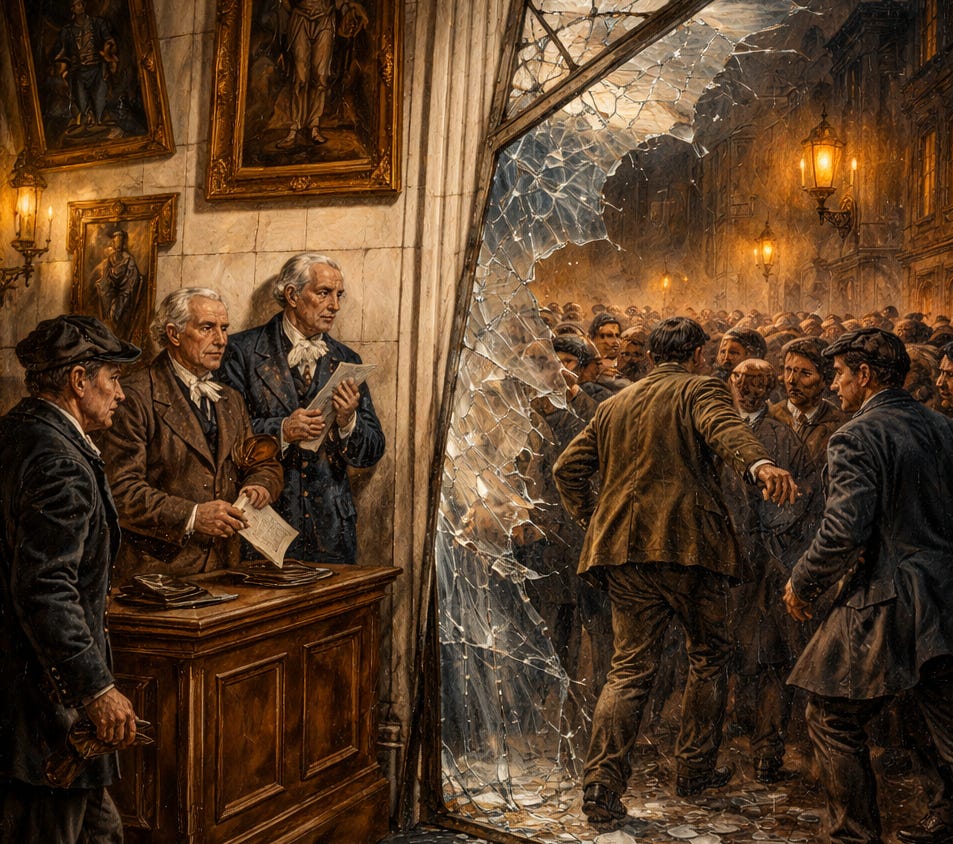
Disorder is not static; it is exploratory. Small transgressions are not harmless—they are signals. If graffiti is tolerated, vandalism follows. If vandalism is ignored, theft follows. If theft is excused, violence arrives. This is not merely how street crime works; it is how radicalisation works. Failure to police early offences does not preserve peace. It manufactures escalation.
Today, the broken windows are rhetorical, institutional, and moral—and Jews are standing directly beneath them.
We are long past the stage where this can be dismissed as a free-speech dilemma. Canada, Britain, and Australia already have the necessary laws. Hate propaganda is criminal. Public threats and incitement are criminal. Calls for the eradication of a people are criminal.
What is absent is not law but resolve. Our police, universities, colleges and public institutions simmer in a murky soup of ambition, cowardice, and antisemitism—no label on the pot, no disclosure of proportions—while they ladle out platitudes to the Jewish community and call it concern.
Chanting “Gas the Jews,” urging “Intifada now,” demanding “From the river to the sea,” calling Jews pedophiles, or depicting them collectively as child-killers are not provocative critiques. They are, in plain legal terms, criminal expressions. The law already recognises this. What has failed is enforcement.
And when the law is not enforced, the first thing that breaks is the window.
Across Canada and the West, the metaphor has become literal. Windows are shattered. Glass is kicked inward. Shards scatter across sidewalks and campuses while authorities stand back, hands folded, assuring the public that the situation is “complex.”
At Toronto Metropolitan University, violent demonstrators attempted to force their way into an Israeli speaker’s event, attacking security while police arrived late and intervened cautiously. Arrests were avoided. Context was cited. “Community relations” were invoked.
At York University, professors hurled red paint—meant to resemble blood—onto a Chapters bookstore and then slipped back into academic life once the glass was swept aside and the paperwork filed. In the United States, a Cornell professor who publicly described the October 7 massacre as “exhilarating” took a short leave before returning to teach, his words treated as protected expression rather than the sharp, cutting incitement to violence that they were.
In British Columbia, at Langara College, a professor who praised the same October 7 atrocities was suspended for months, only to be reinstated after an adjudicator ruled the speech protected and ordered a full return with no sanction. In each case, a window cracked, then broke, and nothing followed except the sound of excuses.
Against this backdrop, the University of Guelph and Humber College stand apart.
To my knowledge, they are the only post-secondary institutions willing to fire a professor for stating support for Israel and accurately describing Hamas as Nazis, while simultaneously tolerating—and actually taking part in by formally aligning themselves with Hamas advocates— enormous amounts of explicit antisemitic rhetoric within their own walls.
Elsewhere, the glass breaks and the crowd advances. Here, the pane is repaired only to punish the wrong person.
These two Canadian institutions may be otherwise unremarkable academic mediocrities. Still, in the Olympics of bigotry, cowardice, and moral acquiescence before a Jew-hating mob, they compete at the highest level.
In Montreal, pro-Palestinian riots have tipped into arson and the burning of vehicles. In Toronto, mezuzahs have been torn from the doors of the elderly. In Europe, synagogues are firebombed and Jewish homes marked as targets. In the United States, mobs occupy university buildings, menace Jewish students, and openly praise mass murder, while administrators haggle over conditions instead of imposing discipline.
This is not a coincidence. It is a sequence.
Broken windows theory was never about vandalism alone. It was about permission. When the first pane is smashed, and nothing happens—no arrest, no sanction, no unequivocal condemnation—the message is received. The shards remain on the ground. The crack spreads. What begins as words becomes motion; what begins as chant becomes shove; what begins as intimidation becomes assault. Each unpunished act tells the next actor that the barrier is already fractured.
This is why claims that a mall must eject someone wearing an IDF hoodie “for safety reasons” are legally and logically inverted. The safety risk does not originate with the individual standing quietly beneath intact glass. It originates with the crowd that has already learned it may break things with impunity. Punishing the visible minority while indulging the threatening majority is not risk management. It is capitulation.
The law is not absent. It is simply being looked through—like a window already shattered, its frame still standing, its function gone.
And that refusal is habitually justified as prudence.
I have watched police stand by while these chants are shouted, while threats are made, while intimidation unfolds—again and again. This happens in Australia. It happens in Canada. It happens in Britain. The pattern is consistent: the law exists, the authority exists, but enforcement is withheld out of fear—fear of backlash, fear of unrest, fear of being accused of bias. But mostly fear of upsetting those people who seem to live on the precipice of violence in their rallies.
This is not neutrality. It is moral cowardice dressed up as wisdom.
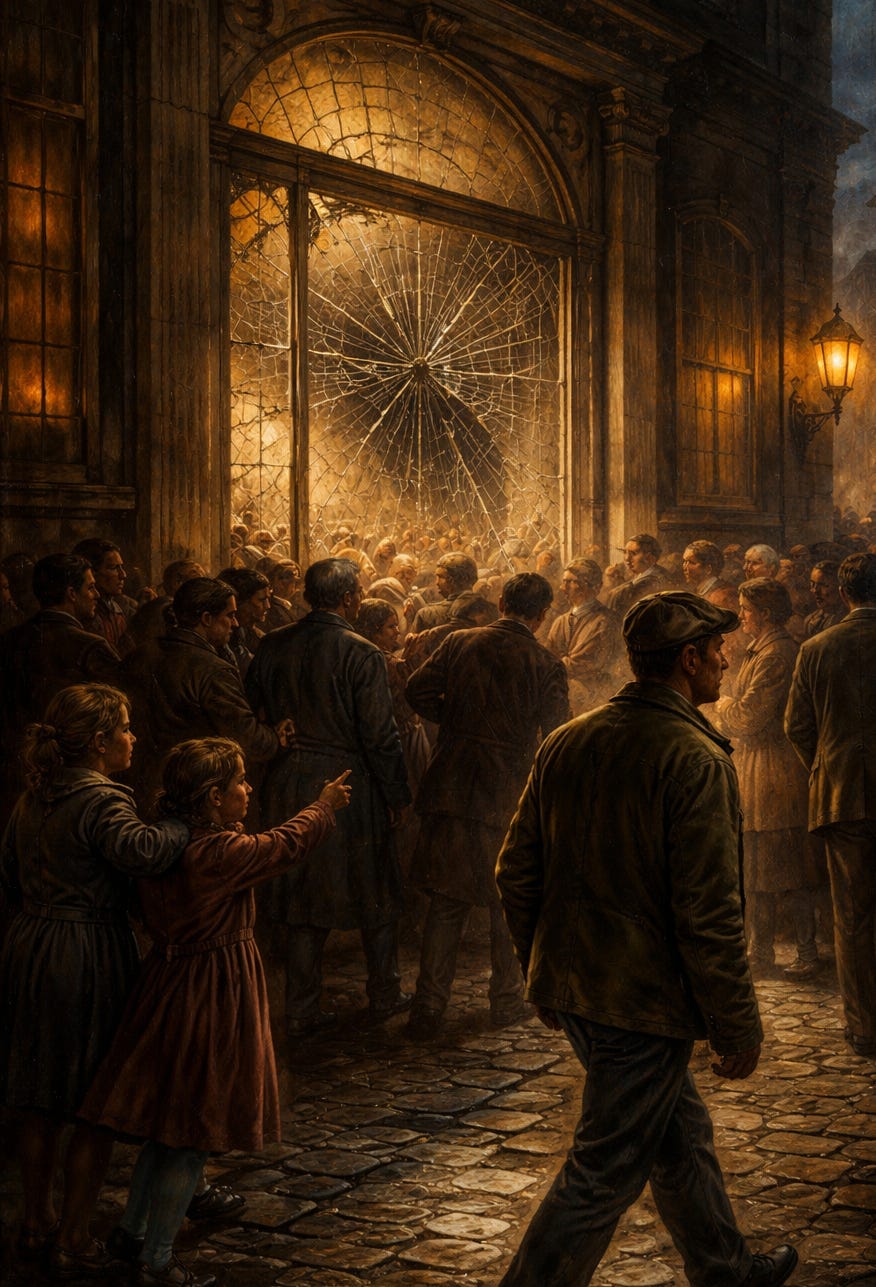
The ancients understood this dynamic long before modern bureaucracies learned to call paralysis “restraint.”
Publilius Syrus, a Roman writer and moralist of the first century BCE, put it with brutal clarity: he who spares the guilty injures the innocent.
Non-enforcement is not a restraint. It is harmful. When the state declines to act against those who violate the law, it transfers the cost of that decision onto those who obey it—the innocent pay for the indulgence of the guilty.
We are told that enforcing the law will make things worse, that intervention will inflame tensions, and that stepping back is the responsible course. But a society that refuses to enforce its own rules out of fear of reaction has already abandoned the rule of law—not dramatically, but quietly. Law does not disappear all at once. It erodes.
This abdication now extends beyond rhetoric and into physical space.
Blocking streets, blocking pedestrian traffic, kneeling for false prayer in the middle of malls or transit corridors—these are not ancient customs suddenly rediscovered. They did not happen ten years ago. They are not spontaneous acts of devotion. People are free to pray in their homes. They are free to pray in their places of worship. That freedom has never been in question.
What is new is the assertion that religious identity grants a license to seize public space, disrupt civic order, and impose oneself on others at will.
That, too, is a broken window.
Public prayer that deliberately obstructs public life has nothing to do with God. It has nothing to do with spirituality. It is a political act—a declaration of dominance. It says: we will do what we want, where we want, and you will accommodate us. It says we are next on their list. It is a threat, not a prayer, or perhaps a prayer that begs God for violence to be meted out upon the Dhimmi world.
And it continues for one reason only: it is tolerated. What is tolerated becomes normalised.
What is normalised escalates.
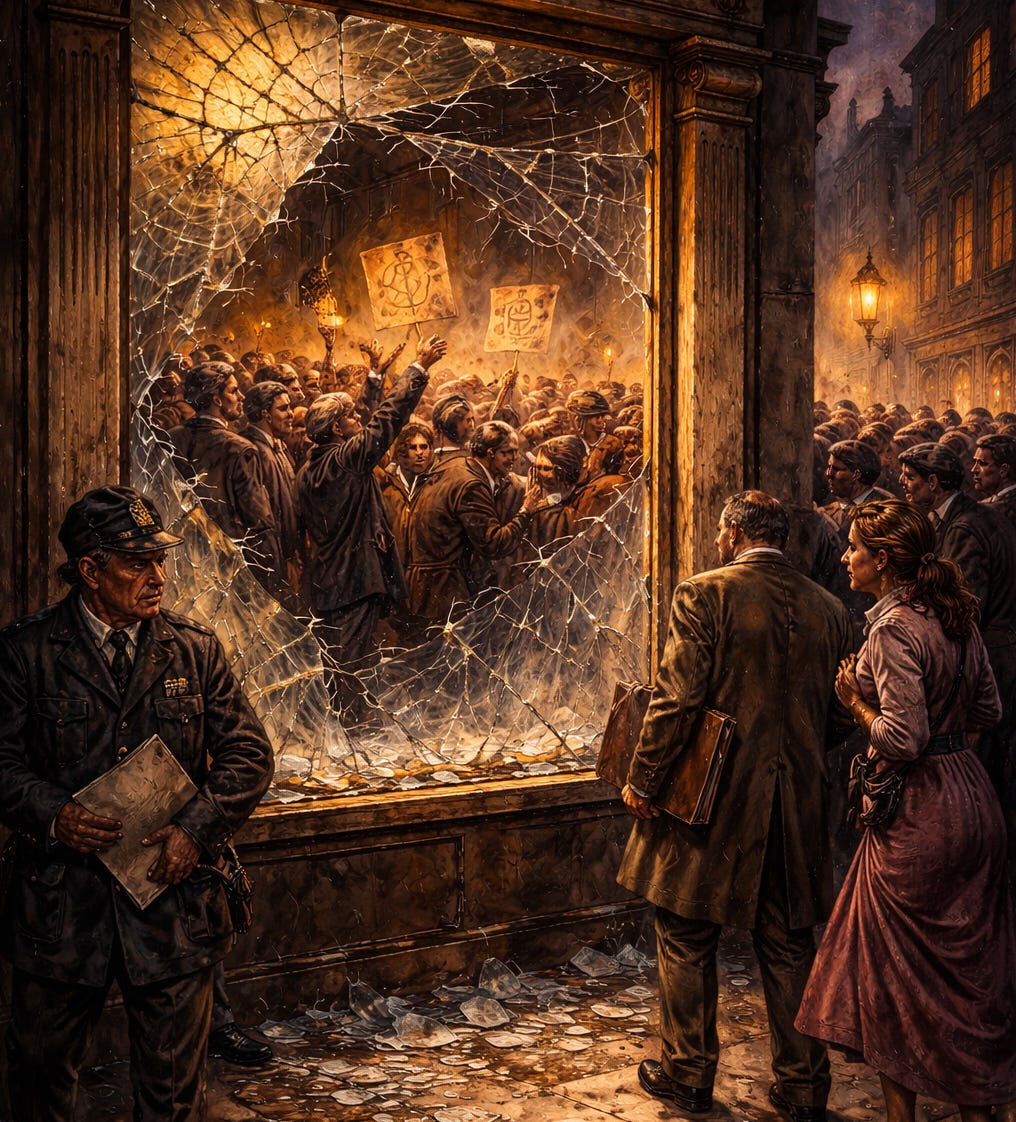
The media reinforce this abdication.
Canadian media outlets—CBC, CTV, the Globe and Mail, Toronto Star, Global TV and even the National Post—have displayed a remarkable unwillingness to name antisemitism when it appears in modern ideological costume.
When a paramedic in North York accused Jews of luring children to a dump in Gaza to murder them—a grotesque fabrication and a modern echo of medieval blood libel—the dominant media instinct was not to stress the criminal seriousness of the allegation. It was to express sympathy for her professional consequences.
The content of the claim—explicit dehumanisation of Jews—was treated as secondary.
But that claim was not merely offensive. It was hate propaganda, clearly covered by the Criminal Code (318, 319). The failure to say so was not journalistic caution. It was moral anaesthesia. Another window left unrepaired.
Universities have followed the same path, with even greater zeal.
On Canadian campuses—including my own—this progressed well beyond insinuation. Professors publicly referred to Jews as Untermenschen - subhuman.
They describe Jews as devil-worshippers and Satanists. They alleged collective Jewish collaboration with the Nazis. These are not private remarks, nor errors corrected in hindsight. They are stated openly, by faculty who ally with administrators exercising institutional authority. Senior administrators and “human rights” officers are informed. No corrective action follows.
My termination for being the one voice standing up to the institutional chorus of Jew hate was not exceptional, but becoming the norm where institutions arrest and punish not the violators, but those who dare stand up to them.
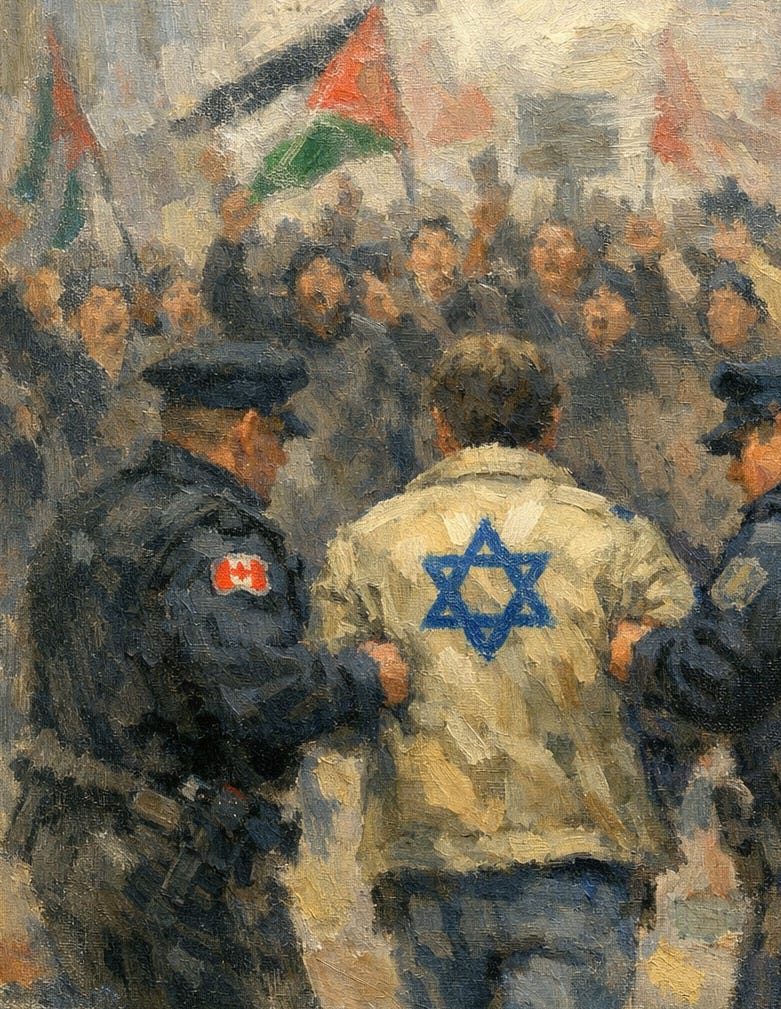
Indeed, Jews and those visibly aligned with Israel have been detained, questioned, or removed for nothing more than being present. In Britain, a man wearing a Star of David was arrested on the theory that visibility itself constituted provocation. In Canada, Jewish bystanders have been dispersed or detained while doing nothing at all, even as nearby crowds engaged in threats and destruction were managed with conspicuous restraint.
The signal could not be clearer: one side is licensed to shatter the air with menace, while the other is disciplined for existing. Presence becomes guilt. Identity becomes the offence.
This is the predictable outcome of selective enforcement dressed up as sensitivity. Human rights law, when enforced by discretion rather than principle, becomes capricious law. It teaches crowds how far they may go by showing them what will not be punished. Each unbroken window invites another stone. Each tolerated threat sharpens the next. And when the law finally descends, it does so not on those who shattered the glass, but on those who dared to stand behind it.
Once such a message is sent, escalation follows logic, not emotion. If the penalty exists only on one side of the moral ledger, the other side will advance. People learn that rhetoric is safe.
Then threats.
Then intimidation.
Then harassment.
Then violence, beating up a Jew, throwing a rock through a synagogue window, ripping off a mezuzah from a door.
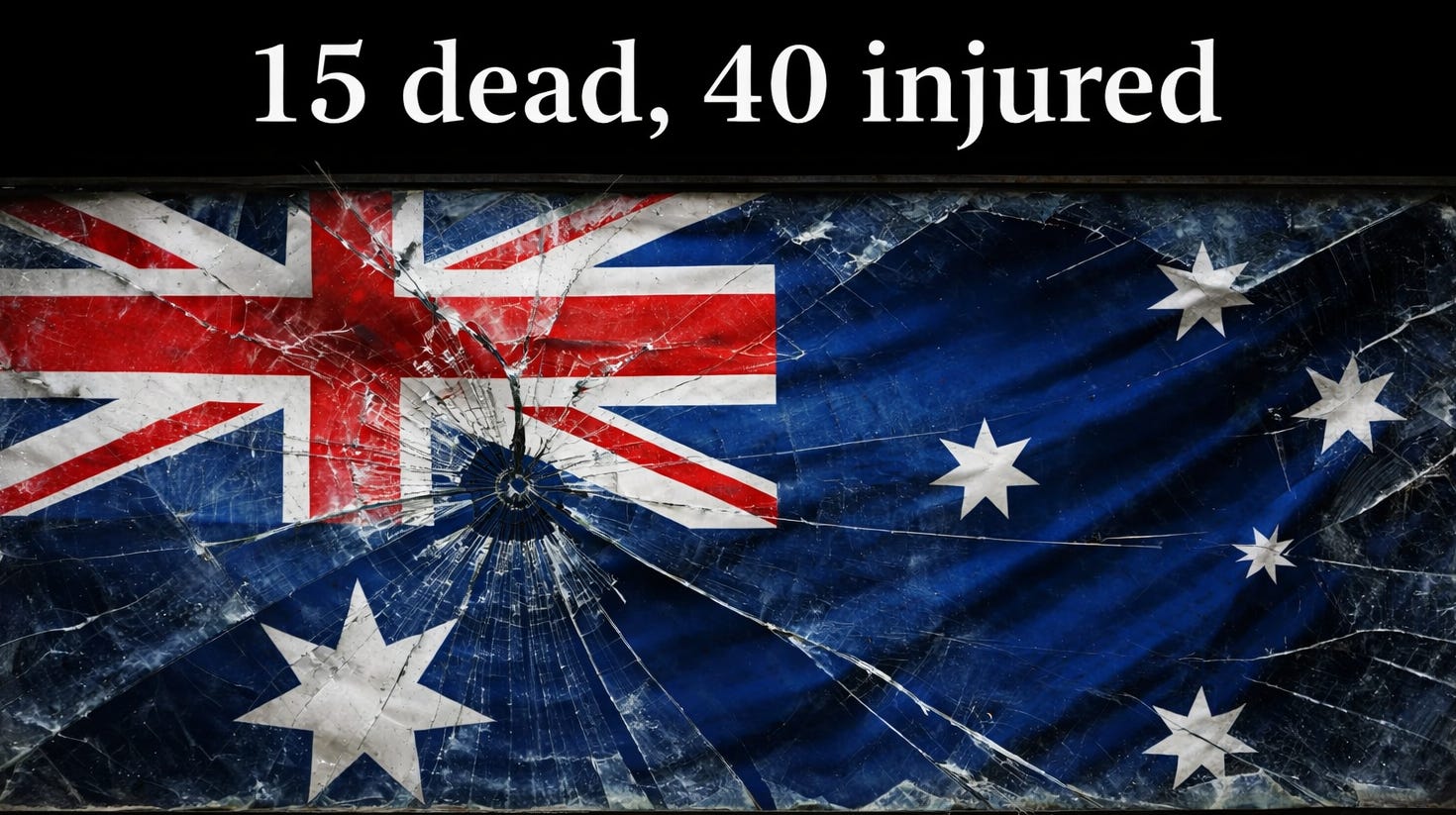
Then, shooting 10-year-olds and their families off a small bridge overlooking a beach at a Hanukkah celebration.
Institutions and politicians reassure themselves that they will intervene when it goes too far. By then, the line has already moved. What will be too far in a year?
Will the murder of two Jews be permissible, it is not three, they will say, will the smashing of Jewish-owned store windows be okay as long as they don’t light a fire?
And this is where clarity matters most. When people say there will be more Bondi Beaches, this is not cynical despair about a society “going to hell.”
It is not prophecy. It is not hysteria. It is an empirical, psychological assessment of how human beings behave when boundaries are removed.
Broken windows theory is not moral commentary; it is predictive.
The allowance of violations, the allowance of violent threats, and the allowance of hate propaganda are not isolated errors. They are leading indicators.
There will be more Bondi Beaches if this continues. Not because people are uniquely evil, but because institutions have chosen not to enforce the rules that restrain ordinary human behaviour. That is what broken windows theory says. That is what psychology confirms. That is what history records.
After Kristallnacht, no one was confused about what broken windows really meant.
Tomorrow I am going to the mall, and I’m wearing an IDF hoodie, not as a provocation. Not to test a theory. But as a simple civic fact: in a civil society, as a civilian walking the streets, I am allowed to wear an IDF hoodie.
If that lawful act brings about threats or violence, I have not provoked anything. I have simply exercised a freedom that belongs to me as a Canadian citizen, and one I am not prepared to relinquish because our streets are now treated as the property of violent, threatening, antisemitic hooligans.
I’ll let you know how it goes.
P.S. On my way into the mall to see my jeweller, I received word that a friend of thirty years had died suddenly in the night. The news emptied me. Whatever armour one carries falls away at such moments. There were tears at the counter, and no room left for performance.
My condolences to the family and friends of Dave Teeuwen—his wife, Patty; his children, Christian and Katy; his brothers, Ryan, Mike, and Matt; and his parents, Connie and Leo. Too young. Too sudden. May the brokenhearted find mercy.
Consider leaving a tip. I am looking to buy some IDF gear.
So beautiful! Thank you so much for moral clarily and courage. Let your friend's memory forever be a blessing
So very sorry about your dear friend. May his memory be a blessing.