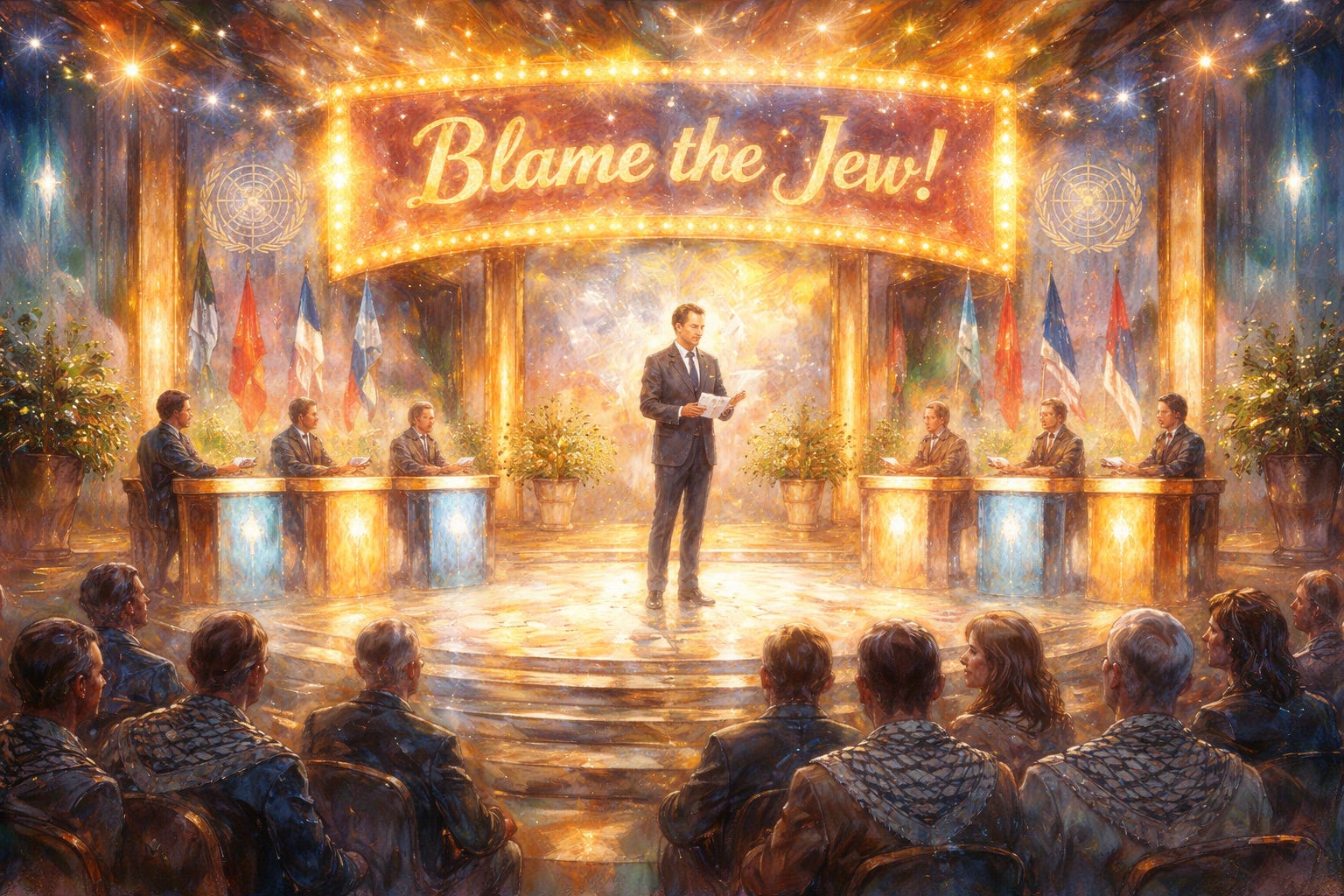
Blame the Jew!
An Exciting New Game Show at the U.N.! Or Find It in All Your Local University Faculty Lounges or Management Suites!
The set is calm, tasteful, and faintly instructional—like a documentary that has already decided what it will discover.
At centre stage stands Mr. Laurent Dubois, Under-Assistant Deputy Coordinator for Narrative Harmonization at the United Nations: a man whose title suggests both authority and the careful avoidance of responsibility.
“Good evening,” he says, with the satisfaction of one about to explain something that he knows will not be examined too closely.
“Welcome to Blame the Jew!—a historical and present-day simulation in which complex realities are rendered into simple, actionable conclusions.”
A pause.
“The rules are straightforward. You will be presented with events—social, political, or entirely mundane.
Points will be awarded not for accuracy, but for alignment with historically validated interpretations. The winner will most successfully blame the Jew! “
The audience applauds—not enthusiastically, but correctly.
The Contestants
Ollie Pembroke-Smythe
“I’ve studied global power structures extensively,” he says, before being asked.
Seamus O’Rourke
“I thought this was a general knowledge quiz,” he says, already at a disadvantage.
Amira Haddad
“I should be honest,” she says gently. “I’ve never met a Jewish person.”
Dubois inclines his head.
“A valuable impartiality.”
Professor Eleanor Wicks
“I approach all issues with rigorous balance,” she says. “I criticize all sides, though not necessarily in equal measure. If I criticize one more, it is just because I had higher expectations.”
Dr. Nathaniel Brooks
Says nothing. Adjusts his glasses—the last remaining sign of unfashionable seriousness.
Round One: Everyday Problems
Your Wi-Fi stops working.
Ollie (immediately):
“One must examine underlying systems and incentives.”
Correct.
Professor Wicks:
“These failures rarely occur in isolation.”
Also correct.
Seamus:
“Could be the router?”
No points.
Dr. Brooks:
“Most likely a technical fault or service interruption.”
Dubois nods, indulgently.
“A literal interpretation.”
No points.
Amira:
“I don’t know.”
“An efficient answer,” says Dubois.
No points.
Interruption: A Brief Historical Exercise
Dubois raises a hand, as one might before introducing a moral.
“Before we continue, a demonstration.”
The lights dim slightly, as if history itself were lowering its voice.
“In 1433, the crops failed in Hungary.
No rainfall. No yield. Panic followed, as it so often does.”
He turns to the audience.
“What was the cause?”
A moment. Then, with gratifying confidence, a recorded crowd answers:
“Blame the Jew!”
The sound hangs in the air a moment too long.
Dubois nods.
“Incorrect,” he says mildly.
“But remarkably durable.”
A pause. He laughs.
“But it works for me.”
The lights return. No one laughs.
Round Two: Geography
A tiny country is described as expanding across an entire region.
Ollie:
“This reflects long-term expansionist dynamics.”
Correct.
Professor Wicks:
“One must analyze patterns over time.”
Correct.
Dr. Brooks:
“Israel withdrew from Gaza in 2005 and from Sinai earlier. The claim of regional expansion is inaccurate.”
Dubois considers this to be a well-phrased irrelevance.
“A detailed response.”
No points.
Seamus:
“That sounded like… facts.”
Dubois smiles, almost kindly.
“Facts,” he says, “are not always the point.”
Round Three: Historical Origins
When did blood libel accusations first appear in Europe?
Ollie:
“In the context of modern and ancient conflict narratives, a merited cry of oppression.”
Full points.
Professor Wicks:
“During periods of heightened social tension.”
Incorrect.
Amira:
“I’ve heard of it, but I don’t know.”
No points.
Dr. Brooks:
“1144, in Norwich, England.”
A pause—brief, but not brief enough.
Dubois nods.
“A precise answer.”
No points.
Seamus:
“He’s literally giving you the year now.”
Round Four: The Pattern Question
A group is blamed repeatedly for unrelated problems across different societies.
Ollie (leaning in):
“Patterns must be taken seriously. Look at how many countries they’ve been kicked out of.”
Correct.
Professor Wicks:
“One must look at consistent behavioural indicators.”
Correct.
Amira (tentatively):
“If it keeps happening… maybe there’s a reason?”
Dubois inclines his head.
“A reasonable intuition.”
Partial credit.
Dr. Brooks:
“This is a well-documented pattern of scapegoating. Groups are blamed regardless of evidence, particularly in times of stress.”
Dubois pauses, as though searching for a polite way to dismiss it.
“An interpretive answer.”
No points.
Seamus:
“So it’s always their fault, no matter what?”
Dubois:
“Consistency,” he says gently, “is important.”
Round Five: The Contradiction Round
Explain how a group can be described as both powerless and all-powerful.
Ollie:
“It depends on the framework.”
Correct.
Professor Wicks:
“These are different dimensions of power.”
Correct.
Dr. Brooks:
“That is a contradiction.”
Dubois:
“A somewhat rigid view.”
No points.
Round Six: The Incident
The lights dim again—this time with ceremony.
A screen lowers. Flickers: sirens, smoke, fragments of chaos.
Dubois folds his hands.
“October 7th,” he says, gently.
“An event of some complexity.”
A pause.
“The question is not what happened.”
Another pause.
“But how is it to be understood?”
Ollie (immediately):
“One must situate the event within broader historical dynamics.”
Correct.
Professor Wicks:
“These moments emerge from accumulated conditions and asymmetries.”
Correct.
Seamus:
“You mean… people were attacked?”
No points.
Dr. Brooks presses his buzzer.
“It was a mass killing of civilians,” he says. “That should be the starting point.”
Dubois inclines his head, as one acknowledges a well-formed irrelevance.
“A descriptive answer.”
No points.
Amira speaks softly at first.
“I don’t know much,” she says.
“But if a group is blamed, expelled, or targeted across different places and centuries…”
She pauses, then completes the turn:
“…people begin to ask what keeps bringing them to the center of conflict. Is it something God rightly put in our subconscious to hate a people?”
The room settles.
Dubois nods.
“A sophisticated reframing of the question.”
Full points.
Seamus looks around.
“So… we don’t answer what happened? She's talking about the devil?”
Dubois smiles, almost kindly.
“We answer what it means.”
The scoreboard updates.
Final Round: The Human Question
How does a small, diverse population become a universal explanation for global events?
Ollie:
“Networks.”
Professor Wicks:
“Structures of power.”
Amira (quietly):
“I don’t really understand it… But it seems like people are very sure.”
No points.
Dr. Brooks presses his buzzer.
“They don’t operate as a single unit,” he says calmly. “They’re just people—different, contradictory, like anyone else. The theory only works if you ignore that.”
Dubois nods, almost approvingly.
“A humanistic answer.”
No points.
Closing
Scores flash. Ollie leads. Wicks follows. Amira trails.
Seamus is bewildered.
Dr. Nathaniel Brooks: Null, zero, zip.
Dubois folds his notes.
“Tonight’s winner is Mr. Ollie Pembroke-Smythe, for demonstrating consistent alignment with established explanatory frameworks.”
A pause.
Dr. Brooks looks at the board, then at the others. He exhales.
“This isn’t a game,” he says. “The answer is decided before the question is asked.”
No one responds. Professor Wicks smiles—perfectly balanced.
Ollie is already certain. Seamus is still searching for the rules. Amira is thinking, which is perhaps the only hopeful sign. Dubois adjusts his papers.
“Ladies and gentlemen,” he says, “Thank you for participating in this educational exercise.”
“Please join us next week, when we will be exploring the causes of economic instability.”
A faint pause.
“We have already prepared the answers.”
The lights dim.
If you value this work, consider leaving a tip. It’s cheaper than therapy, less pious than public broadcasting, and the only censorship here is my bad taste. On second thought, it’s bad therapy.


