


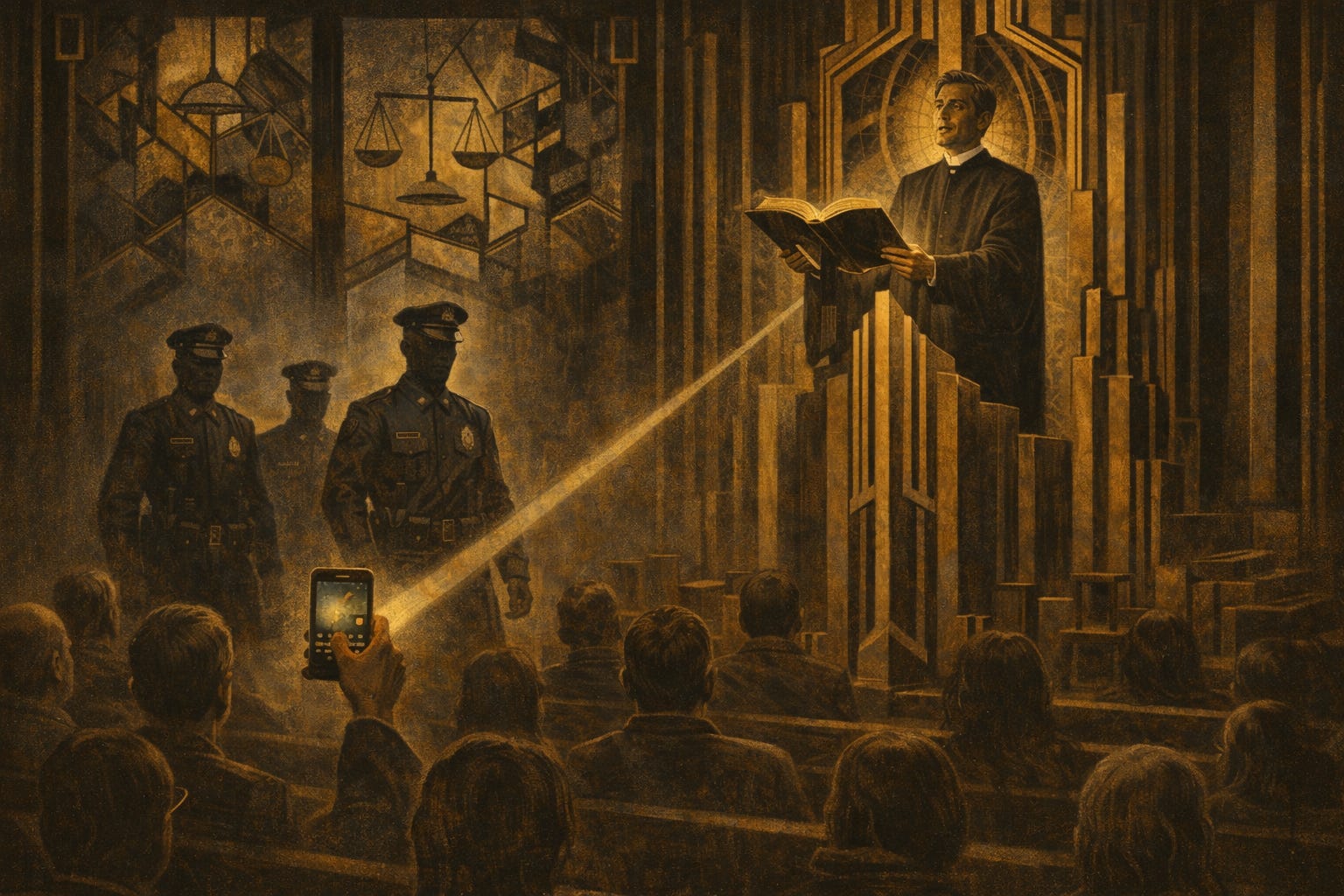
It begins, as these things often do, not with a riot or a revolution, but with a sermon. A quiet Sunday morning at a church in Calgary.
A congregation gathers, the songs and welcome are over, and the sermon commences. A minister stands, not as an agitator but as a custodian of something older than the room itself. He knows—because one would have to be wilfully blind not to know—that what he is about to say is out of step with the present age.
“I know this is not popular,” he says. “But this is what the Word of God says.”
He proceeds carefully. He speaks about conduct, about sin, about moral order. He refers to passages that describe certain acts as wrong, perhaps even “abominable.” He touches on roles—men and women, authority and submission. There is no call to violence, no incitement, no theatrical rage. Only the stubborn articulation of a belief system that has declined to modernize itself.
But somewhere in the pews, someone is recording.
And then, the doors open. The police are here.
The interruption is not dramatic in the cinematic sense. No shouting, no chaos. Just the quiet intrusion of authority. A complaint has been made. Words have been spoken. A threshold—somewhere, in someone’s judgment—has been crossed. The minister is politely informed that he is now part of a process. He is taken away.
Yes, in Canada.
This scenario will be dismissed by many as exaggerated. It will be called alarmist, hyperbolic, perhaps even paranoid.
But the question is not whether it is likely.
The question is whether it is possible.
And under Bill C-9, the answer is yes.
To understand why, one must begin with what the bill actually does. It has passed the House of Commons and now sits before the Senate. It has not yet completed the legislative process, but there is no indication that its central change will be reversed. And that change is not obscure.
The Criminal Code once contained a defence—narrow, qualified, but real—that allowed a person to express, in good faith, an opinion based on a religious text without automatically falling into the machinery of hate speech prosecution.
It did not protect against threats. It did not excuse violence. But it acknowledged that religious traditions contain judgments—about behaviour, morality and human roles—that do not always align with contemporary norms.
Bill C-9 removes that defence.
It does not replace it. It does not refine it. It simply removes it and leaves nothing in its place.
There is no clause protecting sermons. No provision shielding religious instruction. No protection of prayer. No recognition, anywhere in the text, that speech occurring within worship occupies a distinct legal category.
The law does not exempt churches, mosques or synagogues.
It says nothing at all—and in law, silence of this kind is not neutrality. It is exposure.
It is the siren call of a capricious nymph—deciding, on a whim, which ships glide by untouched and which are pulled in and shattered on her jagged rocks.
From this, the consequences follow.
If the standard remains the “wilful promotion of hatred” against an identifiable group—and it does—, and if there is no longer a religious defence, then the rule applies everywhere. It applies to newspapers and podcasts, to classrooms and street corners, and, yes, to places of worship. The law does not recognize sacred space as a boundary.
Which means that there can be illegal sermons. A minister can be arrested mid-sermon; an imam mid-prayer; a rabbi mid-instruction. Not because religion has been outlawed, but because it has been stripped of any explicit protection as religion.
You say it will not happen? Really? You ask, “Why is your weak faith in discretion so blinding you?”
The question is not what will happen in the best case. It is what the law permits in the worst case. A mature legal order does not rely on goodwill to prevent misuse. It relies on clear boundaries.
And here, the boundary has been removed.
There is no indication that the state intends to monitor sermons or plant officials in places of worship. But it does not need to.
In a complaint-driven system, enforcement requires only a listener. If an individual chooses to attend a service, record what is said and file a complaint, there is nothing in the law's structure that prevents it. No clause that says, “this context is off-limits.” Once the complaint is made, the machinery begins to turn.
Nor is this an entirely theoretical concern.
In other liberal democracies—most notably the United Kingdom and Ireland—there have been cases in which individuals have been approached by police over speech, sometimes at their homes, sometimes at points of entry.
One widely discussed case involved an Irish writer being met by multiple officers at an airport over remarks deemed offensive. The specifics of such cases may be debated, but the underlying lesson is not difficult to discern: once speech becomes a matter for policing, the threshold for intervention tends to drift.
Canada is not identical to those jurisdictions. But the logic is not foreign.
And the process itself does not begin at the highest levels of government. Hate propaganda prosecutions may ultimately require the Attorney General's consent, but the earlier stages—the complaint, the investigation, the visit—can begin without such oversight. It is not a system of centralized restraint. It is a system of distributed discretion.
Which is to say: a system that depends on judgment.
And judgment, in practice, depends on people.
This is further complicated by the direction of Canadian constitutional reasoning. In Quebec (Attorney General) v. Kanyinda, the Supreme Court emphasized that the law must consider not only intent, but effects—whether a rule or expression contributes to disadvantage.
Once that lens is applied to speech, the inquiry shifts. It is no longer simply what was meant, but what is perceived to be done.
And once that becomes the governing question, the origin of the speech—religious or otherwise—offers no automatic protection.

Religious traditions, across Christianity, Judaism, and Islam, contain passages that, when translated into modern statements about identifiable groups, can be read as exclusionary or offensive. Historically, the law acknowledged this reality and allowed a narrow defence. Under Bill C-9, that acknowledgement is withdrawn.
Yet any system that relies on discretion will, inevitably, be applied unevenly. Not because the statute commands it, but because human systems are not perfectly neutral. They respond to pressure. They reflect incentives. They act where it is easiest, least costly and where the resistance is lowest.
This is what is meant by capricious law—not law that is random, but law whose application depends on shifting conditions rather than fixed boundaries.
And if one doubts that political considerations enter into such processes, one might recall the candid observation of Liberal Minister Mélanie Joly: “Have you seen my riding?”
(She was implicitly saying that she had many Arabs in her riding and she was not able to take a pro-Israel position)
It is a revealing remark, because it dispenses with the fiction that policy is always driven by abstract principle. It acknowledges, instead, that politics—like all human systems—responds to incentives.
If enforcement follows incentives, it will not be perfectly even. It never is.
Which is why this change is not only unnecessary but unwise.
Canada already has laws against incitement to violence. Those laws are clear. They are sufficient. They draw the line where it matters—at the point where speech becomes action. If someone calls for harm, prosecute them. If someone threatens violence, stop them.
What is not required is the removal of a longstanding protection in favour of a system that says, in effect, “We will decide later.”
Because that is what this becomes.
Speak, if you wish.
Preach, if you must.
Quote, if you believe it to be true.
But understand:
Whether you were permitted to do so will not be decided in advance.
It will be decided afterward.
And if you believe that such a system will be applied with perfect neutrality, untouched by pressure, politics, or human inclination, then you possess a faith far greater than anything expressed from the pulpit.
My prediction is not dramatic. It is cautious.
This will not end well.
These texts are not crimes. But under a regime without a religious defence, their direct modern application to identifiable groups is no longer buffered by statute—it is judged, instead, after the fact.
This law is written in bad faith. It is a sop to the Muslim electorate and the ‘progressive’ illiberal left and will be selectively enforced against Jews and Christians to gain electoral Liberal advantage.
Already, I have friends who have seen signs that proclaim “All Jews are Pedophiles” put up by known offenders at Bathurst and Sheppard.
The police in this case declined to follow up. It was Hate Propaganda - a criminal offence. But Muslim agitators once again have been implicitly granted a hate crime exception clause. Why would C-9 change this?
Last week, police escorted a violent pro-Palestinian mob through a Jewish neighbourhood in Toronto.
Conduct that, under existing law, should already have triggered scrutiny was instead facilitated. That alone should give pause to anyone who believes new discretionary powers will be applied evenly or cautiously.
C-9 will not operate in a vacuum. It will be interpreted, enforced, and—inevitably—selectively applied by institutions that have already shown a willingness to look away in some cases and intervene aggressively in others.
That is not speculation. It is a pattern.
And behind it all lies something even more troubling: the astonishing hubris. Judges and politicians now position themselves to sit in judgment over what millions regard as sacred—texts, traditions, and convictions grounded in the divine—subjecting them to standards that shift with politics, pressure, and fashion.
What is held to be eternal is weighed against what is plainly temporary and found wanting.
Such power will not remain neutral. It rarely does. It will be used—sometimes to punish, sometimes to signal virtue, sometimes to appease constituencies—but always with consequences that extend far beyond its stated purpose.
History offers a consistent warning. When a society becomes comfortable applying its laws unevenly—when certain groups are exposed while others are shielded—it is not long before that imbalance spreads.
The erosion does not announce itself all at once. It begins with selective enforcement, quiet exceptions, and the belief that this time will be different.
And yet this motion will pass—carried along by a compliant, ideologically aligned Senate—with scarcely a blush.
Those who have shown so little restraint, so little consistency, now step forward draped in borrowed moral authority—assuming trust where none has been earned, claiming discretion where none has been demonstrated. They do not persuade; they presume.
They do not earn judgment; they assert it. The arrogance is not incidental—it is foundational. And in a system that will depend entirely on their judgment, that arrogance is not merely troubling. It is oppressive.
A preacher once told me that even Satan has the good sense to dress as an angel of light—and that his followers, naturally, come dressed as servants of righteousness.1
Maybe I could be prosecuted for that statement? But not today, the bill has not passed.
———
Illustrative passages that could create legal exposure if asserted as present-day prescriptions about identifiable groups:
Torah / Old Testament (Judaism & Christianity)
Leviticus 20:13 — punishment for homosexual acts
Leviticus 18:22 — “abomination” language
Deuteronomy 20:16–17 — commands to destroy populations
Exodus 21:20–21 — treatment of servants
Psalm 137:9 — violent retribution imagery
New Testament (Christianity)
Romans 1:26–27 — “unnatural” relations
1 Corinthians 6:9–10 — exclusionary moral lists
1 Timothy 2:12 — limits on women’s authority
Ephesians 5:22–24 — hierarchical marital structure
Revelation (various passages) — judgment and destruction themes
Quran (Islam)
Surah 9:5 — fighting polytheists (context-dependent)
Surah 8:12 — wartime violence language
Surah 4:89 — apostasy-related language
Surah 2:191 — conflict directives
Surah 4:34 — discipline within the household
If you found value in this article and wish to support my ongoing work, please consider leaving a tip. Your support helps me continue producing uncensored content on critical issuesHappy Easter / Belated Passover Greetings
2 Cor 11:14-15
Yes, this is what is coming. As you predict, I expect it to be used against Christians with Muslims getting a pass.
The problem is not the removal of a good faith expression of religious texts in C9, but the hate speech legislation itself.
We should not be policing speech at all. As you say we already have protection for when speech turns into conduct: "They draw the line where it matters—at the point where speech becomes action. If someone calls for harm, prosecute them. If someone threatens violence, stop them."
In a free society the government should not be adjudicating what is acceptable speech. Sometimes is is necessary and proper to express scorn, derision, and yes even HATE for the behavior of certain people or even groups.
Reading the BC Human Rights Tribunal decision against Barry Neufeld and the Supreme Court decisions referenced in there is truly shocking. I don't think average Canadians understand how bad it is.
Excellent and this C9 is seriously toxic. If it passes and made into law, one of my main priorities in life will be working to have it rescinded.
All Canadians who respect and value freedom and natural rights should join the Free Speech Union Canada.