


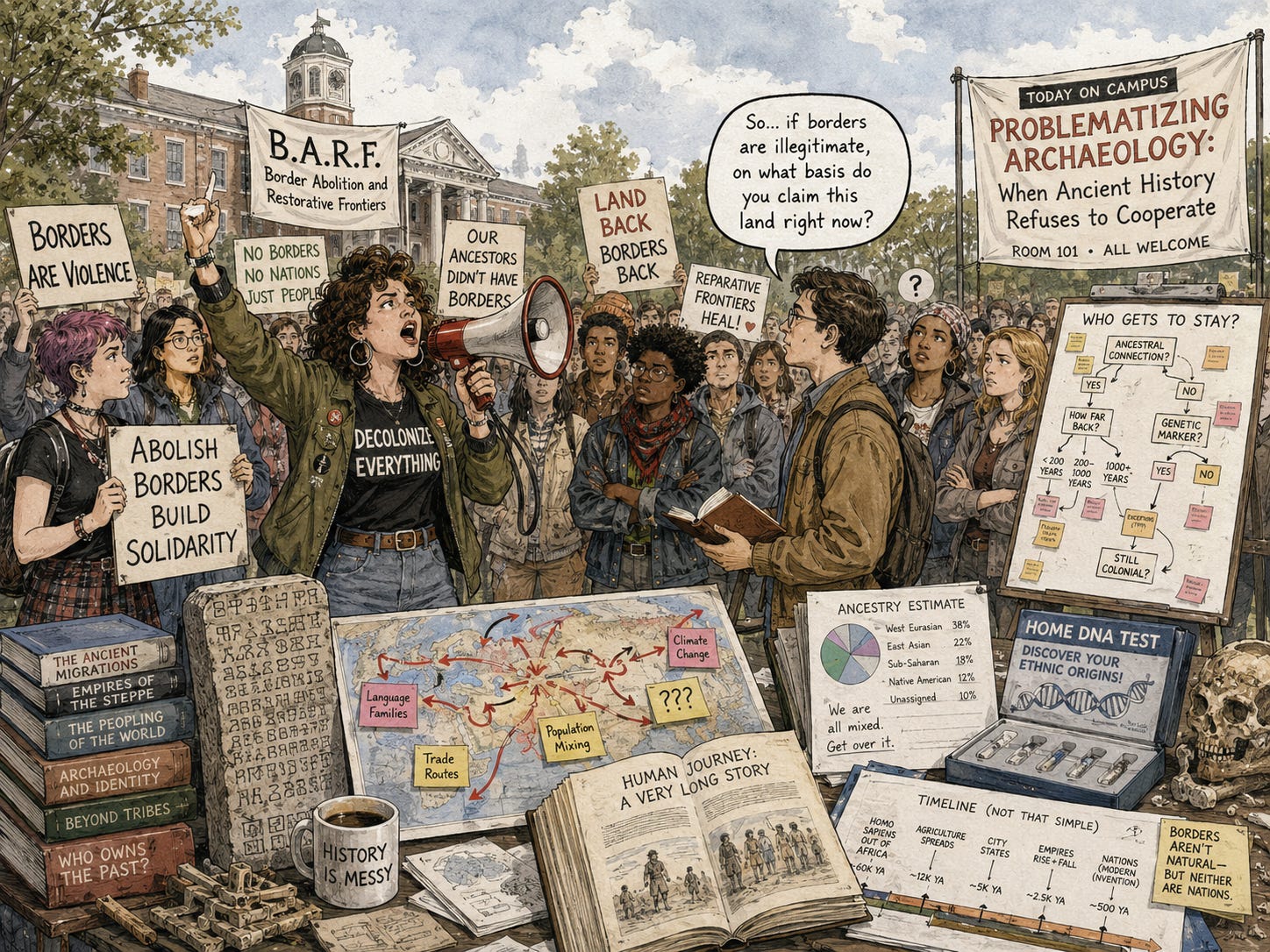
It began, as many moral catastrophes do, with a campus protest, a megaphone, and several people who had recently learned the phrase “settler colonialism” and were now determined to apply it to everything except their own rent-controlled apartments.
The target, naturally, was Israel.
A coalition of activists, professors, NGO consultants, professional sign-holders, blue-haired beauties, revolutionary poets, and people with nose rings named after emotions formed a new organization: B.A.R.F.
Officially, it stood for the Border Abolition and Restorative Frontiers movement.
Unofficially, it stood for what most normal people felt like doing after listening to them for more than six minutes.
B.A.R.F.’s founding principle was simple: Israel was illegitimate because it was built on “stolen land.”
This claim was presented as self-evident. No historical complexity was required. No comparison with other countries was necessary. No examination of empires, migrations, wars, expulsions, purchases, treaties, partitions, exiles, returns, or ancient peoples was allowed. Israel was uniquely guilty because Israel was always uniquely guilty. Just ask the chanting girl in the orange pants who is paid $18/hr to show up for the rallies.
The slogan was clean. The accusation was powerful. The posters were already printed.
Then someone made the mistake of asking a question.
“What about the Jews?”
The room shifted uneasily.
The questioner continued, which was rude.
“What about the archaeological evidence? The ancient Hebrew inscriptions? The kingdoms of Israel and Judah? The attachment to Jerusalem? The exile? The centuries of prayer toward Zion? The fact that Jewish identity is tied to that land going back thousands of years?”
This created a serious problem.
Not a moral problem, obviously. B.A.R.F. had long ago outsourced morality to slogans.
It created a messaging problem.
Because if ancient connection to land mattered, the Jews had one.
If exile mattered, the Jews had one.
If return mattered, the Jews had one.
If historical memory mattered, the Jews had been carrying it around for so long it practically needed its own overhead compartment.
This was intolerable.
So B.A.R.F. convened an emergency conference titled:
Problematizing Archaeology: When Ancient History Refuses to Vote Correctly.
The first speaker explained that archaeology was useful when it supported oppressed peoples, but dangerous when it supported Jews. The second speaker clarified that indigeneity was not about history, blood, culture, memory, religion, language, exile, return, or continuity, but about “positionality.” The third speaker admitted that “positionality” meant “who we currently like.”
This was received with a standing ovation.
But the damage had been done.
The activists had opened a door they could not close. If Israel was illegitimate because people had moved, fought, returned, settled, displaced, and built political institutions on contested land, then the next question was obvious.
What country was not illegitimate?
At first, B.A.R.F. resisted the question. It was not helpful. It lacked nuance. It centred the wrong voices. It was probably funded by someone. But the question would not go away.
So the movement expanded its mission.
Israel was no longer the problem. Borders were the problem.
All borders.
Every country on earth was now placed under review.
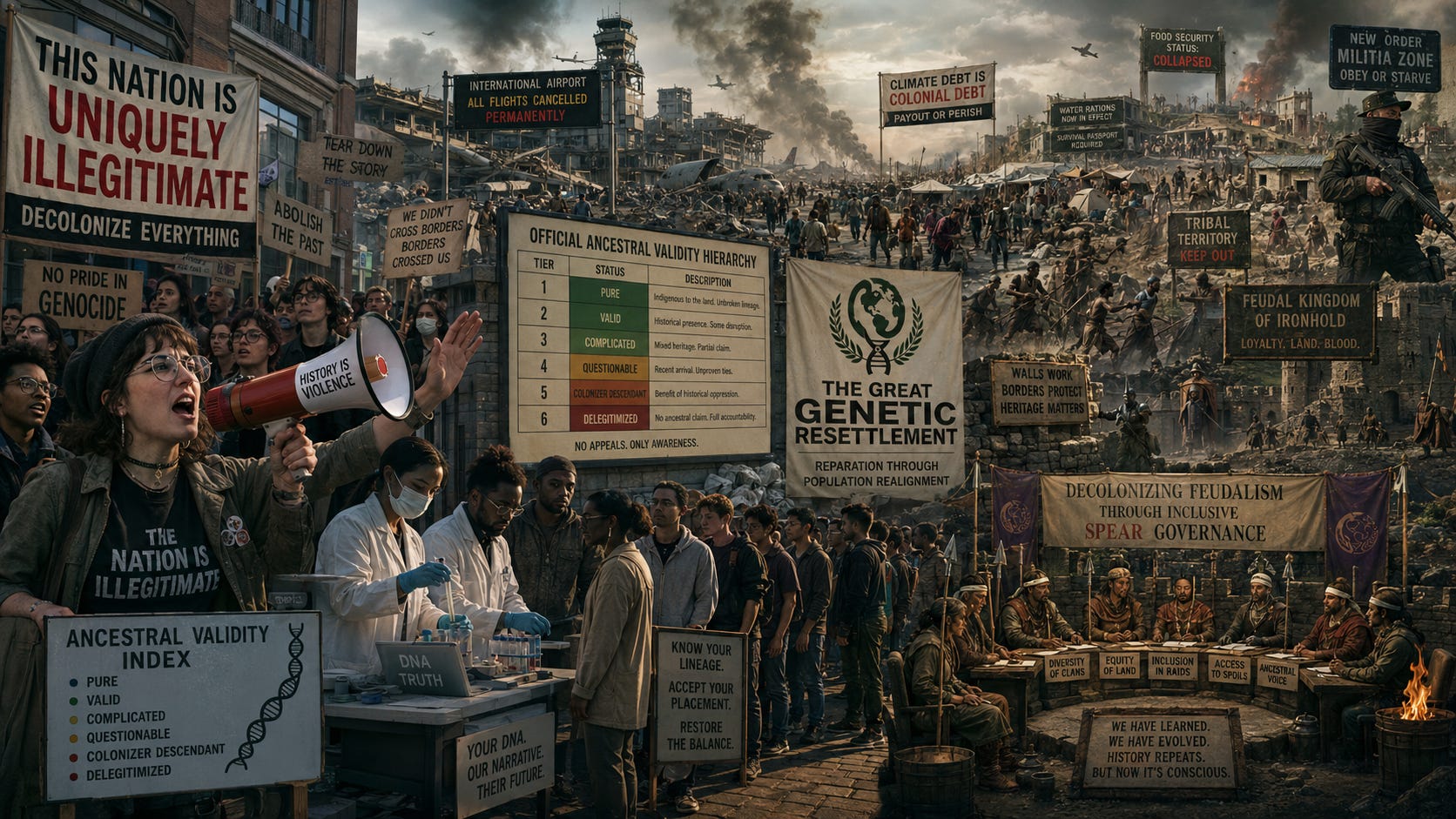
The new initiative was called The Great Genetic Resettlement.
Its purpose was to determine who truly belonged where. Every human being would submit DNA, family records, oral tradition, baptismal certificates, suspiciously confident grandmother stories, and any available 23andMe screenshots. Then B.A.R.F. would determine each person’s proper ancestral homeland and send them back.
This was hailed as visionary.
It was, in fact, insane.
But it had a logo.
The first difficulty was Europe.
The French were not originally French enough. The English were a disaster. The Normans had barged in. The Saxons had barged in before them. The Vikings had barged in on everyone, mostly for exercise. The Romans had barged in wearing sandals and administrative competence. The Celts had claims. The pre-Celts had claims. The people before the pre-Celts could not be reached, but B.A.R.F. felt strongly that their silence should be centered.
Ireland became especially complicated.
One man claimed his family had been there since 1300.
B.A.R.F. replied, “That’s basically Tuesday.”
He asked how far back he needed to go.
“Before harm,” said the committee.
“When was that?”
The committee took a trauma-informed pause.
The Turks were asked to explain Anatolia and responded by not attending the panel. The Hungarians were told to return east, though no one could agree how far. The Italians were divided among Romans, Etruscans, Greeks, Lombards, Ostrogoths, and one man from New Jersey who insisted he had a spiritual claim to the Amalfi Coast.
The Dutch said they could not leave the Netherlands because they had personally rescued much of it from the sea, and if land reclamation did not count as original occupancy, then frankly, the sea should have filed earlier. A tuna wearing a keffiyeh filed an objection.
The committee marked this as “problematic hydrological entitlement.”
Then came North America.
Here, B.A.R.F. expected clarity. Here, surely, the settler-colonial framework would work cleanly. There would be the original people, then the settlers, then guilt, then grants.
Unfortunately, one junior anthropologist, who had not yet learned that facts must pass through ideology before being spoken aloud, mentioned ancient migration across the land bridge.
The room froze. Someone dropped a gluten-free muffin.
A senior activist whispered, “Are you saying Indigenous peoples also came from somewhere?”
No one wanted to answer.
Because if migration made a person illegitimate, then the accusation eventually swallowed everyone.
If arrival were a crime, everyone would be guilty.
If prior presence was the only valid claim, then every group had to keep moving backward in time, chasing the ghost of someone who had arrived before them.
And if everyone had to go back far enough, the entire human race would eventually be standing somewhere in Africa with a clipboard, a grievance, and a very confused moving company.
This was not the outcome B.A.R.F. had intended.
The point of “settler colonialism,” after all, was not to describe the full complexity of human history. That would require humility, patience, and reading books without underlining only the angry parts.
The point was to create a moral weapon.
A magic phrase. A secular curse.
Once someone was called a settler-colonialist, you no longer had to understand them or pretend to listen. You no longer had to argue with them. You no longer had to examine competing claims, historical context, or inconvenient evidence. The accusation itself did all the work.
It was like yelling “witch,” but with footnotes.
The trouble with magic words, however, is that they sometimes escape.
Soon, everyone was accusing everyone else.
The Welsh accused the English.
The English accused the Normans.
The Normans accused the Vikings.
The Vikings accused the Saxons, but cheerfully.
The Saxons accused the Romans.
The Romans accused the Greeks.
The Greeks accused the Persians.
The Persians accused the Macedonians.
The Macedonians asked whether Alexander was available for comment.
The Arabs, Turks, Kurds, Armenians, Greeks, Jews, Persians, Assyrians, Copts, Berbers, and every other people with a history longer than a pamphlet entered the discussion, at which point the Middle East became less a region than a graduate seminar with swords.
By the end of the week, every nation on earth had been declared illegitimate.
Canada? Settler-colonial.
The United States? Settler-colonial with extra cup holders.
Australia? Settler-colonial in bold font.
France? Settler-colonial but with better cheese.
England? Settler-colonial and somehow still smug.
Turkey? Settler-colonial with a very complicated filing cabinet.
Russia? Settler-colonial and currently expanding the definition in real time.
China? Settler-colonial, imperial, civilizational, and not taking questions.
Mexico? Complicated.
Spain? Very complicated.
Everyone? Extremely complicated.
This should have produced reflection.
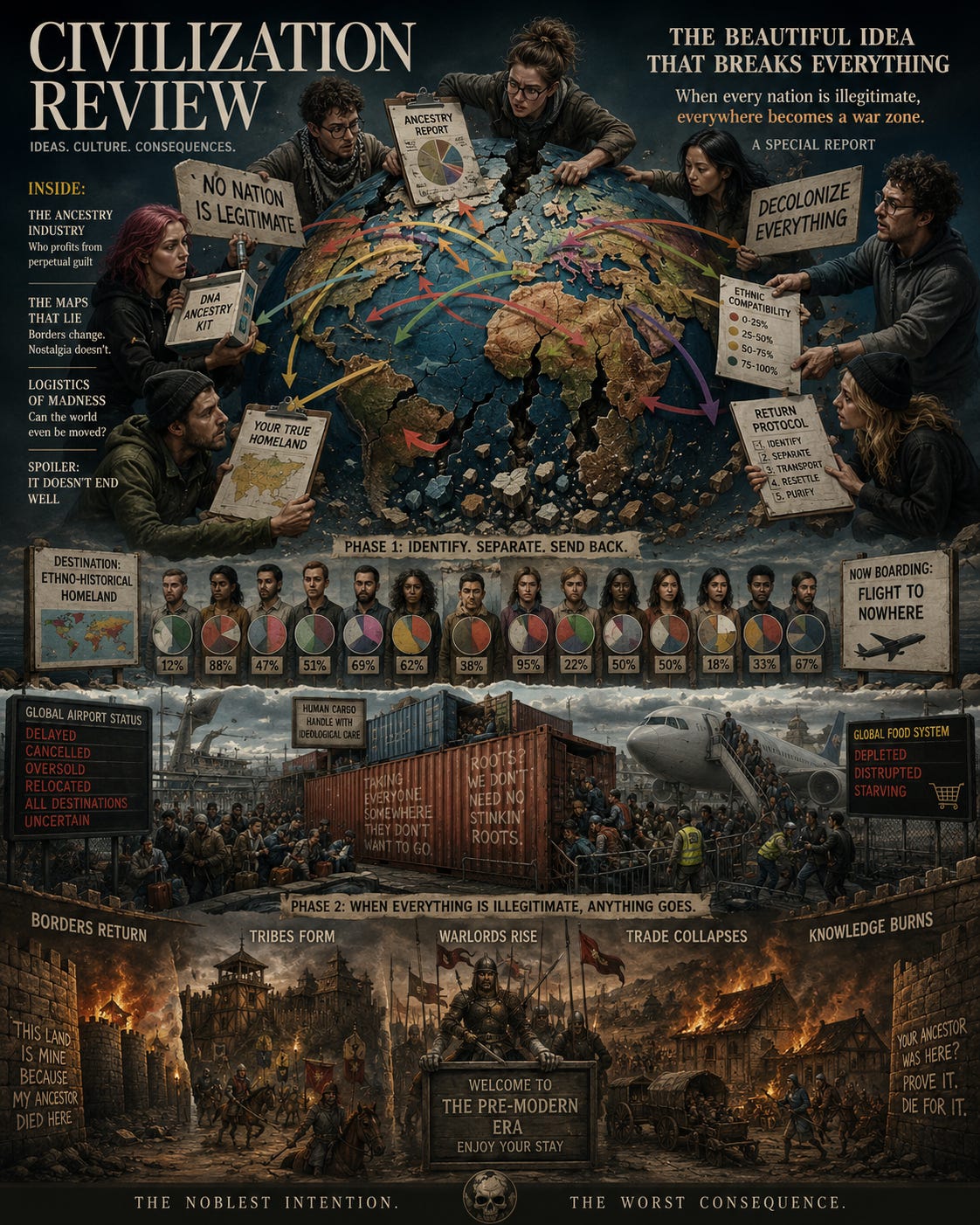
Instead, B.A.R.F. produced a chart.
The chart ranked human beings by ancestral validity. At the top were those with the earliest claim to any given plot of land. Beneath them were later arrivals, then mixed arrivals, then conquerors, then returnees, then people whose ancestors moved for economic reasons, then people who had married into the wrong side of history, then Canadians who said “my family came here for a better life” and were immediately escorted from the room.
The plan was simple: the earliest claimants would receive the best land.
Rivers. Harbours. Fertile valleys. Mediterranean climates. Walkable neighbourhoods.
Later claimants would receive bogs, tundra, former industrial parks, and parts of Winnipeg in February.
Mixed-ancestry people posed a challenge. B.A.R.F. initially proposed dividing them proportionally among ancestral territories. A woman who was 38 percent Irish, 22 percent Scottish, 17 percent French, 11 percent Scandinavian, 8 percent “broadly northwestern European,” and 4 percent “surprise” was assigned to spend Mondays in Cork, Tuesdays in Inverness, alternate Wednesdays in Normandy, and one long weekend per year feeling Viking vaguely.
This was called justice.
Logistics proved difficult.
Billions of people had to move. Entire continents began packing. Airports collapsed. Shipping routes failed. Food supply chains dissolved. Hospitals ran out of staff because half the surgeons had been reassigned to Bronze Age Anatolia. Universities closed briefly, then reopened as Centers for Applied Collapse Studies.
Courts tried to intervene, but courts were instruments of colonial legality.
Property records were abolished, since property was violence.
This created excitement at first, especially among people who did not own anything.
Then they discovered that food is also, in a sense, property.
Things deteriorated.
Without property, farms stopped producing.
Without farms, cities stopped eating.
Without police, “community-led safety” became a six-person committee asking the largest man on the block to please process his anger less physically.
Without borders, armed groups discovered there was nothing preventing them from creating new borders.
Without states, people reinvented the tribe.
Without courts, they reinvented revenge.
Without parliaments, they reinvented councils of elders.
Without the police, they reinvented men with sticks.
Without taxation, they reinvented tribute.
Without constitutions, they reinvented whichever cousin had the most goats and the fewest moral hesitations.
Within six months, the world had achieved B.A.R.F.’s dream.
The nation-state was gone.
Unfortunately, it had been replaced by billions of dead, seven warlords, clans, militias, fortified villages, hereditary grievances, and something called the Free People’s Restorative Onion Collective, which lasted three days before being conquered by a neighbouring beet commune.
Humanity had abolished modern borders and rediscovered ancient ones.
The new map was refreshingly organic. It was also full of fires and rotting bodies.
Soon the tribes became chiefdoms. The chiefdoms became kingdoms. The kingdoms built walls. The walls required guards. The guards required payment. Payment required taxes. Taxes required administration. Administration required records. Records required borders.
The whole thing was starting to look suspiciously like civilization again, only worse and with fewer antibiotics.
After all the seminars, chants, encampments, manifestos, land acknowledgments, and academic articles about dismantling oppressive structures, humanity had successfully moved backward about 1,500 years.
Kings returned.
Priests returned.
Armies returned.
Borders returned.
So did famine, superstition, blood feuds, and the exciting possibility of dying from an infected splinter.
B.A.R.F.’s final surviving committee met in what had once been a luxury conference center but was now the fortified hill-kingdom of Gavin the Unpleasant.
The chair, still wearing her original lanyard, gave the closing remarks.
“Mistakes were made,” she said.
This was the first true thing anyone in B.A.R.F. had ever said.
She explained that the theory had not failed. The theory was beautiful. The theory was liberating. The theory had merely been implemented by insufficiently decolonized people who selfishly wanted food, shelter, order, medicine, and to avoid being raided by Gavin.
A new report was commissioned.
Its title was:
After the Nation-State: Decolonizing Feudalism Through Inclusive Spear Governance.
A grant application followed.
The first sentence read:
“Now that humanity has been liberated from the artificial violence of borders, our next task is to problematize the emerging harms of moat-based exclusion.”
And so, after abolishing the modern world in the name of justice, B.A.R.F. began again.
The tribes became kingdoms.
The kingdoms became empires.
The empires drew borders.
The borders became nations.
The nations became universities.
The universities produced activists.
The activists discovered settler colonialism.
And somewhere, 1,500 years later, a young person with a megaphone stood on a campus lawn and announced that Israel was uniquely illegitimate.
Oops. Been there.

Fun read and good satiric illustation of the absurdity of it all, with focus on the nonsense hurled at Israel as a "colonialist state" guilty of genocide, apartheid, and ethnic cleansing. The brain addled haters operate under the following construct: Israel and Jews are bad, any fact to the contrary must be ignored.
Kinda like the irony of you using AI for the illustrations but at the same time it's also annoyingly contradictory. AI is the ultimate settle-colonialist!
Actually this was pretty hilarious. I almost cracked a smile! ARGH!!!!