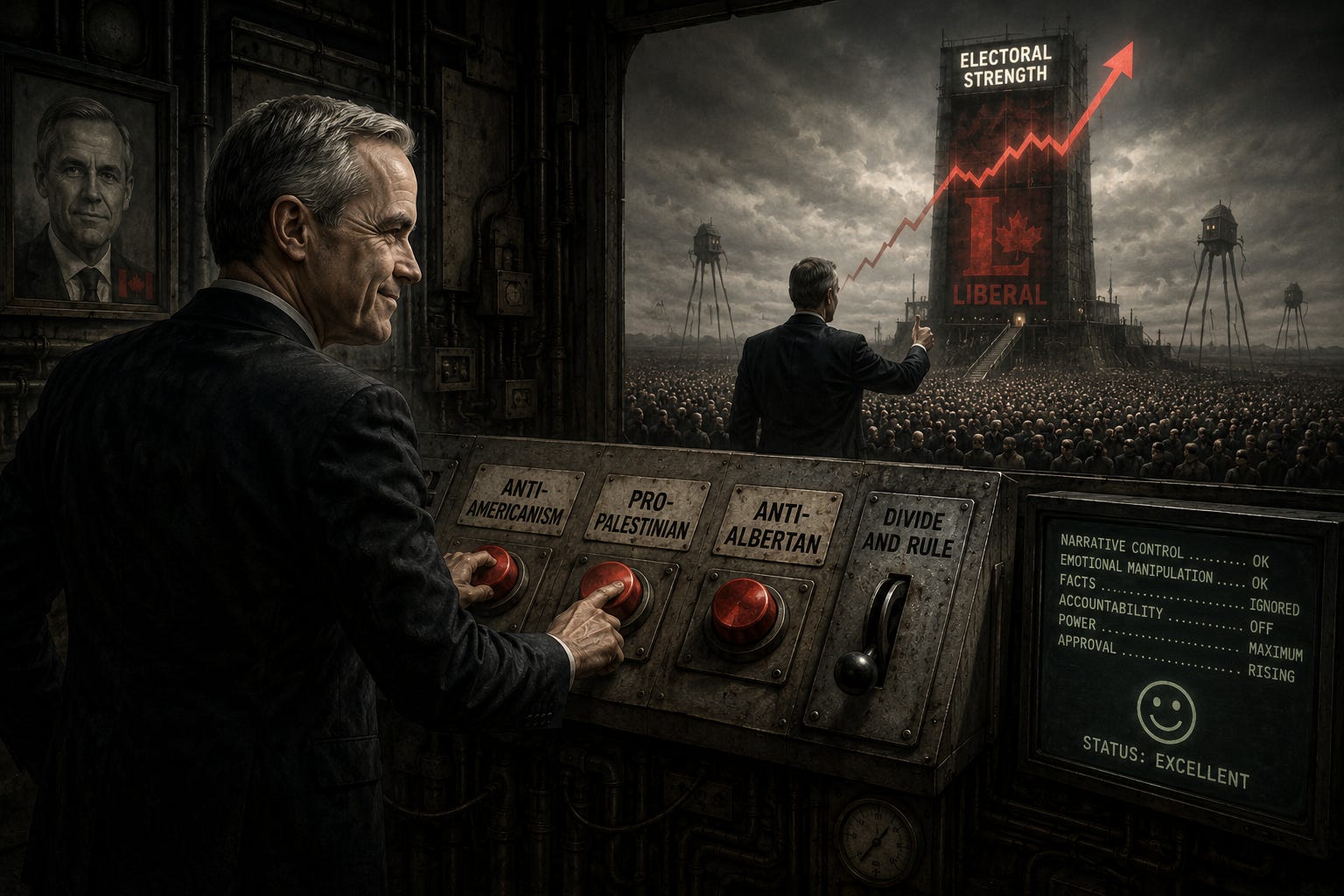
Carney senses grievance the way a shark senses blood in water. He understands symbolism more deeply than substance. He knows that in a country increasingly driven not by policy literacy but by branding, image, tribal identity, and emotional atmospherics, the politician who controls the narrative controls the country.
And Mark Carney may prove to be the most sophisticated practitioner of that politics Canada has ever seen.
Observe the extraordinary sleight of hand now underway.
Canada remains structurally, geographically, economically, and infrastructurally tied to the United States. Roughly three-quarters of Canadian trade flows south. Our pipelines, manufacturing supply chains, energy corridors, transportation systems, and industrial ecosystems were built over generations around continental integration with America.
This is not ideology. It is arithmetic.
Yet Carney has managed to transform a failure to secure stability with our overwhelmingly dominant trading partner into a nationalist branding exercise. Instead of resolving the dependency, he repackages it. Instead of reducing uncertainty, he monetizes it politically.
The message is essentially this: Canada can “pivot” away from the United States toward alternative markets as though decades of structural integration can simply be replaced by rhetoric, aspiration, and press conferences.
It is fantasy economics sold as moral courage.
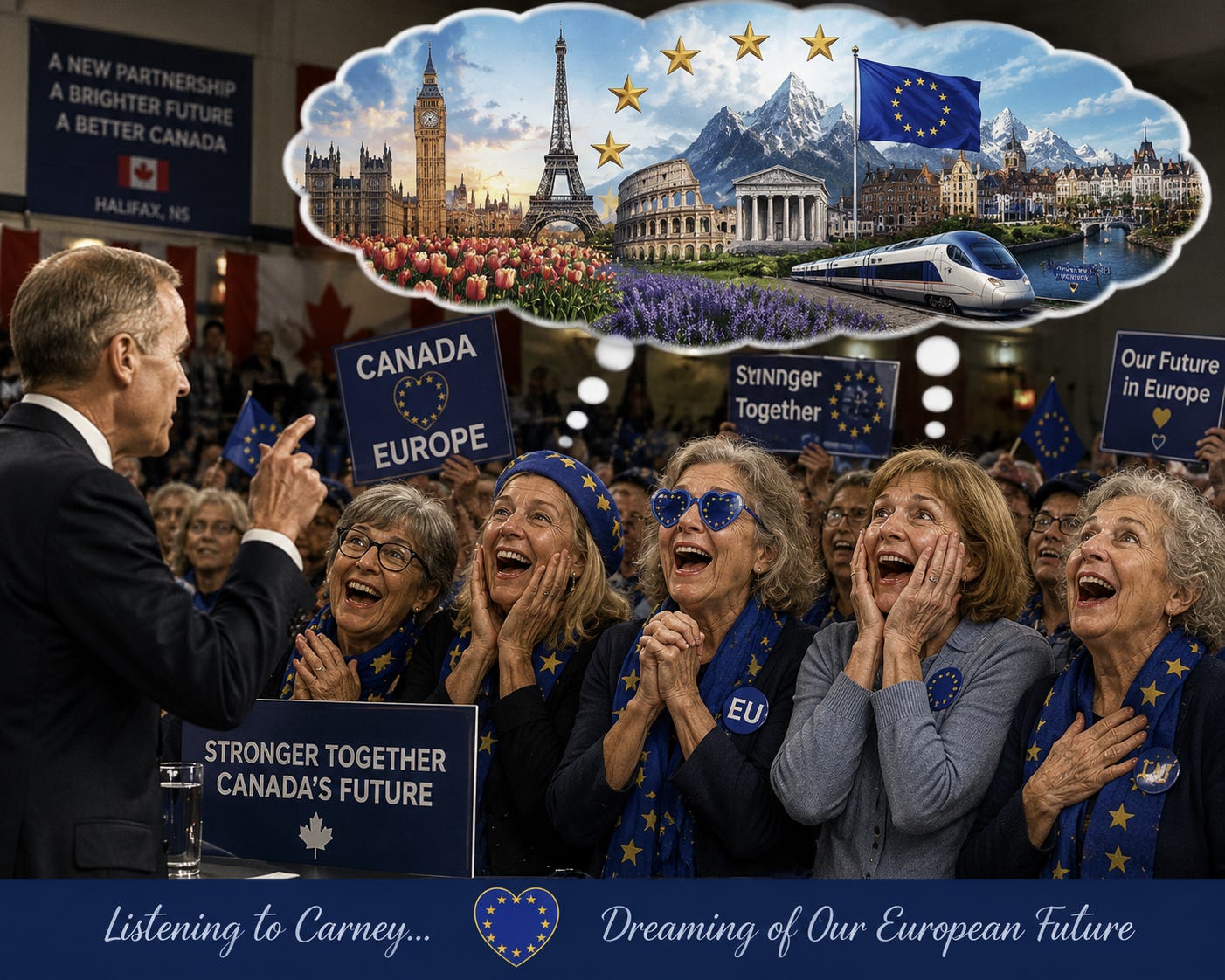
And now comes the newest fantasy whispered into elite Canadian discourse: deeper integration with Europe, even flirtations with the idea of Canada somehow “joining” Europe politically or economically in a far more formal sense.
The idea is almost comically detached from Canadian reality.
Canada is not Belgium. We are not geographically, economically, politically, or structurally integrated into Europe. Our economy is built around North American energy, manufacturing, logistics, agriculture, and continental trade flows. Radically pivoting away from the United States toward Brussels-centred governance structures would not be an act of sophistication. It would be an act of economic self-harm on a staggering scale.
But the fantasy sells because modern politics increasingly operates through aesthetics and emotional association rather than hard structural thinking.