


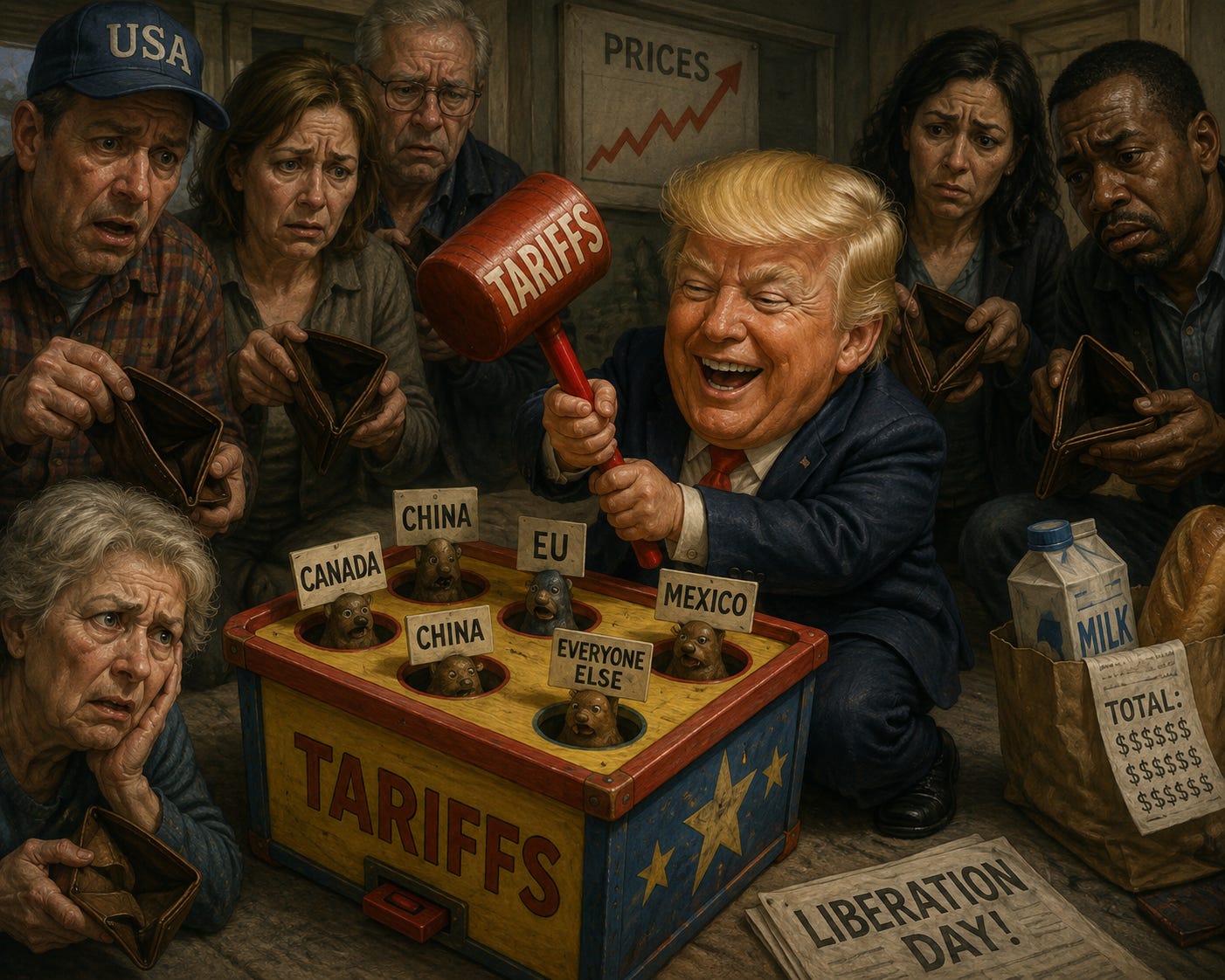
Donald Trump called April 2, 2025, “Liberation Day.” It was one of those phrases that only Trump could have invented: grandiose, theatrical, and so disproportionate to the event that it bordered on parody.
America was apparently about to be liberated. From what? Cheap goods? Efficient supply chains? Comparative advantage? The freedom of American consumers and businesses to buy things from whichever producer could make them best and cheapest?
“Liberation Day” would have been more accurately named Stupid Taxation Day.
More than a year later, we have enough evidence to judge Trump’s experiment against the standards Trump himself established for it. Tariffs were going to bring manufacturing back to America. They were going to reduce America’s enormous trade imbalances. Foreigners were going to pay them. They were going to usher in a new American industrial golden age.
So where is it?
At some point even Donald Trump ought to be capable of uttering three of the most difficult words in the English language: I was wrong.
The theory presented to Americans was wonderfully simple. America imports too much because foreigners have taken advantage of it. Tax foreign goods heavily enough and companies will manufacture those products in America. Factories will reopen, manufacturing employment will soar, and industrial America will rise from the dead.
There is only one annoying problem: it hasn’t happened.
Manufacturing did not suddenly become a larger part of the American economy after Liberation Day. Manufacturing employment weakened through much of 2025 rather than experiencing anything resembling the promised renaissance. There have been genuine bright spots in industrial production and particular industries, and Trump’s defenders are entitled to point to them. But this was not advertised as a program to produce a few bright spots. It was advertised as the rebirth of American manufacturing.
Perhaps there is a simpler explanation for why Americans buy so many things from abroad: it makes economic sense.
If an American company can purchase a component from Canada for $80 but manufacturing it domestically costs $110, imposing a $40 tariff makes the $110 American product suddenly look competitive.
But nothing has become more efficient. The American producer hasn’t improved, and the Canadian producer hasn’t worsened. Government has simply converted an $80 economic choice into a $110 one.
Congratulations. American manufacturing has been “protected.” America is also $30 poorer.
This is the basic principle of comparative advantage. Nations prosper by producing things they are relatively good at producing and trading for things others produce more efficiently. If Donald Trump had his genome sequenced, scientists would discover a previously unknown chromosome: WIN/LOSE.
He is convinced that if America imports $100 from another country and exports only $70, the other country has apparently beaten America 100–70.
But commerce is not the Super Bowl. The American who bought the imported television preferred the television to his money. The foreign manufacturer preferred the money to the television. Both sides believed themselves better off. That is why the transaction occurred.
This is where the story becomes particularly awkward. As former Statistics Canada chief economic analyst Philip Cross has pointed out in the National Post, America’s current-account deficit has grown enormously since Trump first entered office, from roughly $0.4 trillion to around $1.2 trillion.
The current account is broader than the familiar trade deficit, incorporating trade in goods and services as well as international income flows. More importantly, America’s trade deficits have a financial counterpart: capital flows into America. Foreigners who accumulate dollars buy Treasury securities, American stocks, businesses and other assets. The United States attracts staggering amounts of foreign capital because the world considers America an extraordinarily attractive place to invest. That is hardly evidence of American weakness.
Those capital inflows also support the dollar. A stronger dollar makes imports cheaper for Americans while making American exports more expensive abroad. Trump therefore wants several things simultaneously that work against one another: America as the world’s premier destination for capital, a powerful dollar, vastly greater exports and vastly fewer imports. Economics stubbornly refuses to make all four wishes come true simultaneously.
There is an even simpler embarrassment. America’s goods deficit reached roughly $1.24 trillion in 2025. The overall goods-and-services deficit declined slightly, from about $903.5 billion in 2024 to $901.5 billion in 2025, but that improvement reflected America’s strength in services offsetting deterioration in goods. The goods deficit itself increased.
This is rather inconvenient for an economic revolution directed overwhelmingly at imported goods. Trump put tariffs on goods to fix the goods trade problem. America subsequently recorded a goods deficit of roughly $1.24 trillion.
Some liberation.
There are legitimate qualifications. World trade is not perfectly free. China subsidizes industries, has engaged in intellectual-property abuses and protects politically favoured sectors. America also has legitimate national-security reasons for maintaining domestic capacity in weapons, medicines, semiconductors and other strategically essential products. A perfectly respectable argument exists for targeted strategic protection. But that is not an argument for indiscriminately taxing imports from half the planet.
